
Types of wood joints
No single test ranks every joint. In head-to-head tests, mortise-and-tenon and half-lap joints held more than dowel joints, and a glued end-grain butt joint reaches only about 25% of the wood's tensile strength.
Twelve Western joints
Open any card for how the joint works, how strong it is, and how to cut it.
-
-
-
-
-
-
-
-
-
-
-
-
Which wood joint is strongest?
No single test ranks every joint. In head-to-head tests, mortise-and-tenon and half-lap joints held more than dowel joints, and a glued end-grain butt joint reaches only about 25% of the wood's tensile strength.
In the tension test, half-lap and open mortise and tenon were not statistically different. Both held more than the dowel joints in that test. The butt-joint figure is the Handbook’s result for end grain, not a rank against every other joint.
| Study | What was tested | Result in that study |
|---|---|---|
| Demirci, Diler, Kasal and Erdil 2020, Wood Research 65(6):975–988. doi:10.37763/wr.1336-4561/65.6.975988 | L-shaped frames of Scotch pine, Oriental beech, oak and chestnut. Dowel, half-lap, and open mortise and tenon. PVAc and PU. 10 replications. | Tension (Table 3, p. 982): half-lap 568.26 N·m, open mortise and tenon 553.18 N·m (same homogeneity group, not statistically different), dowel 487.55 N·m. Compression (Table 8, p. 984): half-lap 191.12 N·m, open mortise and tenon 169.44 N·m, dowel 100.90 N·m (three different groups). PVAc gave better results than PU. |
| Uysal 2024, BioResources 19(3):6120–6141. doi:10.15376/biores.19.3.6120-6141 | Beech (Fagus orientalis) T-joints, static vertical load. | Table 2, p. 6132: mortise and tenon mean 204.29 N·m (abstract: 204 N·m); dowel 153.53 N·m (abstract: 154 N·m). Gluing increased the moment capacity of staple joints. |
| Bas, Dénes and Csiha 2024, Forests 15(2):343. doi:10.3390/f15020343 | European beech, D3 PVAc. Glued Domino loose tenons versus dismountable Domino connectors. | T-joint withdrawal (Table 2): glued Domino loose tenons 6838.4 N, connectors 2981.4 N (about twice). Bonding the shoulders did not significantly change T-joint withdrawal. In corner joints, shoulder bonding raised bending moment capacity in compression by almost 20% and had no significant effect in tension. |
| Demirci, Diler, Kasal and Erdil 2020, BioResources 15(2):3136–3146. doi:10.15376/biores.15.2.3136-3146 | Box joints in Scotch pine, poplar and fir. PVAc and PU. 4, 8 or 12 teeth. | 12-tooth joints had the highest moment capacities and 4-tooth joints the lowest, in tension and in compression. PVAc was more effective than PU. Scotch pine was highest in tension and poplar highest in compression. The effect of surface area was not linear. |
| Wang, Chen, Xu, Guan, Yan and Wu 2020, BioResources 15(4):9291–9302. doi:10.15376/biores.15.4.9291-9302 | Box frames of melamine-formaldehyde-modified poplar, PVAc. A keyed joint in three sizes (T1, T2, T3) and a dovetail pulled in two directions (S1, S2). | Glued contact force decreased in the order S2 > T2 > T3 > S1 > T1: the dovetail was strongest in one direction and below two keyed variants in the other. Dovetail failure always occurred at the root of the tenons in the S1 direction. |
| Śmietańska and Mielczarek 2022, Annals of WULS, Forestry and Wood Technology 118:55–66. doi:10.5604/01.3001.0016.0489 | Glued corner joints in MDF and chipboard panels, not solid wood. Four beech dowels, two Domino pins, or a mix. | Four beech dowels gave the highest force: 1,169 N in MDF and 617 N in chipboard. Domino pins were the lowest variant. |
| Atar, Keskin, Peker, Üstündağ, Togay and Candan 2010, BioResources 5(1):343–355. doi:10.15376/biores.5.1.343-355 | Dovetail corner joints at 75°, 78°, 81°, 84° and 87°. Oriental beech, European oak, Scotch pine and MDF. PVAc and D-VTKA. Diagonal tension. The angle is the cutter angle; 90° would be a square cut. The paper equates 81° with 1:6. Off square, 81° is 9° (about 1:6.3) and 84° is 6° (about 1:9.5). | Table 4, p. 350: highest mean by angle 84° (0.725 N/mm²), lowest 75° (0.496 N/mm²). European oak highest by material (0.861 N/mm²), MDF lowest (0.218 N/mm²). PVAc 0.644 N/mm², D-VTKA 0.609 N/mm². The authors suggest PVAc and 81°. |
| Çinar, Atar and Üstündağ 2019, Forest Products Journal 69(2):131–140. doi:10.13073/fpj-d-14-00084 | The same angles and materials as the tension study, in diagonal compression. | Best angle 84° (0.302 N/mm²), worst 75° (0.207 N/mm²). Best interaction: Oriental beech, 81° and D-VTKA (0.445 N/mm²). |
| USDA Wood Handbook (FPL-GTR-282, 2021), pp. 10-16 and 10-17 | Bonded joints: edge-grain, end-to-end, and end-to-edge. | Shaped edge joints such as tongue and groove typically do not produce higher strength than a flat glued edge; their advantage is alignment. End-grain butt joints are practically impossible to make strong enough for ordinary service; with special techniques they reach about 25% of the tensile strength parallel to the grain. A scarf or finger end joint needs a bonding area at least 10 times the cross section, and slopes of 1 in 12 or flatter give the highest strength. A well-made scarf, finger or lap end joint can have up to 90% of the tensile strength of clear wood. In plywood, a slope of 1 in 8 is typical for structural scarf and finger joints. Dowels, mortise and tenons, and rabbets are examples of end-to-edge joints made strong (Fig. 10-8). |
Each row is one study. Different woods, glues, shapes and loads mean the rows are not one ranking.
Joints by job
The Handbook groups bonded joints by how the grain meets: edge to edge (Fig. 10-6), end to end (Fig. 10-7) and end to edge (Fig. 10-8).
| Joint | Grain meeting | Typical use | Page |
|---|---|---|---|
| Butt | Edge-to-edge, end-to-end, or end-to-edge | A quick meeting of faces, held by glue or fasteners | Butt joint |
| Tongue and groove | Edge-to-edge (Fig. 10-6B) | Lining up the edges of panels and flooring | Tongue and groove |
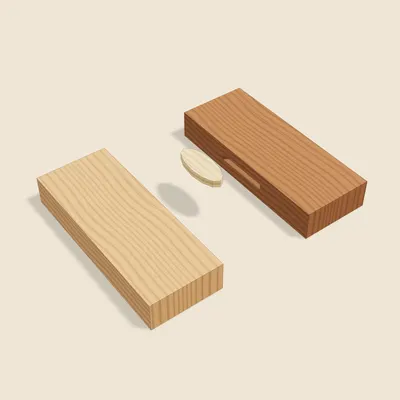
| Biscuit | Edge-to-edge, sometimes end grain | Keeping two edges in line while glue in the slots sets | Biscuit joint |
| Scarf | End-to-end (Fig. 10-7B) | Splicing length in a board or timber | Scarf joint |
| Box (finger) | End grain at a corner. The Handbook’s finger joint is the end-to-end splice (Fig. 10-7C–E) | Boxes and drawers; end splices when the fingers run along the length | Box joint |
| Dovetail | End-to-edge (Fig. 10-8G) | Boxes and drawers that must resist pulling apart | Dovetail joint |
| Miter | End-to-edge (Fig. 10-8B) | Frames and trim | Miter joint |
| Half-lap | A crossing, or an end-to-end lap in end grain (p. 10-17) | Frames and crossings that finish flush | Lap joint |
| Dado | End into a face, across the grain (Fig. 10-8E) | A shelf housed in a side | Dado joint |
| Rabbet | End-to-edge (Fig. 10-8E) | Case backs and corner rebates | Rabbet, on the dado page |
| Mortise and tenon | End-to-edge (Fig. 10-8D) | Chairs, tables and frames | Mortise and tenon |
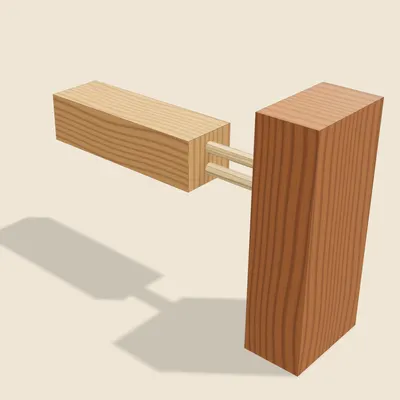
| Dowel | End-to-edge (Fig. 10-8C), also edge-to-edge | Frames and edge joints located by pins | Dowel joint |
| Pocket hole | End against a face | Cabinets and face frames fastened with an angled screw | Pocket hole |
| Bridle | End-to-edge, with the slot open on the end | Frame corners. No separate Western page; the Chinese example is below | Bridle |
Joint strength also depends on the wood
Joint strength also depends on the wood. Hardness of the woods in the USDA Wood Handbook is on the Janka hardness chart. Each species page is under wood.
Chinese joinery equivalents
Wood joints fall into a dozen families, defined by how the two pieces meet: end to face, edge to edge, crossing, end to end, or at a corner. Within each family the variants differ in how much shows and what stops the joint coming apart. This guide explains the twelve families with their usual English names, where each is used, and a Chinese example of each that you can take apart in 3D.
The twelve families at a glance
| Joint | How it holds | Typical use |
|---|---|---|
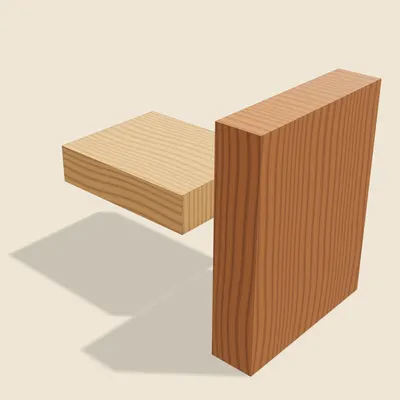
| Butt | Glue or fasteners only | Edge-glued panels, quick boxes |
| Edge joints | Tongue, lip or loose tenon along the edge | Panels and floors |
| Lap and halving | Each piece cut away so they overlap | Crossing rails, frames |
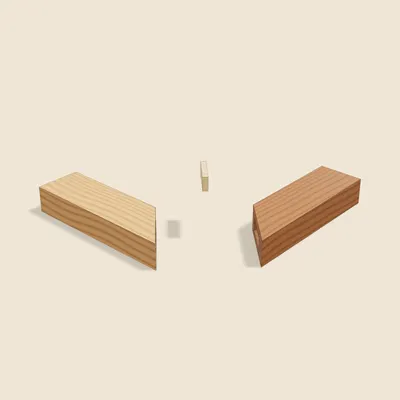
| Mitre | 45° faces, needs a tenon, key or spline | Frames, flush corners |
| Mortise and tenon | Tenon in a hole, shoulders against racking | Chairs, tables, doors, timber frames |
| Bridle | Open mortise clasps the other piece | Frame corners, table legs |
| Box (finger) | Interlocking square fingers | Boxes, carcases |
| Dovetail | Flared tails cannot pull out | Drawers, boxes, beams |
| Housing and groove | A board seated in a slot | Shelves, panels in frames |
| Dowel and loose tenon | A separate pin or tenon in both pieces | Board edges, rail ends |
| Splice and scarf | Ends overlapped, hooked or keyed | Long beams, curved arms |
| Keys, wedges and pins | A driven part locks the joint | Tightening and repair |
Why joints are shaped the way they are
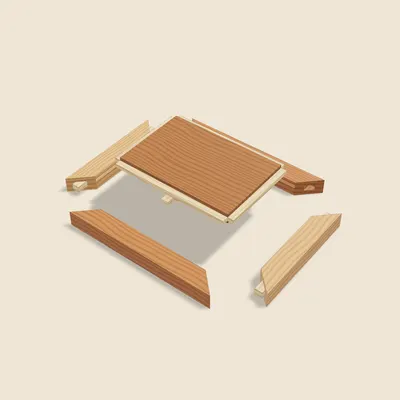
Wood is strong along the grain and weak across it, and it swells and shrinks with humidity far more across the grain than along it. Two rules follow. End grain glues poorly, so a joint that meets end to face needs shape, such as a tenon or a dovetail, rather than glue alone. And a wide board fixed rigidly across the grain of another will eventually split one of them, so good joints let panels move. The Chinese frame and floating panel is the classic answer: the panel sits loose in a groove in a mitred frame.
Butt joints
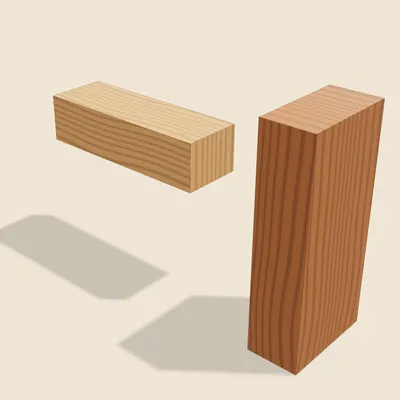
The end or edge of one piece simply meets another. It is the simplest joint, held only by glue, nails, screws or dowels. Edge to edge, though, long grain meets long grain and glue holds very well: two thick boards planed dead straight and glued make the plain glued edge joint.
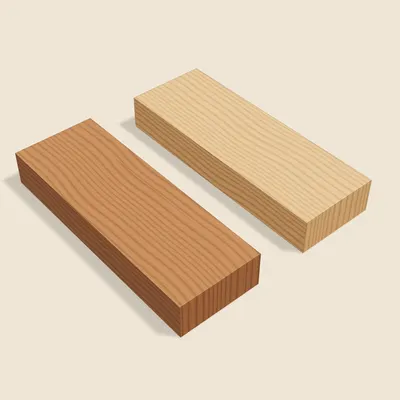
Edge joints: tongue and groove, rebated and splined
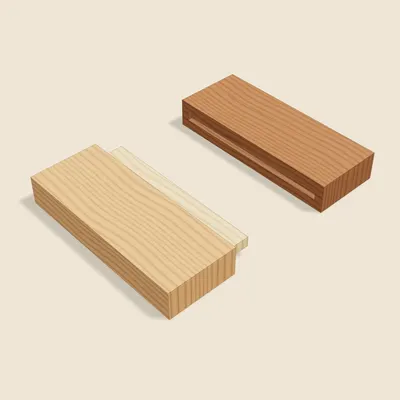
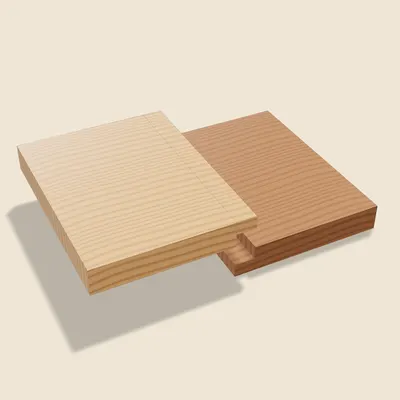
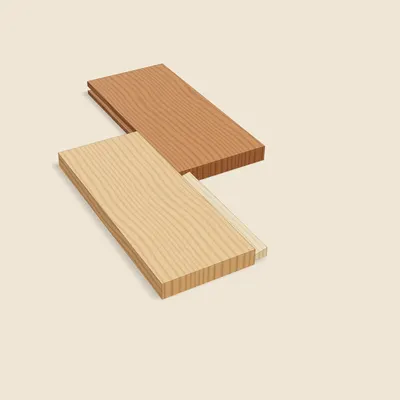
To join boards into a panel without relying on glue alone, the edges are shaped. In a tongue and groove one edge carries a ridge that fits a groove in the next; a loose tongue makes it a spline joint. In a rebated edge each board is cut back to half its thickness along the edge, and the two boards lap.
- 1
- 2
- 3
Lap and halving joints
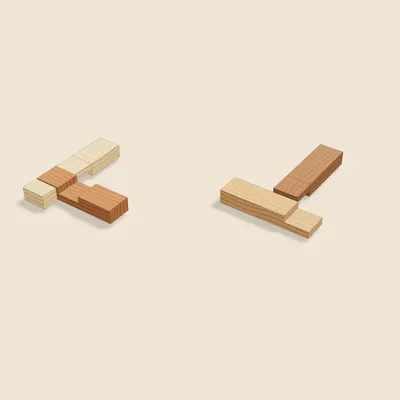
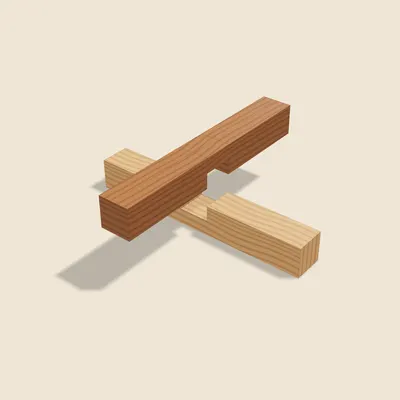
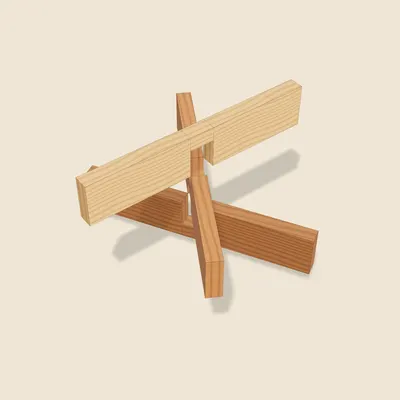
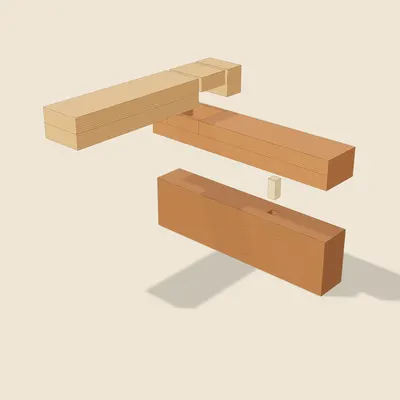
Material is removed from each piece where they meet so that they overlap and finish flush. Long grain meets long grain over a large area, so a glued lap is strong. A cross-halving lets two rails pass through each other; three bars can cross the same way if each keeps a different third of its depth.
A recreational use of the same crossing idea is the Luban lock, a notched-stick puzzle rather than a structural joint.
Mitre joints
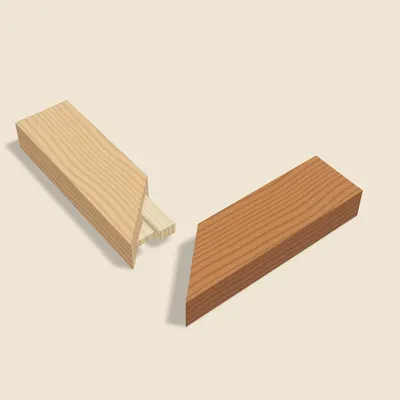
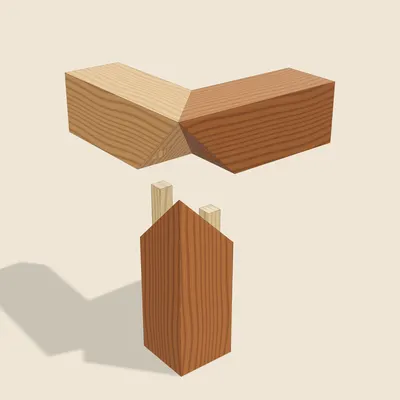
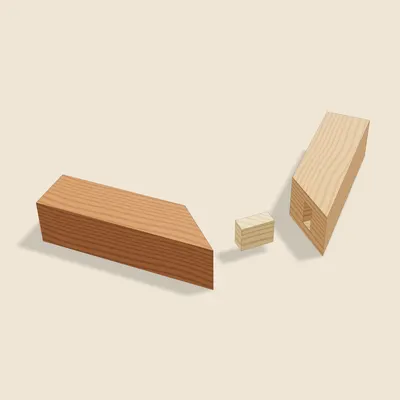
Both pieces are cut to 45° so the corner shows no end grain. A bare mitre is weak, because its faces are largely end grain, so good mitres hide a tenon, a key, a block or a spline inside. Chinese frames almost always do: every frame-and-panel top has a tenon through its mitred corners.
Mortise and tenon joints
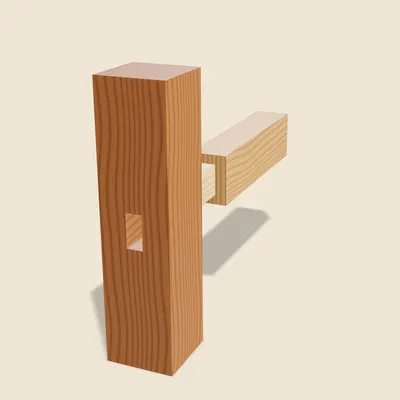
A tenon on the end of one piece fits a hole, the mortise, in the other; shoulders around the tenon stop the joint from racking. It is the workhorse of chairs, tables, doors and timber frames, with variants for whether the tenon shows and how it is locked. The full guide is on the mortise and tenon joint page.
Bridle joints
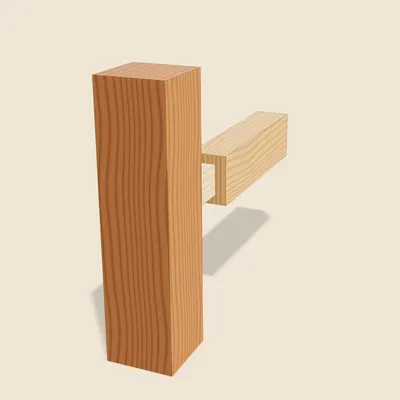
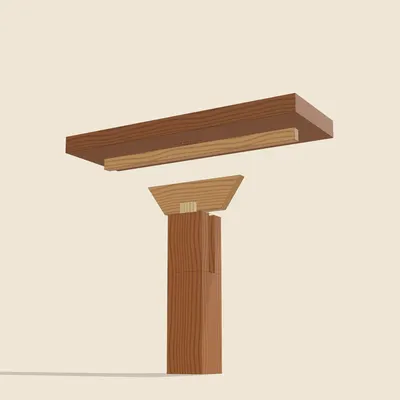
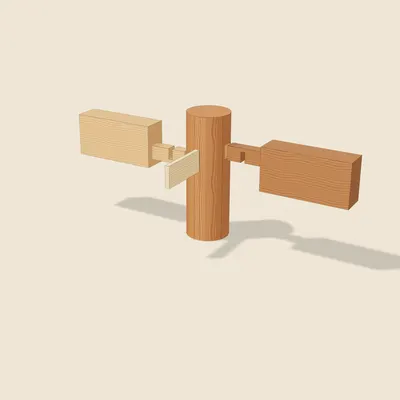
Also called an open mortise and tenon: the mortise is cut through on three sides to make a fork, which clasps the other piece. Timber framers use it at rafter tops and in some sill corners. In Chinese tables the slotted top of the leg clasps the apron in the jiatou joint.
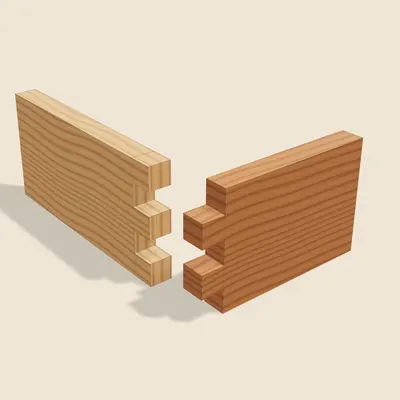
Box (finger) joints
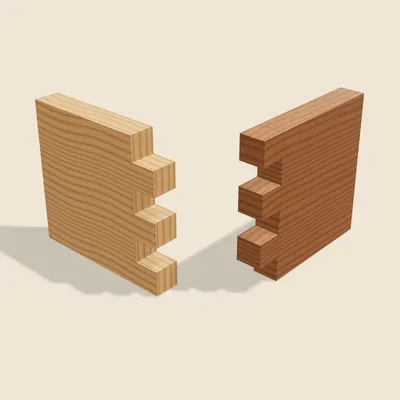
Interlocking square fingers at a corner, the dovetail’s straight-sided cousin. The fingers give plenty of long-grain glue surface but, unlike dovetails, do nothing to stop the joint being pulled apart along the board. The Chinese form shows on both faces.
Dovetail joints
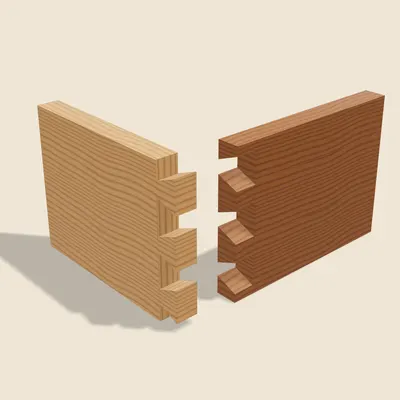
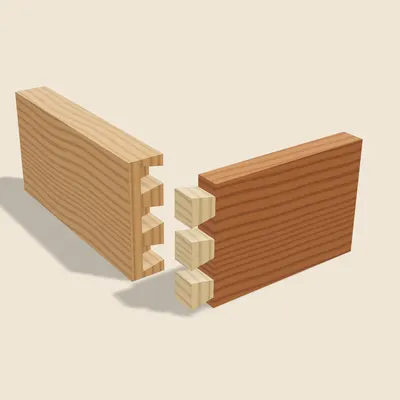
Flared tails lock into matching pins, so the joint cannot be pulled apart along the tail board. The types differ in how much shows: through, half-blind, fully hidden, and sliding. The dovetail joint page compares them side by side.
Housing, dado and groove joints
A slot is cut in one piece for another to sit in. Across the grain it is a dado or housing, as for a shelf in a bookcase side; along the grain it is a groove. A dovetail-section housing turns it into a sliding dovetail. A groove round the inside of a frame holds a floating panel.
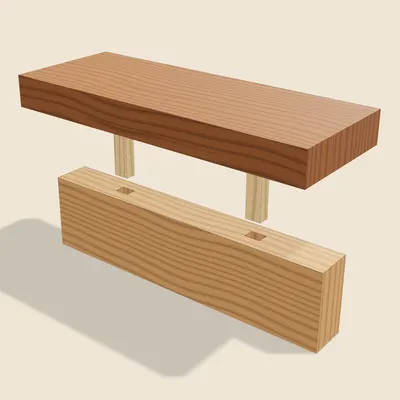
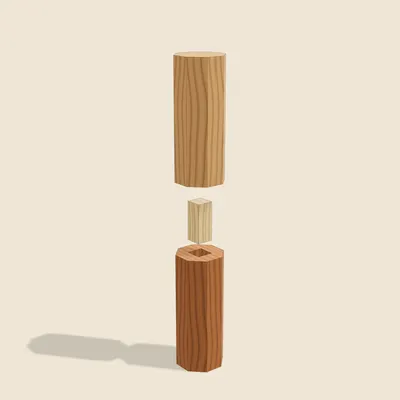
Dowel and loose-tenon joints
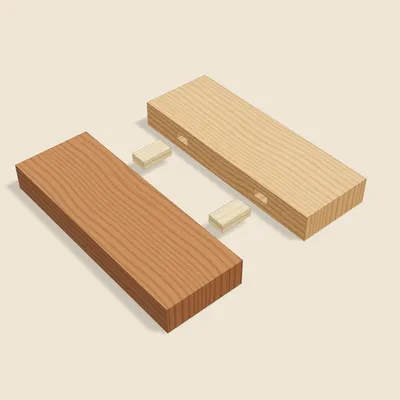
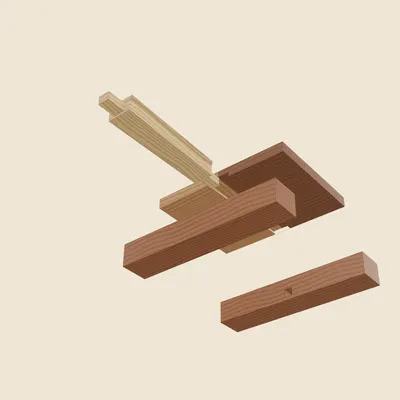
Instead of shaping one piece, both are bored or mortised and a separate part joins them: a round dowel, a biscuit, or a flat loose tenon. Factory furniture relies on dowels because they are quick to drill by machine. Traditional loose tenons have a further advantage: a worn tenon can be replaced without scrapping the part.
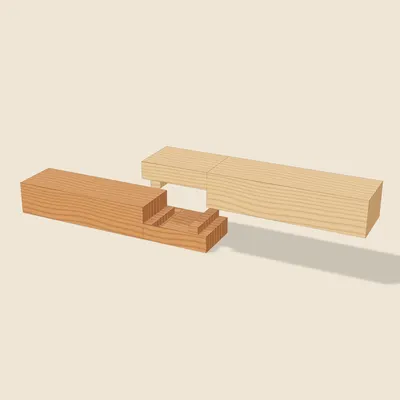
Splice and scarf joints
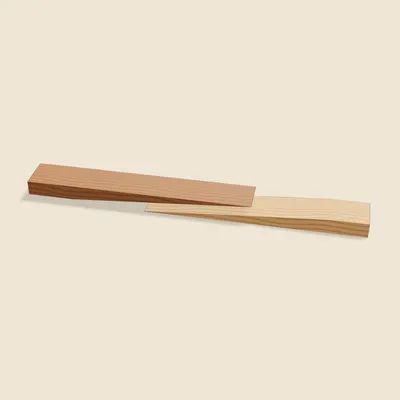
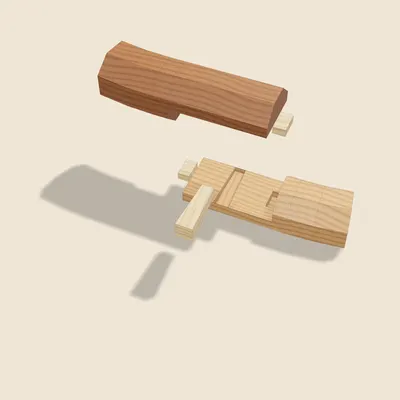
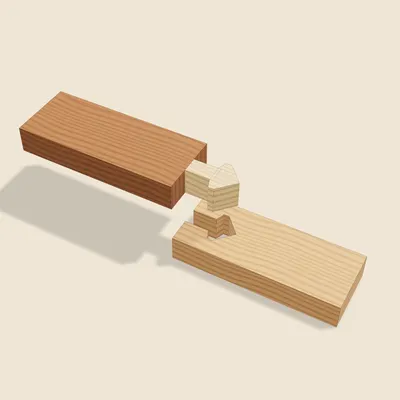
A splice joins two members end to end to make a longer one; a scarf does it with sloping or stepped cuts that overlap. Timber buildings need them for long beams and plates, and Chinese chairs use them for the curved arm of a horseshoe chair, locked by a tapered key.
- 1
- 2
- 3
- 4
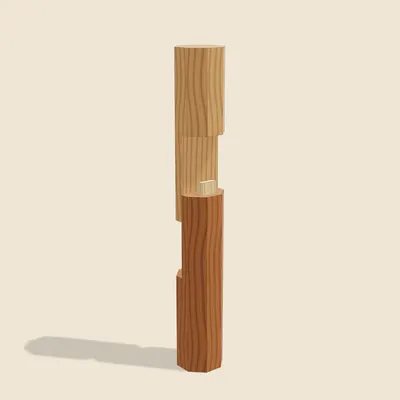
Keys, wedges and pins
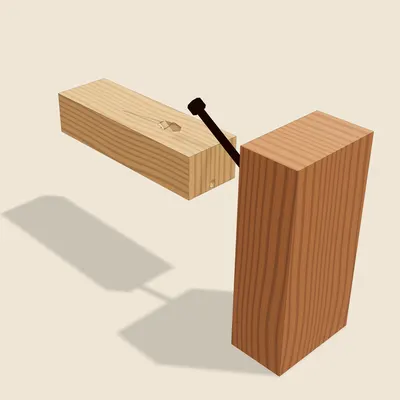
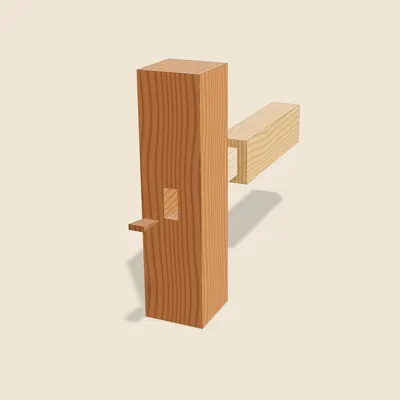
Some joints are finished by a separate driven part that locks or tightens them: a wedge spread into a tenon, a pin through a mortise and tenon, or a bow-tie key across a seam. They are also how old joints are tightened and repaired.
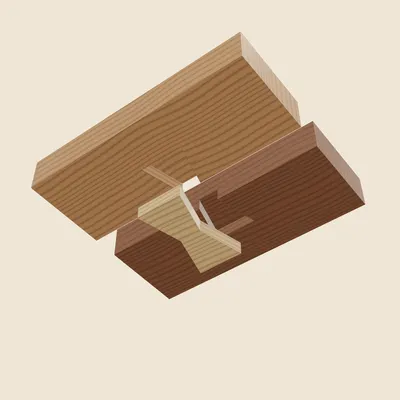
Modern machine joints
Pocket screws, biscuits, dominoes and cross dowels are fast to make with jigs and machines and rely on glue and metal rather than interlocking shape. The Chinese vs Western joinery page sets a pocket-screw corner beside a self-locking one.
Where to go next
For the Chinese families in depth, the types of Chinese joints map sorts every joint by how the members meet in a piece of furniture or a building. To see the joints in place, open a whole piece such as the waisted square table. For interlocking puzzles built on the same idea, see the burr puzzle.