
Lap joint
A half-lap cuts away half of each member so the two finish flush. In tension tests of L-shaped frames, half-lap joints (568.26 N·m) and open mortise-and-tenon joints (553.18 N·m) were not statistically different, and both held more than dowel joints (487.55 N·m).
How a lap joint works
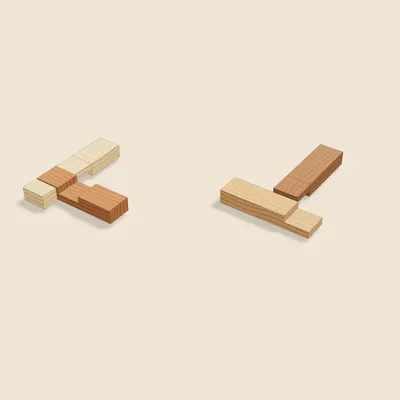
In a half-lap, each piece gives up half its thickness where they overlap, so the stack is no thicker than one piece. A corner lap joins two ends. A tee lap lets one piece cross the other. A full lap, by contrast, lets one piece lie on the face of the other without cutting both down to a flush face.
The glue is on the cheeks, which are long grain, and the shoulders stop the joint sliding along the lap.
How strong is it?
Under tension, half-lap and open mortise and tenon were in the same homogeneity group: 568.26 N·m and 553.18 N·m. Dowels were lower, at 487.55 N·m. Under compression the three separated, and the half-lap was the higher result: 191.12 N·m, then open mortise and tenon at 169.44 N·m, then dowel at 100.90 N·m. The frames were Scotch pine, Oriental beech, oak and chestnut, with PVAc or PU. PVAc gave better results than PU.
| Study | What was tested | Result in that study |
|---|---|---|
| Demirci, Diler, Kasal and Erdil 2020, Wood Research 65(6):975–988. doi:10.37763/wr.1336-4561/65.6.975988 | L-shaped frames of Scotch pine, Oriental beech, oak and chestnut. Dowel, half-lap, and open mortise and tenon. PVAc and PU. 10 replications. | Tension (Table 3, p. 982): half-lap 568.26 N·m, open mortise and tenon 553.18 N·m (same homogeneity group, not statistically different), dowel 487.55 N·m. Compression (Table 8, p. 984): half-lap 191.12 N·m, open mortise and tenon 169.44 N·m, dowel 100.90 N·m (three different groups). PVAc gave better results than PU. |
Each row is one study. Different woods, glues, shapes and loads mean the rows are not one ranking.
Hardness of the woods in the USDA Wood Handbook is on the Janka hardness chart.
How to cut a half-lap
Gauge half the thickness, saw the shoulder and the cheek, and fit the faces flush.
- Mark half the thickness. A half-lap removes half the thickness from each piece. Gauge that line from the face that will stay flush.
- Mark the length of the lap. For a corner, the lap is as long as the other piece is wide. For a tee, mark the width of the crossing piece in the middle.
- Saw the shoulder and the cheek. Saw the shoulder down to the gauge line, then saw or chisel the cheek until the waste falls away.
- Fit and glue. The two cheeks meet in the middle and the outer faces land flush. Glue the long-grain cheeks.
When to use it
Use a half-lap where two pieces must cross or meet and finish in one thickness: frames, stretchers, the corner of a light frame. Where a post must keep its full section, a mortise and tenon leaves more wood in the post. An end-to-end lap is one of the end joints the Handbook groups with scarfs. The 568.26 N·m, 553.18 N·m and 487.55 N·m results are from L-shaped frame tests, not from that end-joint passage.
The twelve Western joints, and every within-study result, are on types of wood joints. Related joints: mortise and tenon, dowel, scarf.