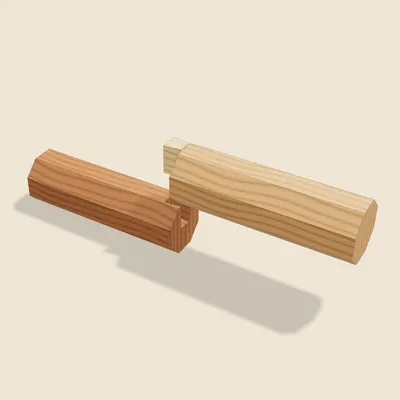
Dovetail joint: types compared
A dovetail joint locks two boards with flared tails and matching pins. Each tail is wider at its tip than at its root, so the joint cannot be pulled apart in the direction that would open an ordinary box corner. The types differ mainly in how much of the joint shows. Below: how the flare works, a comparison of through, half-blind, secret mitred and sliding dovetails, and the Chinese dovetail family, 燕尾榫 (yànwěi sǔn, “swallow-tail tenon”), with a 3D model to take apart.
How a dovetail works
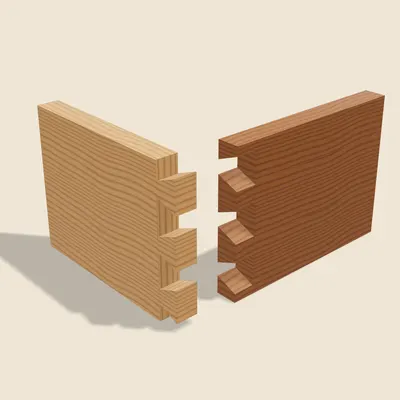
Cut a row of trapezoid tails on the end of one board and matching pins on the end of the other. Pull along the tail board and the narrow roots of the tails jam against the pins, so the corner holds against exactly the force that would pull a plain box corner apart. The joint goes together in one direction only, the direction in which the tails slide in, and glue or a neighbouring part closes that last route.
The flare is set as a slope, written 1:n. The angle off square is the arctangent of 1/n, set out under Dovetail angles and ratios. The English name compares the shape to a dove’s tail; the Chinese name, 燕尾, to a swallow’s.
Dovetail angles and ratios
A dovetail slope written 1:n leans off square by θ = arctan(1/n). To one decimal place, 1:5 is 11.3°, 1:6 is 9.5°, 1:7 is 8.1° and 1:8 is 7.1°. Unrounded, 1:6 is 9.46° and 1:8 is 7.13°. The dovetail angle calculator converts a ratio or an angle off square, lays out tails and pins, and prints a full-size template.
The corner-joint tests report a cutter angle, and 90° on that scale would be a square cut. The tension paper equates 81° with 1:6. Off square, 81° is 9° (about 1:6.3) and 84° is 6° (about 1:9.5). The angles tested were 75°, 78°, 81°, 84° and 87°, in Oriental beech, European oak, Scotch pine and MDF.
A square-fingered box joint is the corner without the flare. Hardness of the woods in the USDA Wood Handbook is on the Janka hardness chart.
The twelve Western joints, and every within-study result, are on types of wood joints. Related joints: box joint, mortise and tenon, miter.
How strong is it?
In diagonal tension, the highest mean by angle was 84° (0.725 N/mm²) and the lowest was 75° (0.496 N/mm²). By material, European oak was highest (0.861 N/mm²) and MDF lowest (0.218 N/mm²). PVAc averaged 0.644 N/mm² and D-VTKA 0.609 N/mm². The authors suggest PVAc and 81°.
In diagonal compression the best angle was also 84° (0.302 N/mm²) and the worst was 75° (0.207 N/mm²). The best combination was Oriental beech at 81° with D-VTKA (0.445 N/mm²).
On poplar box frames, glued contact force of a dovetail and a keyed joint decreased in the order S2 > T2 > T3 > S1 > T1. The dovetail was strongest in one pull direction and below two keyed variants in the other. Failure of the dovetail was always at the root of the tenons in the S1 direction. S1 and S2 are the two pull directions; T1, T2 and T3 are three sizes of the keyed joint.
| Study | What was tested | Result in that study |
|---|---|---|
| Atar, Keskin, Peker, Üstündağ, Togay and Candan 2010, BioResources 5(1):343–355. doi:10.15376/biores.5.1.343-355 | Dovetail corner joints at 75°, 78°, 81°, 84° and 87°. Oriental beech, European oak, Scotch pine and MDF. PVAc and D-VTKA. Diagonal tension. The angle is the cutter angle; 90° would be a square cut. The paper equates 81° with 1:6. Off square, 81° is 9° (about 1:6.3) and 84° is 6° (about 1:9.5). | Table 4, p. 350: highest mean by angle 84° (0.725 N/mm²), lowest 75° (0.496 N/mm²). European oak highest by material (0.861 N/mm²), MDF lowest (0.218 N/mm²). PVAc 0.644 N/mm², D-VTKA 0.609 N/mm². The authors suggest PVAc and 81°. |
| Çinar, Atar and Üstündağ 2019, Forest Products Journal 69(2):131–140. doi:10.13073/fpj-d-14-00084 | The same angles and materials as the tension study, in diagonal compression. | Best angle 84° (0.302 N/mm²), worst 75° (0.207 N/mm²). Best interaction: Oriental beech, 81° and D-VTKA (0.445 N/mm²). |
| Wang, Chen, Xu, Guan, Yan and Wu 2020, BioResources 15(4):9291–9302. doi:10.15376/biores.15.4.9291-9302 | Box frames of melamine-formaldehyde-modified poplar, PVAc. A keyed joint in three sizes (T1, T2, T3) and a dovetail pulled in two directions (S1, S2). | Glued contact force decreased in the order S2 > T2 > T3 > S1 > T1: the dovetail was strongest in one direction and below two keyed variants in the other. Dovetail failure always occurred at the root of the tenons in the S1 direction. |
Each row is one study. Different woods, glues, shapes and loads mean the rows are not one ranking.
Hardness of the woods in the USDA Wood Handbook is on the Janka hardness chart.
Types of dovetail joints
| Type | What shows | Typical use | Chinese counterpart |
|---|---|---|---|
| Through (plain) | End grain of both boards, on both faces | Boxes and carcases | 燕尾榫, through form |
| Half-blind | Tails seen from the side only; the front stays plain | Drawer fronts | 半隐燕尾榫 |
| Secret mitred (full-blind) | A single mitre line | The finest cabinet and box work | 闷榫 |
| Secret double-lapped | A thin strip of end grain on one edge | Carcases with hidden joints | — |
| Sliding | A tongue running across the face of a board | Shelves, partitions, battens | 穿带, 走马销 |
- 1
- 2
- 3
- 4
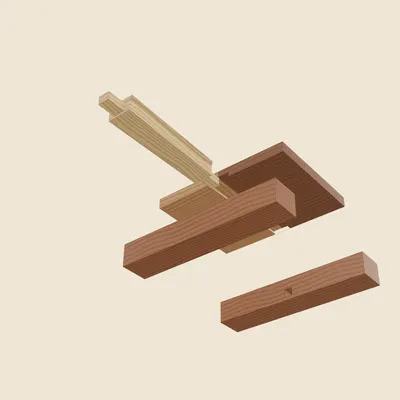
- 5
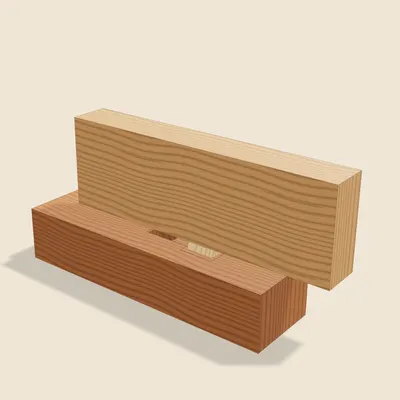
Through dovetail
In a through or plain dovetail both boards show end grain on both faces of the corner. Western cabinetmakers often hid it under veneer; today it is usually left visible as a sign of handwork. Wang Shixiang, writing on Ming and Qing drawers, found the through joint only on roughly made pieces: fine drawers used the half-blind or the fully hidden form instead.
Half-blind dovetail
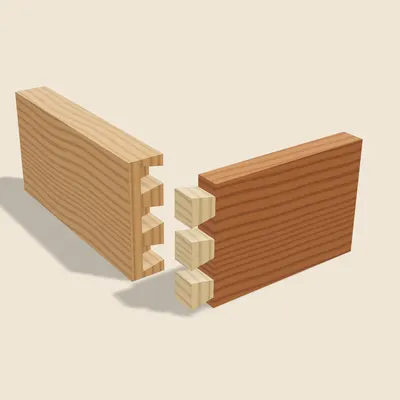
The sockets for the tails are cut into the back of the front board but stop short of its face, so the front stays plain and the tails show only from the side. It is the classic drawer-front joint of Western furniture, the alternative to a through-dovetailed box with a false front glued on. Chinese drawers use the same arrangement, 半隐燕尾榫. Wang places it in the middle of his ranking of drawer corners, between the open joint that shows on both faces and the fully hidden one.
Secret mitred dovetail
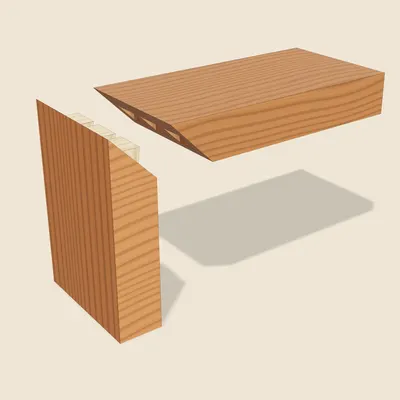
The outer edges of both boards are cut to 45° and the dovetails are cut inside the mitre, so when the corner closes only a single diagonal seam shows. Western joiners reserve it for the best cabinet and box work. In Chinese furniture this is the men sun (闷榫), literally a “closed-in” tenon. Wang notes it on low tables built from three thick boards and even on very thin drawer sides.
Sliding dovetail
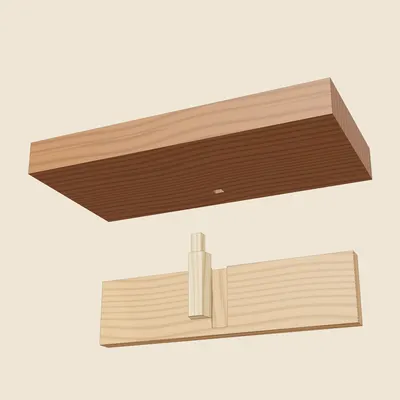
A sliding dovetail joins one board to the face of another away from its end. A dovetail-section tongue slides along a matching housing, so the parts cannot separate across the joint. Western joiners use it for shelves and bottoms into cabinet sides and for partitions, and often taper the housing so the parts slide easily at first and tighten at the end.
Chinese tabletops use the same idea at panel scale. The chuandai (穿带) batten slides across the back of the panel in a dovetail housing; housing and batten are both slightly wider at one end (出梢, chūshāo), so the batten tightens as it is driven in from the wide end, and its ends tenon into the frame. Wang Shixiang warns that too much taper lets the batten creep back and too little lets it slide straight through. The zouma xiao (走马销) is a sliding dovetail made to be taken apart: a planted dovetailed key drops into the wide end of a slot and slides to the narrow end to lock.
The Chinese dovetail family
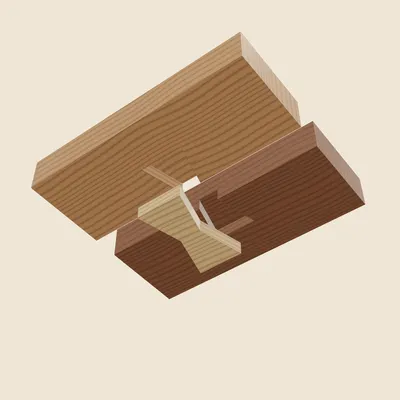
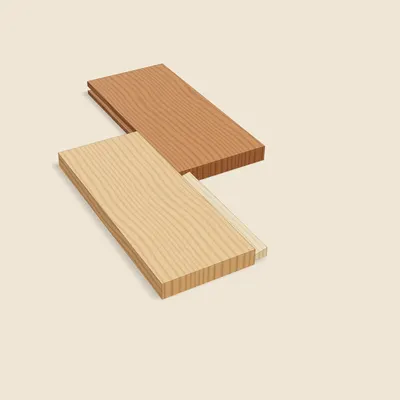
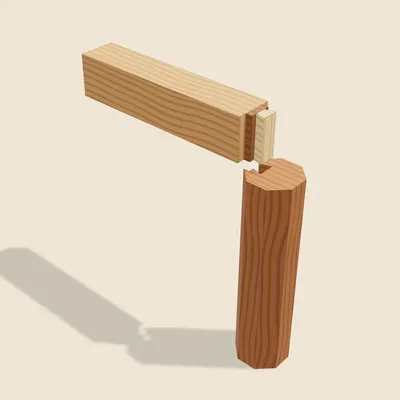
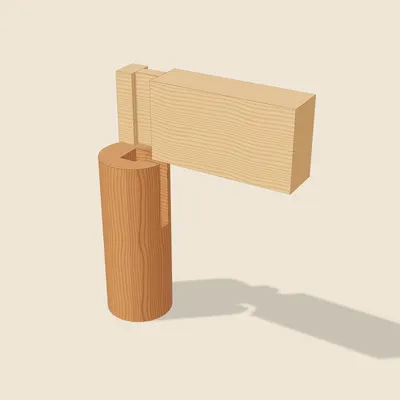
Western shop books mostly treat the dovetail as a corner joint. Chinese woodwork uses the flare in more places: a bow-tie key let in across a seam, a half-dovetail tongue that keeps the boards of a panel from stepping, a half-dovetail key that holds an apron flat, and, in timber buildings, beam ends cut as dovetails that drop into slots in the column heads so they cannot be pulled out sideways. The Qing building rules in the Yingzao suanli fix the length of a tie-beam’s tenon as a fraction of the column diameter, three tenths at the column heads.
- 1
- 2
- 3
- 4
- 5
- 6