
Dowel joint
In beech T-joints under a static vertical load, a mortise and tenon averaged 204.29 N·m and a dowel joint 153.53 N·m.
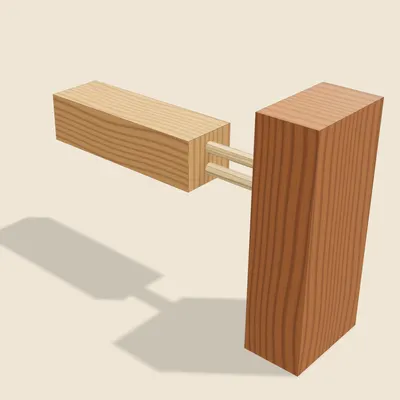
How a dowel joint works
Round pins sit in holes drilled in both members. The pins locate the parts and, once glued, give the joint long-grain glue on the walls of the holes plus whatever glue is on the faces that meet. The Handbook lists dowels with mortise and tenons and rabbets as end-to-edge joints that can be made strong (Fig. 10-8).
How strong is it?
In the beech T-joints, the mortise and tenon mean was 204.29 N·m and the dowel mean was 153.53 N·m.
In L-shaped frames the dowel was the lower result in both loads: 487.55 N·m in tension, against a half-lap at 568.26 N·m and an open mortise and tenon at 553.18 N·m (those two not statistically different), and 100.90 N·m in compression, against 191.12 N·m and 169.44 N·m. The frames were Scotch pine, Oriental beech, oak and chestnut. PVAc gave better results than PU.
In MDF and chipboard panels, not solid wood, four beech dowels gave the highest force of the connectors tested: 1,169 N in MDF and 617 N in chipboard. Domino pins were the lowest variant in that panel test.
| Study | What was tested | Result in that study |
|---|---|---|
| Uysal 2024, BioResources 19(3):6120–6141. doi:10.15376/biores.19.3.6120-6141 | Beech (Fagus orientalis) T-joints, static vertical load. | Table 2, p. 6132: mortise and tenon mean 204.29 N·m (abstract: 204 N·m); dowel 153.53 N·m (abstract: 154 N·m). Gluing increased the moment capacity of staple joints. |
| Demirci, Diler, Kasal and Erdil 2020, Wood Research 65(6):975–988. doi:10.37763/wr.1336-4561/65.6.975988 | L-shaped frames of Scotch pine, Oriental beech, oak and chestnut. Dowel, half-lap, and open mortise and tenon. PVAc and PU. 10 replications. | Tension (Table 3, p. 982): half-lap 568.26 N·m, open mortise and tenon 553.18 N·m (same homogeneity group, not statistically different), dowel 487.55 N·m. Compression (Table 8, p. 984): half-lap 191.12 N·m, open mortise and tenon 169.44 N·m, dowel 100.90 N·m (three different groups). PVAc gave better results than PU. |
| Śmietańska and Mielczarek 2022, Annals of WULS, Forestry and Wood Technology 118:55–66. doi:10.5604/01.3001.0016.0489 | Glued corner joints in MDF and chipboard panels, not solid wood. Four beech dowels, two Domino pins, or a mix. | Four beech dowels gave the highest force: 1,169 N in MDF and 617 N in chipboard. Domino pins were the lowest variant. |
Each row is one study. Different woods, glues, shapes and loads mean the rows are not one ranking.
Hardness of the woods in the USDA Wood Handbook is on the Janka hardness chart.
How to drill one
Mark shared centers, drill square, and glue the pins and the meeting faces.
- Mark the same centers on both pieces. The holes have to share an axis. Mark from the faces that must land flush.
- Drill square to the face. A hole that leans shows up as a joint that will not close. Drill both members to the depth the pin needs, and no farther than the wood allows.
- Dry-fit the pins. The pins should enter with hand pressure. If a pin bottoms out before the shoulders close, the hole is short or the pin is long.
- Glue and close. Glue the pins and the meeting faces, then close the joint and clamp until the shoulders are tight.
When to use it
Dowels suit frames and edge joints where a mortise and tenon would be more work and the tested gap is acceptable for the job. They are not the higher result in the solid-wood frame and T-joint tests above. A biscuit aligns an edge with a wafer instead of round pins. A loose tenon is a separate tenon rather than a round pin.
The twelve Western joints, and every within-study result, are on types of wood joints. Related joints: mortise and tenon, biscuit, butt.