
Joinery without nails
Classical Chinese furniture is famous for holding together without nails or screws. That is not a trick: it follows from how wood behaves, and from joints designed to lock themselves. This page walks through floating panels, self-locking corners, assembly order, glue and metal, with links to take-apart models.
The problem with nails
Wood swells and shrinks with humidity, much more across the grain than along it. A wide board nailed tight to a frame cannot move, so it splits, or the nails work loose. Joinery answers this by letting each part move where it needs to.
Across-the-grain movement is the enemy of a rigid fastening. A table top several board-widths wide can change size by a visible amount between a dry winter and a humid summer. If the frame and the panel are locked into one unmoving sheet, something tears: the panel cracks, the glue line fails, or the fastener crawls. Mortise-and-tenon furniture treats that movement as a given and designs paths for it.
The same logic appears in timber buildings, where large members meet in fitted joints rather than in a nailed box — see the dougong hub for one building-scale family. Furniture is simply the scale most people meet first when they search for “joinery without nails.”
Let the panel float
The typical Chinese top, seat or door is a mitred frame with a groove inside and a thin panel set into it. The panel is not fixed; it can grow and shrink inside the groove. Battens slid across its underside in dovetailed housings keep it flat without pinning it.
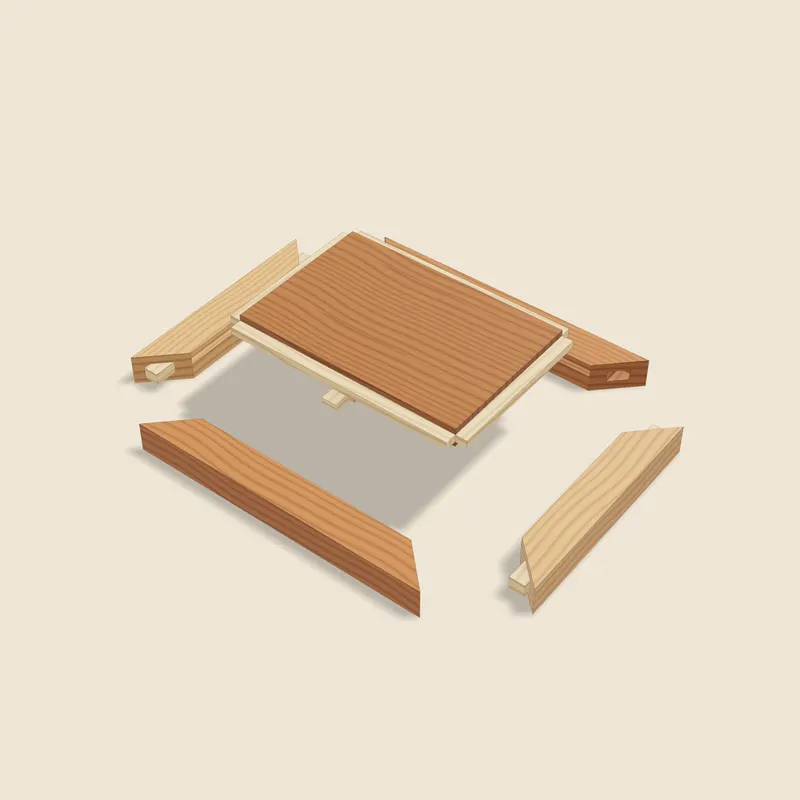
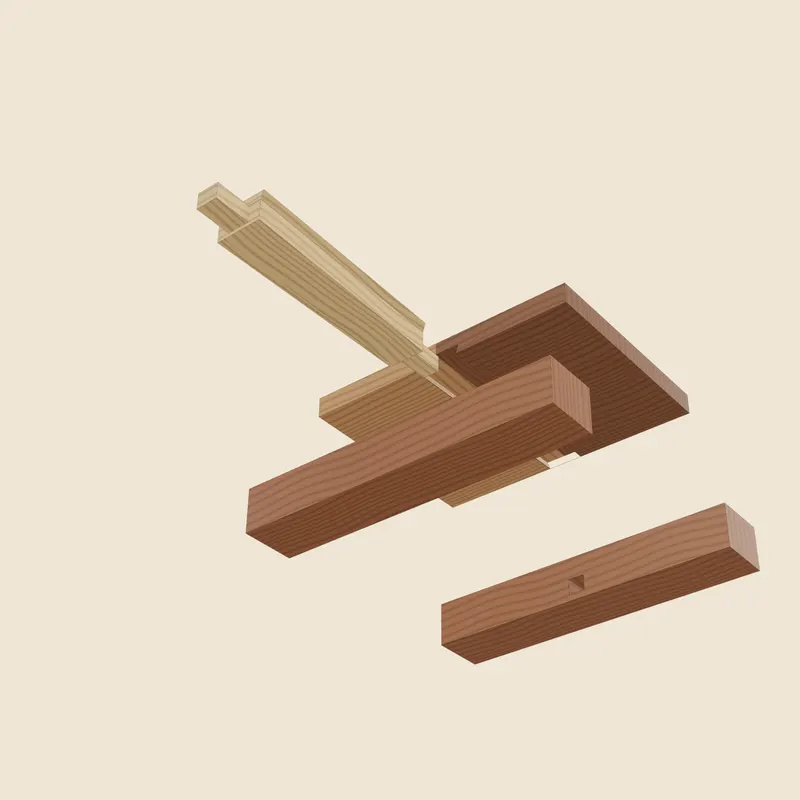
Edge joints such as the tongue-and-groove build wider panels from narrower boards; breadboard-style ends and related forms appear where a rail caps the panel. None of that works if you nail the panel through its face into the frame. The groove is the allowance; the batten is the anti-warp device; the mitred frame is the structure you see from above.
On whole pieces, look at the waisted square table or square-corner cabinet zone lists: top frame and panel are almost always called out separately for this reason.
Joints that lock themselves
Many joints are shaped so that the act of assembly locks them. A dovetail cannot be pulled straight out. In the baojian joint the apron is hung onto a pin that widens downward, so it tightens as it goes home. A sliding lock drops into the wide end of a slot and slides to the narrow end. A wedged scarf is locked by a tapered key. Wedges also tighten through tenons from the far side.
Other self-locking habits show up at table corners: the clasping-leg clamps an apron in a slotted leg; the three-way mitre seats three members so the corner cannot open without lifting a tenon. Blind and through tenons (ban-sun, tou-sun) locate posts and rails before any wedge is driven. The shared idea is mechanical interference — wood in the way of the wrong direction of pull — not a hidden screw.
The featured Luban lock series dramatises mutual locking for the hand. It is a puzzle series, not furniture joinery — after you try it, return to baojian, jiatou and floating panels for real structure.
Order of assembly
Because parts lock each other, the order matters. In a waisted table the aprons go onto the legs first and the top goes on last, its frame taking the long and short tenons of the legs. Step diagrams for a joint therefore follow the order in which the piece can actually be put together.
If you reverse the order, the hanging pin of a baojian corner cannot enter its slot, or the long and short tenons clash with the frame’s own joinery. That is why each joint page’s “how it is made” sequence is not a suggestion — it is the only order that clears the geometry. The learning path sequences joints so earlier lessons (plain tenons, frames) unlock later corners (baojian, jiatou, zongjiao).
What about glue and metal?
“No nails” does not mean nothing but wood. Glue is used in some joints, and later work sometimes relied on it more: the baojian guide notes that by the late Qing some corners were held by glue alone. Cabinets carry metal hinges and fittings. The point is that the structure stands on its joints.
Metal face plates, lock plates and hinge leaves on a cabinet are the parts that must move or be keyed for security. Glue can fill a shoulder or secure a small moulding. When glue becomes the only thing holding a leg to an apron, as in some late shortcuts Wang described, the piece has left the classical structural logic.
Taking it apart
Joints can also be made to come apart on purpose. The railings of a luohan bed are often fitted with loose tenons or sliding locks so the bed can be dismantled and moved.
Knock-down thinking shows up elsewhere too: pins and keys that release when driven back, stretchers that can leave their mortises once wedges are freed, apron assemblies that lift off hanging pins. Repair and transport both depend on that. A joint that can only be destroyed to open is closer to a permanent fastening than to classical sunmao practice.
Load paths without fasteners
A nail carries load in a small cylinder of steel. A fitted tenon carries load across broad wooden shoulders. That is why a well-made corner can stay quiet for centuries while a nailed board works loose: the bearing area is larger, and seasonal movement does not lever the same small hole over and over.
On a waisted table the apron and leg share a mitred shoulder and a triangular tenon; the hanging pin resists pull-out; the top’s long and short tenons locate the leg under the frame. On a recessed-leg table the slotted leg and apron form a ring that stiffens the angle under the overhanging top. Follow those paths on the furniture pages — for example kang table and recessed-leg altar table — and the slogan “without nails” becomes a diagram rather than a slogan.
Buildings as well as furniture
The same family of ideas scales up. Timber-frame joints fix columns, tie beams, and stack bracket sets without treating the hall as a nailed crate. The timber-frame group and the dougong stack are the building-side companions to this furniture page. Readers who arrive from architecture and readers who arrive from antique tables are looking at one craft principle at two scales.
For style context around the hardwood furniture that made the slogan famous, open Ming furniture characteristics. For a full joint catalogue, use the beginner guide and joint types.