
Mortise and tenon joint
A mortise and tenon joint fits a projecting tongue, the tenon, into a matching hole, the mortise. It is one of the oldest ways to join two pieces of wood at an angle, and it is still the standard joint of frames, chairs, tables and timber buildings. Below: the parts of the joint with a 3D model to take apart, the main types, how the joint carries load, and how to cut one by hand.
Parts of a mortise and tenon joint
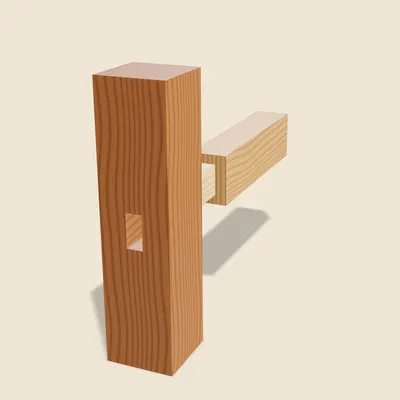
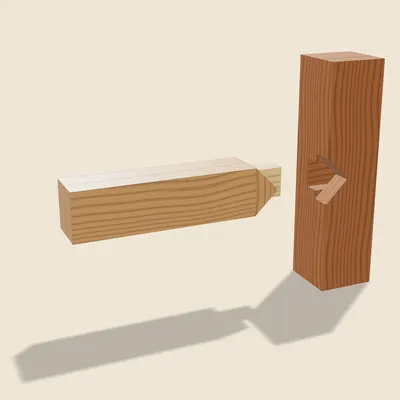
The tenon is cut on the end of one member, usually called the rail. Its broad faces are the cheeks, which show long grain; the end-grain faces around its root are the shoulders. The mortise is the hole cut in the other member, the post, stile or leg, to receive it. When the joint closes, the shoulders seat against the face of the post and the cheeks bear on the walls of the mortise.
A common rule in Western joinery makes the tenon about one third the thickness of the rail. The remaining two thirds become shoulders, which resist the sideways forces that would twist the tenon in its mortise and hide any ragged edge at the mouth of the hole. Chinese woodworkers use the same parts under their own names: 榫 (sǔn) for the tenon and 卯 (mǎo) for the mortise. Together the two characters make sunmao, the Chinese word for joinery itself.
Types of mortise and tenon joints
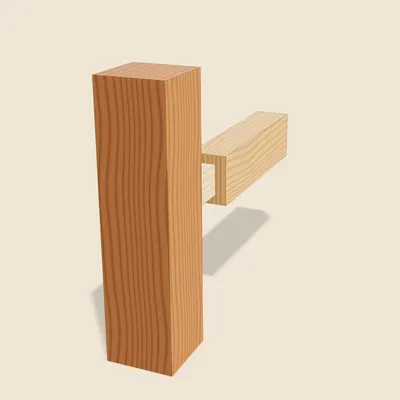
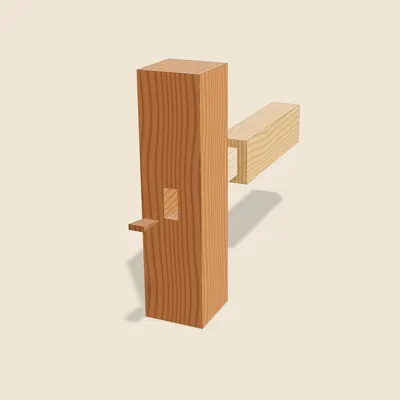
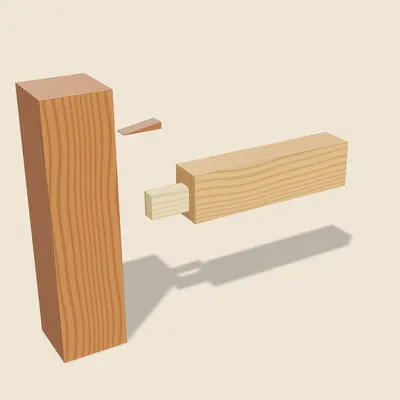
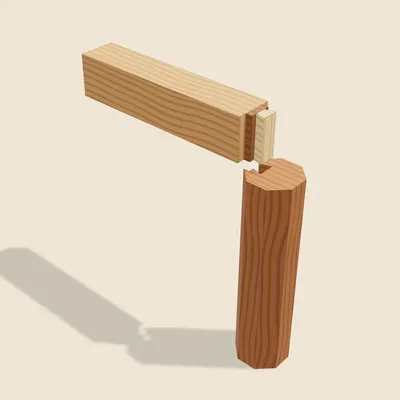
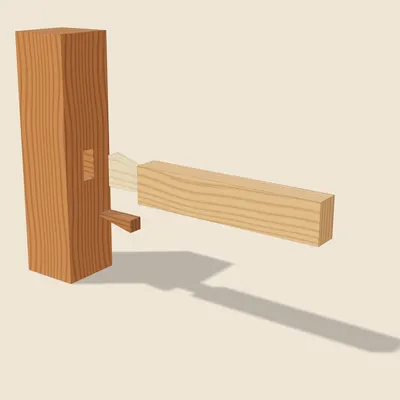
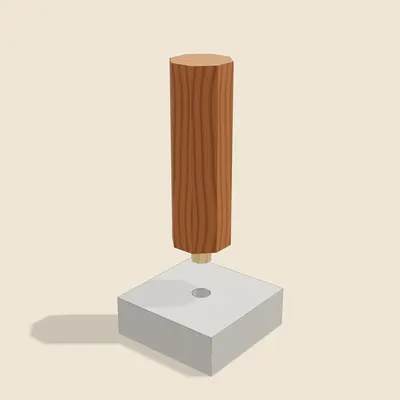
Every variant answers two questions. Does the tenon show on the far side? And what stops it pulling out? A through tenon passes right through the post and shows its end grain; a blind or stub tenon stops inside and leaves the outside clean. A plain tenon resists pulling out only by friction and glue, so many variants add a lock: a wedge that spreads the tenon end, a pin or peg through the cheeks, a tusk key through a projecting tenon, or a dovetailed tenon that is wider at the tip than at the root. A loose or floating tenon is a separate piece let into mortises in both members. Cut the mortise open on three sides and the joint becomes a bridle.
The cards below pair those Western names with Chinese joints that use them. Each opens a 3D model you can take apart.
- 1
- 2
- 3
- 4
- 5
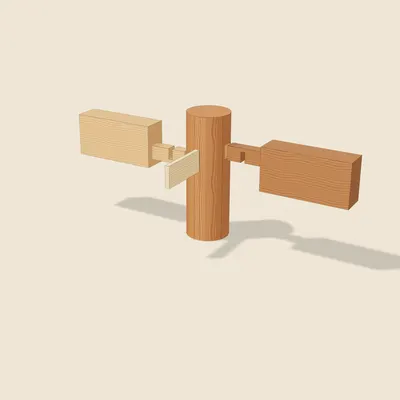
- 6
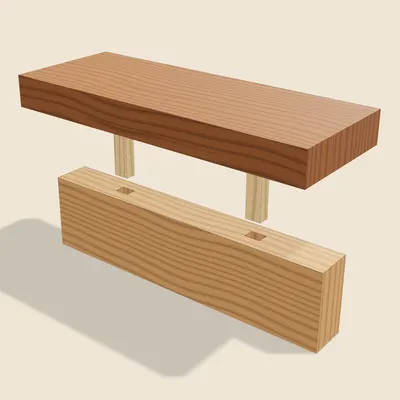
- 7
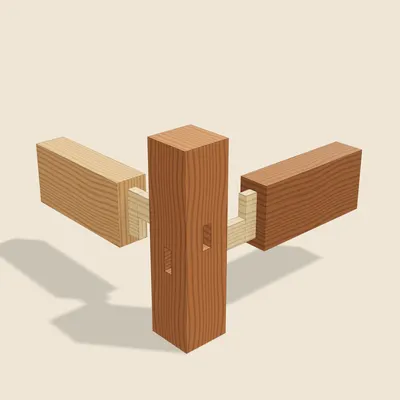
- 8
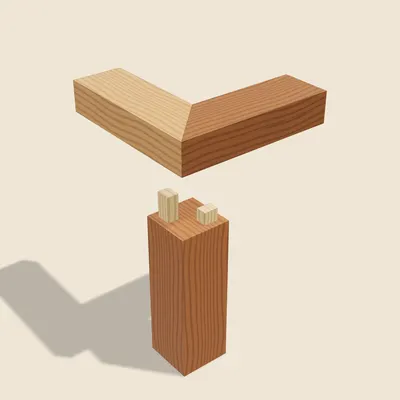
- 9
- 10
- 11
- 12
How a mortise and tenon carries load
Press down on a table rail and the load passes through the tenon’s cheeks into the walls of the mortise, and through the shoulders onto the face of the leg. Rack the frame sideways and the shoulders bear against the leg and stop the rail from rotating. That is why a well-fitted shoulder matters as much as a well-fitted tenon.
Pull the rail straight out and a plain tenon has only glue and friction to resist. Locks exist for that force. A wedge spreads the end of a through tenon so it is wider than the mouth of the mortise. A pin through the cheeks puts a peg across the joint. A dovetailed beam end, such as the sleeve-shouldered dovetail in a column head, is shaped so that it cannot leave sideways at all, and the hook-and-wedge tenon catches on a sloping face.
In a timber building the joint is neither rigid nor a free hinge. Load tests on straight tenons from traditional Chinese timber structures describe them as semi-rigid. As the frame sways, the tenon rotates in the mortise and crushes the wood across the grain at the tenon end and neck. Friction and that crushing absorb energy, but each cycle leaves a larger gap, so the joint grows less stiff as it loosens. Longer and wider tenons resist rotation better.
How strong is it?
In tension tests of L-shaped frames, an open mortise and tenon resisted 553.18 N·m and a half-lap 568.26 N·m. Those two results were not statistically different. Dowel joints in the same test resisted 487.55 N·m. In compression the three fell into different groups: half-lap 191.12 N·m, open mortise and tenon 169.44 N·m, dowel 100.90 N·m. The frames were Scotch pine, Oriental beech, oak and chestnut, glued with PVAc or PU. PVAc gave better results than PU.
In beech T-joints under a static vertical load, a mortise and tenon averaged 204.29 N·m and a dowel joint 153.53 N·m.
A loose tenon is a separate piece seated in both members. In European beech glued with D3 PVAc, withdrawal of T-joints with glued Domino loose tenons averaged 6838.4 N, about twice the 2981.4 N of dismountable Domino connectors. Bonding the shoulders did not significantly change T-joint withdrawal. In corner joints, shoulder bonding raised bending moment capacity in compression by almost 20% and had no significant effect in tension.
| Study | What was tested | Result in that study |
|---|---|---|
| Demirci, Diler, Kasal and Erdil 2020, Wood Research 65(6):975–988. doi:10.37763/wr.1336-4561/65.6.975988 | L-shaped frames of Scotch pine, Oriental beech, oak and chestnut. Dowel, half-lap, and open mortise and tenon. PVAc and PU. 10 replications. | Tension (Table 3, p. 982): half-lap 568.26 N·m, open mortise and tenon 553.18 N·m (same homogeneity group, not statistically different), dowel 487.55 N·m. Compression (Table 8, p. 984): half-lap 191.12 N·m, open mortise and tenon 169.44 N·m, dowel 100.90 N·m (three different groups). PVAc gave better results than PU. |
| Uysal 2024, BioResources 19(3):6120–6141. doi:10.15376/biores.19.3.6120-6141 | Beech (Fagus orientalis) T-joints, static vertical load. | Table 2, p. 6132: mortise and tenon mean 204.29 N·m (abstract: 204 N·m); dowel 153.53 N·m (abstract: 154 N·m). Gluing increased the moment capacity of staple joints. |
| Bas, Dénes and Csiha 2024, Forests 15(2):343. doi:10.3390/f15020343 | European beech, D3 PVAc. Glued Domino loose tenons versus dismountable Domino connectors. | T-joint withdrawal (Table 2): glued Domino loose tenons 6838.4 N, connectors 2981.4 N (about twice). Bonding the shoulders did not significantly change T-joint withdrawal. In corner joints, shoulder bonding raised bending moment capacity in compression by almost 20% and had no significant effect in tension. |
Each row is one study. Different woods, glues, shapes and loads mean the rows are not one ranking.
Hardness of the woods in the USDA Wood Handbook is on the Janka hardness chart.
The twelve Western joints, and every within-study result, are on types of wood joints. Related joints: half-lap, dowel, dovetail.
How to cut a mortise and tenon by hand
The usual order is mortise first, then tenon. A mortise chisel cuts a hole of fixed width, while a saw and paring chisel can trim a tenon to fit whatever hole you made. The steps below suit a blind or through tenon in square stock; the sizes follow the stock, not a fixed table.
- Set the gauge to the chisel. Pick a mortise chisel close to one third of the rail’s thickness and set both pins of a mortise gauge to its width. The chisel fixes the width of the mortise, and therefore of the tenon.
- Lay out the mortise. Knife the two ends of the mortise across the post with a square, then scribe its walls with the gauge, always running the fence against the show face.
- Chop the mortise. Drive the chisel with a mallet, bevel towards the waste, and lever the chips out as you work down to depth. For a through mortise, chop from both faces and meet in the middle so the far side does not break out.
- Lay out the tenon. Knife the shoulder line all round the rail. Without changing the gauge, and again from the show face, scribe the cheeks across the end and down both edges.
- Saw the cheeks, then the shoulders. Saw the cheeks on the waste side of the lines, then saw the shoulders down to meet them. Keep the tenon at full width until the cheeks are pared, so the layout lines stay visible.
- Pare and fit. Pare the cheeks until the tenon slides in with firm hand pressure, then saw it to width. The shoulders should close tight against the post all round.
- Lock the joint. Glue it, drive a pin through the post and tenon, or, for a through tenon, saw a kerf into its end and drive a wedge after assembly (破头楔).
A very old joint, found everywhere
Early Neolithic well linings excavated near Leipzig used tusked tenons. Ancient Egyptian furniture and the planks of the Khufu ship (around 2500 BC) were joined with mortises and tenons, and the sarsen stones of Stonehenge were shaped with stone versions of the joint. Mediterranean shipwrights locked hull planks with loose tenons pinned through both edges, a technique the Romans called coagmenta punicana, “Phoenician joints”.
In China the joint became the basis of both building and furniture. The Song building manual Yingzao Fashi (1103) draws the joints of official timber halls, including pinned opposed beam tenons. Late Ming and early Qing hardwood furniture kept tenons blind on the main show faces and used through tenons and wedges on the small faces, a balance Wang Shixiang describes as strength against neatness.
The same habit of locking members by shape appears in the Luban lock, a notched-stick puzzle rather than a structural mortise and tenon.
Where to find it in a piece of furniture
In a Chinese table the legs meet the top frame with long-and-short tenons; the aprons hang on the legs with jiatou or baojian joints; stretchers enter the legs as blind or big-in, small-out tenons; and the top frame itself is mitred, with a tenon through each mitred corner. The waisted square table shows each of them in place, and types of wood joints sets the mortise and tenon beside the other joint families.