
Chinese vs Japanese joinery
Chinese and Japanese woodworkers both build without nails, and many of their joints are close relatives. The two traditions are best known for different things, though, and the same joint is often named and used differently. The cards below pair a Chinese joint on this page with the Japanese idea it is usually compared to — comparisons of principle, not claims of descent.
What they share
Both traditions join timber with shaped tenons, mortises, laps, dovetails, pins and wedges rather than nails, for the same reasons: wood moves, and a fitted joint can be taken apart and repaired. Both developed a rich set of joints for timber buildings as well as for furniture.
In both crafts you will meet through and blind tenons, half-laps at crossings, scarf splices that lengthen a beam or a curved rail, and keys or wedges that lock a joint after assembly. The shared toolbox is large enough that English-language books often print a Chinese and a Japanese name on facing pages. Facing-page name pairs mark shared geometry families — through and blind tenons, half-laps, scarfs — while each tradition still cuts and names its own shop forms.
If you already know Western cabinetmaking, the shared ground will feel familiar: mortise and tenon, dovetail, bridle, scarf, key. The Chinese and Japanese catalogues add named variants and assembly habits around that ground. Learning one tradition helps you read the other — as long as you keep the names and the load paths straight.
Different emphases
Japanese joinery is best known in the West through its timber architecture and through books such as Seike’s The Art of Japanese Joinery, which divide joints into tsugite (継手, splices that lengthen a member) and shiguchi (仕口, connections that join members at an angle). Chinese joinery is best known through the hardwood furniture of the Ming and early Qing studied by Wang Shixiang, with its waisted and flush-sided tables, mitred frames and floating panels. Both traditions also share a large family of timber-frame joints for buildings.
Put differently: popular Japanese references often start from the building frame and from spectacular splices; popular Chinese references often start from a table corner, a cabinet stile or a chair arm. The underlying idea — shaped wood locking shaped wood — is shared; the catalogue you meet first is not.
At a glance
A compact extract of the points already on this page — not a claim that every shop follows one national rule.
| Point | Chinese (this site) | Japanese (usual English books) |
|---|---|---|
| Best-known entry | Ming / early Qing hardwood furniture (Wang Shixiang) | Timber architecture; Seike’s tsugite / shiguchi split |
| Shared ground | Shaped tenons, mortises, laps, dovetails, pins and wedges; structure is not a nailed box | |
| Name habit | Shape or action (抱肩, 夹头); workshop aliases vary | 継手 lengthen a member; 仕口 meet at an angle |
| Through vs blind | tou-sun / ban-sun teaching pair | Same functional choice for strength, face, and end grain |
| Furniture logic | Waist or not; corner legs vs recessed; floating panels; baojian / jiatou / zongjiao | Sashimono cabinetry often celebrated for precise splices |
| Building scale | Timber-frame + dougong | Deep temple / hall carpentry (photo plates in English refs) |
-
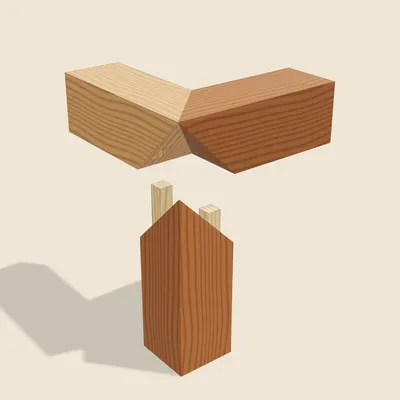 Japanese comparison Three-way mitre (sankaku-tome family) Three members meet with a mitre on every face.
-
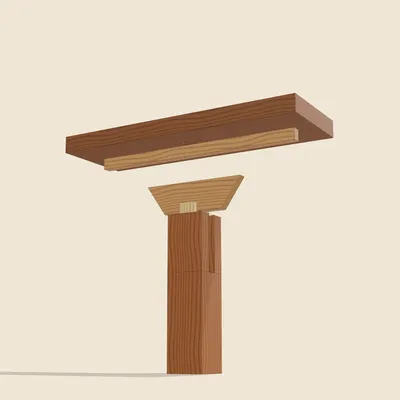 Japanese comparison Bridle / clasping joint (shiguchi) The leg is slotted to clamp the apron, like a bridle.
-
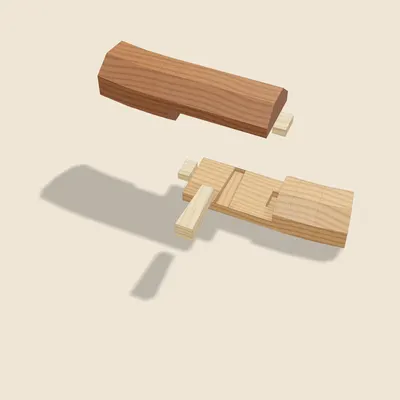 Japanese comparison Keyed scarf (kanawa-tsugi) A tapering key locks a scarf in a curved rail.
-
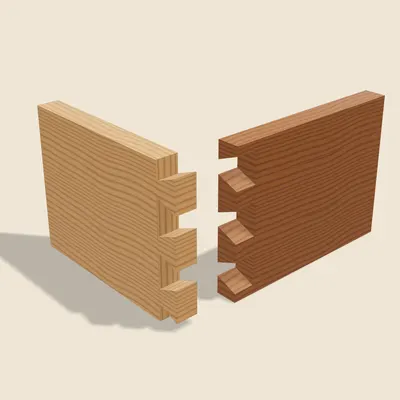 Japanese comparison Dovetail (ari-tsugi / ari-kake) Flared tenon that cannot be pulled straight out.
-
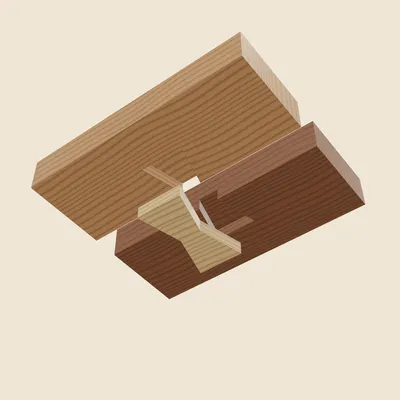 Japanese comparison Butterfly key (chigiri) A double-dovetail key across a crack or seam.
Close relatives
Open any Chinese joint for its 3D model. The Japanese name is the usual comparison in English-language joinery books, not a one-to-one workshop equivalent.
How to use the comparison cards
Each card shows a Chinese joint with a 3D thumbnail and a Japanese comparison name used in English joinery books. Follow the Chinese link for assembly order, diagrams and STLs. Use the Japanese name as a bridge if you already know that literature — then check a Japanese reference for the real workshop form. For whole Chinese pieces, continue to the furniture pages; for a structured path, use the learning path.
Through and half tenons
Both traditions use tenons that pass through a mortise and tenons that stop inside it. On the Chinese side, the plain through tenon and blind tenon are the teaching pair; wedges may tighten a through tenon from the far face. Japanese furniture and building work likewise choose through or stopped tenons for strength, appearance and whether end grain may show.
The useful comparison is functional: through tenons advertise the joint and can be wedged; blind tenons keep a clean face. Ming hardwood furniture often prefers hidden work on show surfaces (a table top, a cabinet front) and may allow through tenons where the eye does not rest — for example high on a bookcase. That is a design choice about surfaces, not a national rule.
Dovetail variants
Flared dovetail geometry appears in both catalogues. Chinese furniture uses yanwei forms at board corners and related housings; sliding dovetail ideas show up in battens and locks such as chuandai and zouma xiao. Japanese work has its own ari-tsugi / ari-kake family for similar “cannot pull straight out” jobs. The cards above pair several of these relatives; open the Chinese page for the take-apart model rather than assuming the angles and assembly order match a Japanese textbook plate.
Sashimono logic vs Ming furniture logic
Sashimono (指物) in Japanese craft talk points to fine cabinetry and furniture joinery — precise members, often light stock, often celebrated for intricate splices. Ming hardwood furniture logic, as Wang Shixiang described it, starts from how a piece stands: waist or no waist, legs at the corners or set in, frame-and-panel tops that let boards move, corners such as baojian, jiatou and zongjiao that make structure readable as line.
A spectacular Japanese scarf may lengthen a temple beam; a baojian corner hangs an apron onto a waisted Chinese table. Same craft family — interlocking wood without nails — different load paths and assembly orders.
Nails, metal, and aesthetic emphasis
“Without nails” is a shared slogan with shared exceptions. Classical Chinese furniture uses metal for hinges and fittings on cabinets; glue appears in some joints, and later work sometimes leaned on it more. Japanese carpentry likewise uses metal where the job demands it, while still treating shaped joints as the structural default in timber frames. The point of the slogan in both places is that the frame is not a nailed box.
Aesthetic priorities diverge in emphasis more than in virtue. Ming furniture writing praises restraint, visible structure and proportion — the joint as a clean seam. Japanese joinery display often praises the ingenuity of a splice or the precision of a complex interlocking cut. Neither tradition is only austere or only showy; both have plain work and elaborate work. The useful differences sit on specific joint pages and specific objects, not in abstract national character.
Timber frame on both sides
Chinese timber-frame joints — column feet, beam-to-post dovetails, mantis-head splices, bracket sets — sit in the timber-frame and dougong hubs. Japanese building joinery is equally deep; English readers often meet it first through published photo plates of temple splices. A fair comparison at building scale is “both cultures solved long-span wooden roofs with interlocking carpentry,” not “one invented what the other copied.”
For a single Chinese bracket path, climb from yidou-sansheng to pingshenke, zhutouke, jiaoke and liujin. For furniture-scale Chinese corners, stay with baojian, jiatou and zongjiao. Crossing those wires is the most common confusion in popular comparison articles.
Names
Chinese joint names often describe the shape or the action (抱肩, “embracing the shoulder”; 夹头, “clasping head”), and the same joint can have different workshop names in Suzhou and Beijing. Japanese names do the same in their own language. A Chinese joint is best known by its Chinese name; translating it into a Japanese term can suggest a closer match than exists.
On this page the Chinese names stay primary in headings and links. Japanese comparison names appear on the cards as bridges for readers who arrive from Seike, Sato and Nakahara, or from English blogs that only list Japanese terms. When in doubt, click through to the Chinese joint and read how that specific corner goes together.
Learn more
For Chinese joinery start with the beginner guide and the learning path; the further reading list includes the Japanese books cited here. For wood and object context, Ming furniture characteristics and huanghuali explain materials without replacing joint geometry. For building brackets as a separate Chinese speciality, open dougong.