
Box joint
A box joint interlocks square fingers on the ends of two boards, so the glue is on the sides of the fingers rather than on end grain alone. In tests of Scotch pine, poplar and fir box joints with 4, 8 or 12 teeth, the 12-tooth joints had the highest moment capacity and the 4-tooth joints the lowest.
How a box joint works
Square fingers on one board fill the gaps in the other. The joint goes together from one direction, like a comb. Pull across the corner and the glue on the finger sides is what resists; the shape does not flare the way a dovetail does.
A box corner and the Handbook’s finger joint are not the same cut. The Handbook’s finger joint is an end-to-end splice. That splice, like a scarf, needs a bonding area at least 10 times the cross section, and a well-made finger, scarf or lap end joint can reach up to 90% of the tensile strength of clear wood. Those figures are for the end splice, not a measured box corner. In plywood, a slope of 1 in 8 is the typical structural finger or scarf, which is a third case.
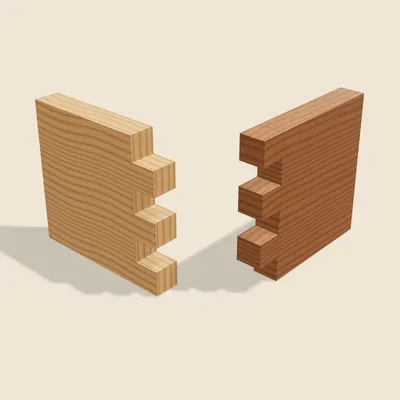
How strong is it?
Among the tooth counts tested, 12 teeth gave the highest moment capacity in both tension and compression, and 4 teeth the lowest. PVAc was more effective than PU. Scotch pine was highest in tension and poplar highest in compression. Adding fingers adds glue area, but the paper reports that the effect of surface area was not linear.
| Study | What was tested | Result in that study |
|---|---|---|
| Demirci, Diler, Kasal and Erdil 2020, BioResources 15(2):3136–3146. doi:10.15376/biores.15.2.3136-3146 | Box joints in Scotch pine, poplar and fir. PVAc and PU. 4, 8 or 12 teeth. | 12-tooth joints had the highest moment capacities and 4-tooth joints the lowest, in tension and in compression. PVAc was more effective than PU. Scotch pine was highest in tension and poplar highest in compression. The effect of surface area was not linear. |
Each row is one study. Different woods, glues, shapes and loads mean the rows are not one ranking.
Hardness of the woods in the USDA Wood Handbook is on the Janka hardness chart.
How to cut a box joint
Lay the fingers out equally, cut one board, and transfer the marks.
- Divide the end into equal fingers. Mark equal fingers across the end. Of the counts tested — 4, 8 and 12 teeth — 12 had the highest moment capacity. The gain was not linear with surface area, so more fingers are not a guarantee of a proportional gain.
- Cut one board. Saw on the waste side of the lines and chop out the sockets. The fingers are square, not flared.
- Mark the mating board from the first. Stand the cut end on the second board and knife around the fingers you have already made.
- Cut the second board and glue. Saw and chop the mating fingers, dry-fit the corner, then glue the long-grain sides of the fingers.
When to use it
Use a box joint on boxes and drawers when you want the glue area of interlocking fingers and you do not need the flare of a dovetail. For an end-to-end splice in a long board, the Handbook’s case is the scarf or finger joint, not this corner.
The twelve Western joints, and every within-study result, are on types of wood joints. Related joints: dovetail, scarf, dado.