Bazhang Sun (巴掌榫): Palm Splice for Column Repair
Palm splice · 墩接巴掌榫
A timber column standing on damp stone rots from the foot up. Replacing the whole column means taking the roof apart.
Instead, carpenters cut the rotten part away and splice on a new foot with a bazhang sun, a “palm” joint.
- Chinese
- 巴掌榫 · bāzhang sǔn
- Also called
- 墩接巴掌榫
- Joins
- A new column foot to an old column
- Found in
- Repairs of timber-frame buildings; lengthening
- Signature parts
- Two half-thickness palms · insert tenons · iron hoops
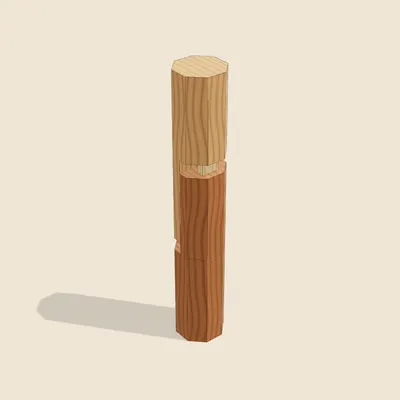
How it works
Cut back to sound wood
The rotten foot is sawn off and a new piece of the same section is prepared.
Two palms
Each piece is cut away to half its thickness over the splice, leaving a flat “palm”. The palms lie face to face. A building-conservation guide gives the palm length as about one and a half to two times the column diameter, and its thickness as half the diameter.
Insert tenons and hoops
A short tenon at each palm end enters the shoulder of the other piece, so the palms cannot slide apart. The tenon is about one eighth of the diameter thick. Iron hoops are then fitted around the splice.
How it's made
 Step 1
Cut and replace
Saw off the rotten foot; prepare a new base.
 Step 2
Palm on the old column
Cut the old column to a half-thickness palm.
 Step 3
Matching palm
Cut the new base to the matching palm.
 Step 4
Insert tenons
Leave a short tenon at each palm end.
 Step 5
Close up
Bring the palms face to face.
 Step 6
Hoops
Bind the splice with iron hoops.
Variations
Without tenons
Simple half-lap splices are also used where loads are light.
Furniture
The same lapped principle is used to lengthen members.
Can you CNC this?
Possible, with design or setup changes
The palms are flat half-laps and suit a 3-axis machine if the column is square or faceted and clamped on its side. A round column may need a cradle, or the curved outside left to hand work. The short tenons at the palm ends are cut into end-facing shoulders, which may need the part clamped upright or the tenons made as separate loose tenons.
General note: a round cutter cannot leave a sharp inside corner, so every recess keeps the tool radius. Round the mating edges or add dogbone reliefs. Sloping faces, undercuts and curves may need special bits, extra setups or more axes.
Free STL downloads (one file per part)
- New column foot with palm 带巴掌的新柱根 · bazhang-sun-new-base.stl
- Old column with palm 带巴掌的原柱 · bazhang-sun-old-column.stl
Proportions are illustrative, not measured dimensions. The files are unitless: scale them to suit and check fits and allowances before cutting. Each file is a closed (watertight) solid with its mortises and slots already cut, exported in its assembled position, ready to import into CAM or modelling software. Licence: CC BY 4.0 (credit: Chinese Joinery).
Related joints
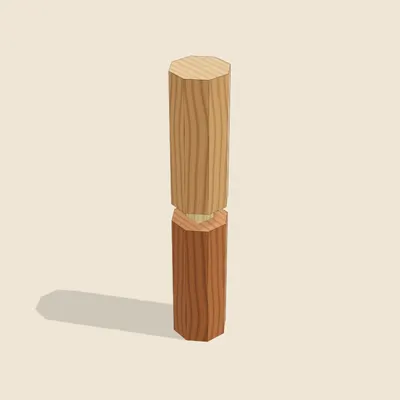
Hidden Dowel
àn xiāoTwo lengths meet end to end and a square pin hidden inside the joint keeps them in line: nothing shows outside.
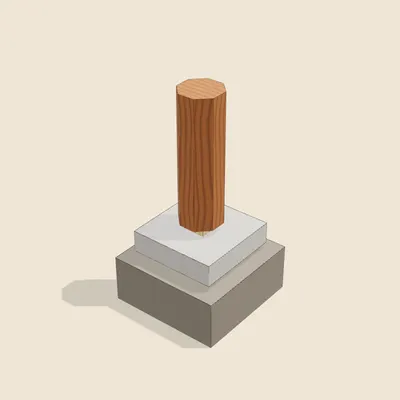
Through-Base Tenon
tàodǐng sǔnA long square tenon at the column foot passes through a hole in the base stone into the foundation below.
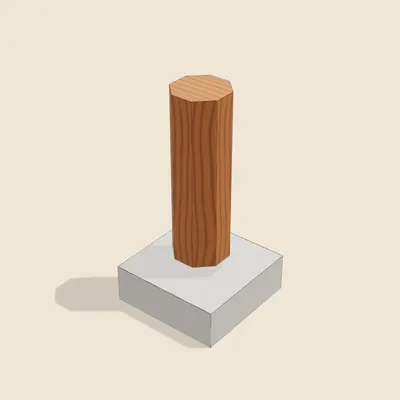
Column-Foot Tenon
guǎnjiǎo sǔnA short round tenon at the column foot drops into a socket in the stone base, so the column can’t shift.
Questions
What is a bazhang sun?
A half-lap “palm” splice used mainly to repair a rotten column foot.
How long is the palm?
A conservation guide gives about 1.5 to 2 times the column diameter.
What holds it?
Short insert tenons at the palm ends, plus iron hoops.