An Xiao (暗销): Hidden Dowel for Joining Columns
Hidden dowel · 暗销榫
Some columns are made of two lengths butted end to end. From outside the joint is only a fine line.
What keeps the two pieces in line is a square pin buried in the joint: an an xiao, a hidden dowel.
- Chinese
- 暗销 · àn xiāo
- Also called
- 暗销榫
- Joins
- Two column lengths end to end
- Found in
- Decorative, lightly loaded columns
- Signature parts
- Square pin · matching holes · glued ends
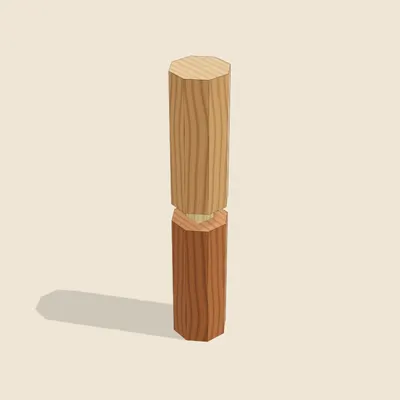
How it works
End to end
The two lengths are butted end to end. A square hole is cut into each end face.
A square pin
A square pin goes into both holes. A building-conservation guide gives the pin as about one third of the column diameter square, and between half and one full diameter long. The ends and the pin are glued.
Where it is used
The same guide keeps this method for decorative columns with a clear oil finish that carry no real load. Load-bearing columns are spliced with lapped joints such as the palm splice.
How it's made
 Step 1
End to end
Butt two lengths end to end.
 Step 2
Hole in one end
Cut a square hole in one end face.
 Step 3
Matching hole
Cut the matching hole in the other.
 Step 4
Square pin
Make a pin about a third of the diameter.
 Step 5
Set and glue
Set the pin in and glue the ends.
 Step 6
Hidden
Nothing shows; for lightly loaded posts.
Variations
Hidden dowels elsewhere
Hidden square pins are also used where a plate beam meets end to end.
Can you CNC this?
Yes, with small changes
The square holes are cut into the end faces, so each length may need clamping upright, or the holes drilled on a vertical setup. A round-cornered or round pin is easier than a sharp square one.
General note: a round cutter cannot leave a sharp inside corner, so every recess keeps the tool radius. Round the mating edges or add dogbone reliefs. Sloping faces, undercuts and curves may need special bits, extra setups or more axes.
Free STL downloads (one file per part)
- Lower column length 下段柱 · an-xiao-column-lower.stl
- Hidden square pin 暗销 · an-xiao-hidden-pin.stl
- Upper column length 上段柱 · an-xiao-column-upper.stl
Proportions are illustrative, not measured dimensions. The files are unitless: scale them to suit and check fits and allowances before cutting. Each file is a closed (watertight) solid with its mortises and slots already cut, exported in its assembled position, ready to import into CAM or modelling software. Licence: CC BY 4.0 (credit: Chinese Joinery).
Related joints
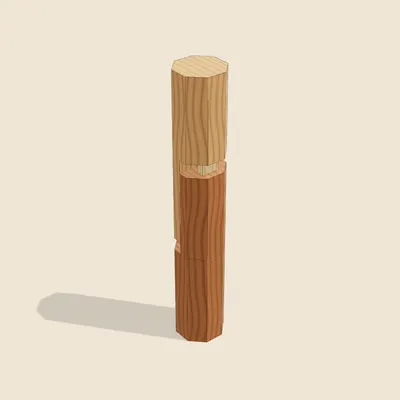
Palm Splice
bāzhang sǔnOld column and new foot are each cut to a half-thickness “palm”; the palms overlap, short tenons lock their ends, and iron hoops bind it.
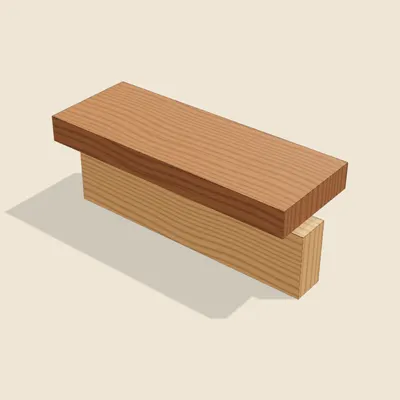
Loose Tenon
zāi xiāoThe tenon is a separate piece of wood planted into mortises in both parts, easy to replace if it wears.
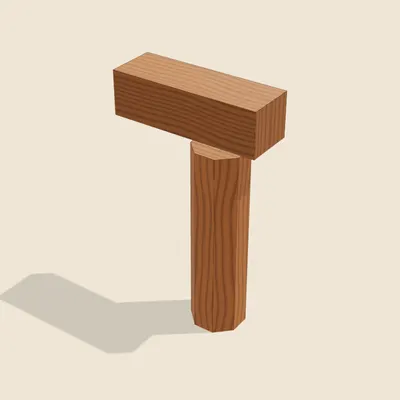
Column-Head Tenon
mántou sǔnA short square tenon on the column head fits a socket under the beam, so the beam can’t slide off.
Questions
What is an an xiao?
A square pin hidden inside an end-to-end joint.
How big is it?
A conservation guide gives about 1/3 of the column diameter square and 0.5–1 diameter long.
Is it strong?
It keeps the pieces in line but is used where loads are light.