
Miter joint
Set the saw or miter gauge 180° divided by the number of sides off a square cut: 45° for a square frame and 30° for a hexagon. Both pieces at a corner get the same setting. A miter opens when the wood changes width across the grain and the two angled ends no longer meet.
How a miter works
The ends are cut so the joint line bisects the corner. Set the saw or miter gauge 180°/n off a square cut, and give both pieces at a corner the same setting. On a square frame that cut is 45° to each edge. Neither face shows end grain if the cut is tight. The glue, though, is mostly on end grain.
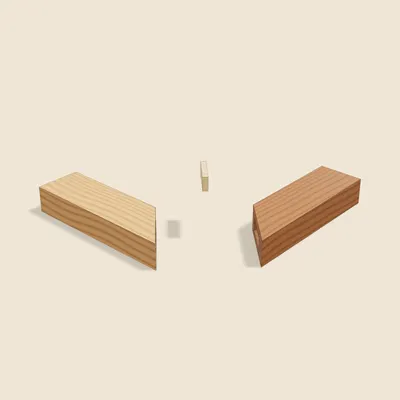
Why miters open
A 4-inch-wide flat-sawn northern red oak miter going from 6% to 10% moisture content widens by about 0.049 in. (about 1/20 in.), which shows as a gap at the heel. For another width or species, use the wood movement calculator.
The same movement is why a plain miter in a wide piece is a poor place to trust end grain alone. Backband trim mitered at the corners should be glued and splined before erection.
How to cut one
Set the saw 180°/n off a square cut, use that setting on both pieces, and spline the corner if the frame will see a change in moisture.
- Divide 180° by the number of sides. Set the saw or miter gauge that many degrees off a square cut. A four-sided frame is 45°. A six-sided frame is 30°. Both pieces at a corner get the same setting.
- Cut both pieces at the same setting. Each piece at the corner uses that same setting off square. A gap at the toe or the heel is a cut that does not add up, or wood that has moved since the cut.
- Reinforce a corner that must stay closed. A spline across the miter, a key, or glue plus that spline is the usual fix. The Handbook’s line for backband trim is to glue and spline the miters before the trim goes up.
- Expect movement across the grain. A plain miter can open at the heel when the wood widens across the grain, even when the corner was tight on the day it was cut.
When to use it
Use a miter when the corner should show no end grain: picture frames, trim, the mitred edge of a cabinet. Reinforce it. A dovetail or a box joint shows the end grain and locks the corner by shape. A half-lap finishes flush without the angled glue line.
The twelve Western joints, and every within-study result, are on types of wood joints. Related joints: dovetail, box joint, half-lap.