
Butt joint
A glued end-grain butt joint reaches only about 25% of the wood’s tensile strength parallel to the grain. The USDA Wood Handbook calls end-grain butt joints practically impossible to make strong enough for ordinary service with conventional bonding techniques.
How a butt joint works
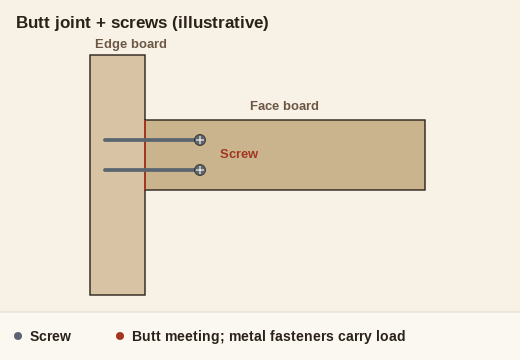
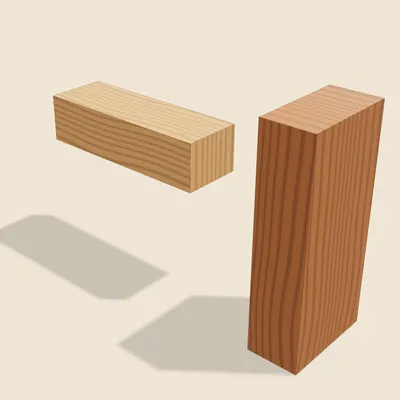
One surface simply meets another. Nothing is cut to interlock. Screws, nails or glue are the whole connection. Edge to edge, the meeting is long grain to long grain. End grain to a face, or end grain to end grain, puts glue on the open ends of the fibres.
How strong is it?
The Handbook’s figure for end grain is about 25% of the tensile strength of the wood parallel to the grain, even with special techniques. With conventional bonding it calls a strong end-grain butt practically impossible for ordinary service. That is not a rank against every other joint. It is the result for this glue face.
A flat edge-grain joint is a different meeting. Shaped edges such as tongue and groove typically do not beat that flat glue line; they only align it.
| Study | What was tested | Result in that study |
|---|---|---|
| USDA Wood Handbook (FPL-GTR-282, 2021), pp. 10-16 and 10-17 | Bonded joints: edge-grain, end-to-end, and end-to-edge. | Shaped edge joints such as tongue and groove typically do not produce higher strength than a flat glued edge; their advantage is alignment. End-grain butt joints are practically impossible to make strong enough for ordinary service; with special techniques they reach about 25% of the tensile strength parallel to the grain. A scarf or finger end joint needs a bonding area at least 10 times the cross section, and slopes of 1 in 12 or flatter give the highest strength. A well-made scarf, finger or lap end joint can have up to 90% of the tensile strength of clear wood. In plywood, a slope of 1 in 8 is typical for structural scarf and finger joints. Dowels, mortise and tenons, and rabbets are examples of end-to-edge joints made strong (Fig. 10-8). |
Each row is one study. Different woods, glues, shapes and loads mean the rows are not one ranking.
How to cut one, and how to replace it
Plane an edge joint straight and glue it. For end grain, switch joints rather than hoping the end-grain glue will do.
- Decide which faces meet. Edge grain to edge grain is a real glue joint. End grain to end grain is the case the Handbook calls practically impossible to make strong enough for ordinary service with conventional bonding. A plain end-to-edge joint is also hard to make strong; the Handbook’s strong end-to-edge examples are dowels, mortise and tenons, and rabbets.
- For an edge, plane both edges straight. A flat edge joint is the Handbook’s baseline. Glue those long-grain faces and clamp them.
- For end grain, change the joint. A scarf of 1 in 12 or flatter, or a finger joint, gives the bonding area the Handbook asks for: at least 10 times the cross section. A mortise and tenon, a dowel or a half-lap moves the glue off pure end grain.
- Do not expect the end-grain glue line to carry the piece. With special techniques an end-grain butt still reaches only about 25% of the tensile strength parallel to the grain.
When to use it
An edge-glued butt is the ordinary way to make a wider panel. An end-grain butt is a temporary or lightly loaded meeting. To fix the end-grain case, use a scarf (slope of 1 in 12 or flatter; length equal to 12 times the thickness), a finger joint with bonding area at least 10 times the cross section, or a mortise and tenon, dowel or half-lap. A well-made scarf, finger or lap end joint can reach up to 90% of the tensile strength of clear wood. That 90% is the Handbook’s figure for those end joints, not for the butt.
The twelve Western joints, and every within-study result, are on types of wood joints. Related joints: dowel, biscuit, pocket hole.