
Goutou Dazhang (勾头搭掌): The Hooked Lap That Joins Song Column-Top Plates
Hooked lap splice · 普拍方间缝勾头搭掌 · 勾頭搭掌
A Song hall carries its bracket sets on a flat plate laid along the column tops.
Where two lengths of plate meet, the Yingzao Fashi draws a lap with hooks.
- Chinese
- 勾头搭掌 · gōutóu dāzhǎng
- Joins
- Two lengths of column-top plate (普拍方), end to end
- Found in
- Song-dynasty halls, over a column
- Signature parts
- Half lap · hooked teeth
- Compare
- Mantis-head splice
How it works
The plate
The Yingzao Fashi (1103) puts a flat plate, the 普拍方, on top of the columns and lintels to carry the bracket sets. In the chapter on platforms (卷四, 平坐) its thickness is given as one cai depth (厚隨材廣), that is 15 fen of the module, and its width as the full width of the timber used.
The drawing
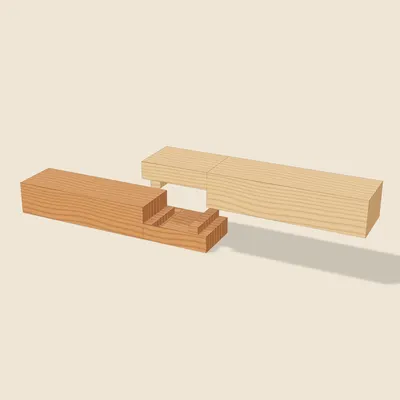
Juan 30, in the plate of mortises for beams and lintels (梁額等卯口第六), shows three ways to join lengths of purlin or plate. Next to the two mantis-head splices is the 普拍方間縫勾頭搭掌: two ends drawn apart, one lowered to half depth with small hooked steps on the lap, the other with the matching cut on its underside.
How it works
Each plate end keeps half its depth, so the two together are as thick as the plate. The hooks catch each other along the length, so once the upper end is dropped on, the seam cannot be pulled open; the bracket set above holds it down.
Inferred reconstruction (推断复原)
This joint is an inferred reconstruction. It is inferred from: the juan 30 drawing of the 普拍方間縫勾頭搭掌 and the plate thickness in juan 4. Inferred, not sourced: the length of the lap, the size and position of the hooked teeth, and the width of the plate; the drawing is small and gives no measurements.
History
The plate
The Yingzao Fashi (1103) puts a flat plate, the 普拍方, on top of the columns and lintels to carry the bracket sets. In the chapter on platforms (卷四, 平坐) its thickness is given as one cai depth (厚隨材廣), that is 15 fen of the module, and its width as the full width of the timber used. (Yingzao Fashi juan 三十 (plate scan p. 30)).
Juan 30, in the plate of mortises for beams and lintels (梁額等卯口第六), shows three ways to join lengths of purlin or plate. Next to the two mantis-head splices is the 普拍方間縫勾頭搭掌: two ends drawn apart, one lowered to half depth with small hooked steps on the lap, the other with the matching cut on its underside.
How it works. Each plate end keeps half its depth, so the two together are as thick as the plate. The hooks catch each other along the length, so once the upper end is dropped on, the seam cannot be pulled open; the bracket set above holds it down.
Proportions
The plate
The Yingzao Fashi (1103) puts a flat plate, the 普拍方, on top of the columns and lintels to carry the bracket sets. In the chapter on platforms (卷四, 平坐) its thickness is given as one cai depth (厚隨材廣), that is 15 fen of the module, and its width as the full width of the timber used.
Proportions in the model are illustrative.
Common mistakes
Common mistakes
- Putting the seam off the column. The plate splice sits over a column, under a bracket set; a free-span seam loses that seating.
- Treating lap and hook sizes as book figures. Only plate thickness (厚隨材廣) is sourced; lap length and hooked teeth are inferred from the small juan 30 drawing.
- Reading it as a mantis-head. Juan 30 draws both: mantis-head has a narrow neck and wider pointed head; this splice is a half-lap with hooked teeth. See the mantis-head page before renaming a photo.
- Assembling from the wrong face. One end keeps the lower half, the other the upper; the upper end drops on so the hooks catch along the plate.
Related joints elsewhere
Related forms
Western and Japanese workshops have relatives that share a geometric idea (scarf, bridle, dovetail, halving, keyed splice) under other names; they are bridges for readers, not claims of descent.
Stay with the Chinese construction on this page before renaming a piece. See also Compare two joints when a look-alike is listed there.
How it's made
 Step 1
Splice
Two plates meet over a column.
 Step 2
Apart
Lifted apart.
 Step 3
Lower half
Lower half of one end.
 Step 4
Hook
A hooked tooth on the lap.
 Step 5
Upper half
Upper half, with its own tooth.
 Step 6
Locked
Teeth lock: the ends cannot pull apart.
Variations
Mantis-head splice (螳螂頭口)
Drawn beside it for purlins and plates: a narrow-necked head dropped into a matching socket.
Qing plate crossing
At corners, Qing plates cross with half-laps and hidden pins instead.
Can you CNC this?
Yes, with small changes
Each end is a half-depth pocket from one face with a small raised tooth and a matching groove, all straight 3-axis cuts; long plates are limited by the bed size.
Free STL downloads (one file per part)
- Plate end, lower half with hook 普拍方(下半搭掌带勾头) · goutou-dazhang-plate-lower-half.stl
- Plate end, upper half with hook 普拍方(上半搭掌带勾头) · goutou-dazhang-plate-upper-half.stl
Before cutting or printing, read the CNC and 3D-printing notes on tool radius, scaling the STL files and their licence.
Related joints
Mantis-Head Splice
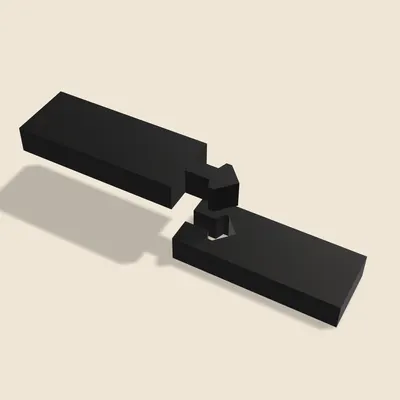
tángláng tóu sǔnOne member ends in a narrow neck and a wide “mantis head”, cut through its full depth; it drops from above into a matching socket in the next member, so the two cannot be pulled apart.
Crossed Plates at the Corner
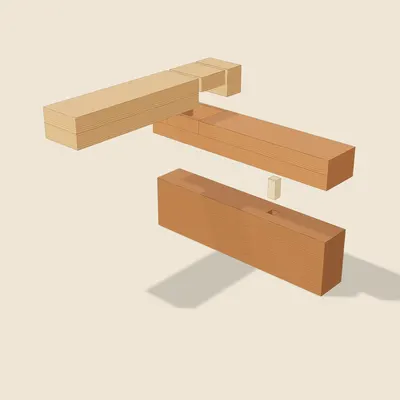
píngbǎnfāng dājiāoAt the corner the two plates cross, each cut away by half its height; a thin lip is left outside the cut, and hidden pins tie the plate to the beam below.
Palm Splice
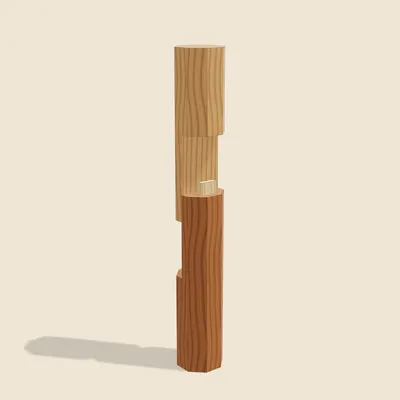
bāzhang sǔnOld column and new foot are each cut to a half-thickness “palm”; the palms overlap, short tenons lock their ends, and iron hoops bind it.
Questions
Where is the seam placed?
Over a column, under a bracket set.
Are the sizes from the book?
Only the plate thickness; the lap and hook sizes are inferred.
Why hooks?
So the joint cannot be pulled apart along the plate.