Zongjiao Joint (粽角榫): The Chinese Three-Way Mitre Explained
Three-way mitre · Rice-dumpling joint · 三角齐尖 · 三碰肩
Pick up a zongzi, the pyramid-shaped rice dumpling, and look at a corner: three folded edges meet in a single point. The top corner of a square Chinese cabinet has exactly that shape, and that is where this joint gets its name.
The zongjiao sun brings a leg and two frame members together so that from every side you see only one 45° line running into the corner. No end grain shows anywhere. It is the joint that gives 'four-sides-flat' tables and square-cornered cabinets their crisp, block-like look.
- Chinese
- 粽角榫 · zòngjiǎo sǔn
- Also called
- Three-way mitre · 三角齐尖 · 三碰肩
- Joins
- A leg or post and two frame members
- Found in
- Four-sides-flat tables, bookcases, cabinets
- Signature parts
- Three 45° mitres · long and short tenons
- Stock
- Three square members of the same size
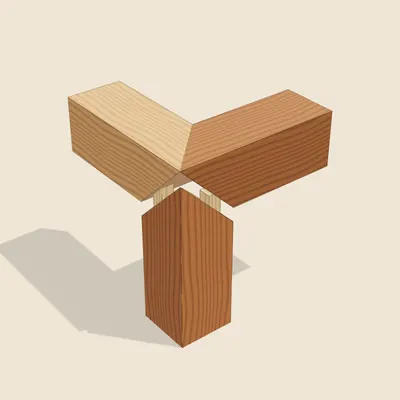
How it works
Three mitres, one point
Each of the three members is mitred at 45°, so wherever you stand, the corner shows a single diagonal line running into the point where all three meet. For the lines to meet cleanly the three pieces should be square and the same size.
What holds it
The post (a leg or a cabinet stile) ends in two tenons at right angles: one long, one short. They run up into mortises in the two horizontal members. Inside the mitres the wood is hollowed so the mitred laps of the three pieces seat on one another. In Andrew Hunter's version, one rail also sends a tenon through the other.
Through or hidden
On a table top the long tenon stays hidden so the surface remains clean. On a tall bookcase or cabinet, whose top sits above eye level, it can run right through for extra strength.
The trade-off
Because so much joinery meets at one point, the corner is crowded. On tables, makers add stretchers or a hump-backed brace (霸王枨) to stiffen it.
How it's made
 Step 1
Prepare three matching pieces
Start from straight, square stock of the same section. Mark the outside faces and lay out every line from them.
 Step 2
Cut the post
Cut the two outside 45° mitres at the top of the post, leaving two tenons. Cut one of them short so it clears the tenon coming in from the rail.
 Step 3
Cut the first rail
Cut its mortises, its 45° mitre, and the mitred seat that takes the post's mitred laps.
 Step 4
Cut the second rail
Cut the mortise for the post's long tenon, the rail's own tenon, and its mitred face and seat.
 Step 5
Assemble and check
Bring the three pieces together. From each outside face, the mitre line should run straight into the corner point.
Tip One maker sets the post's corner down by 3–5 mm to stop a small gap opening at the point over time.
Variations
Through or blind tenons
Blind on tables, where the top must stay clean; through tenons are fine on tall cabinets and bookcases.
Four-sides-flat tables
Tables whose legs, aprons and top all meet flush (四平式) use this joint at every corner.
The Western three-way mitre
Fine Woodworking's Andrew Hunter builds the same corner for cabinet frames, with through tenons, and leaves it unglued.
Can you CNC this?
Hard on a 3-axis machine as drawn
Hard: three members meet with three 45° mitres on three faces, and the mitre faces slope to every cutting direction. It may need 3D surfacing in several setups or a 5-axis machine, and the point would likely need hand fitting.
General note: a round cutter cannot leave a sharp inside corner, so every recess keeps the tool radius. Round the mating edges or add dogbone reliefs. Sloping faces, undercuts and curves may need special bits, extra setups or more axes.
Free STL downloads (one file per part)
- Post 竖材 · zongjiao-sun-post.stl
- Long side 大边 · zongjiao-sun-long-side.stl
- End rail 抹头 · zongjiao-sun-end-rail.stl
Proportions are illustrative, not measured dimensions. The files are unitless: scale them to suit and check fits and allowances before cutting. Each file is a closed (watertight) solid with its mortises and slots already cut, exported in its assembled position, ready to import into CAM or modelling software. Licence: CC BY 4.0 (credit: Chinese Joinery).
In museum collections
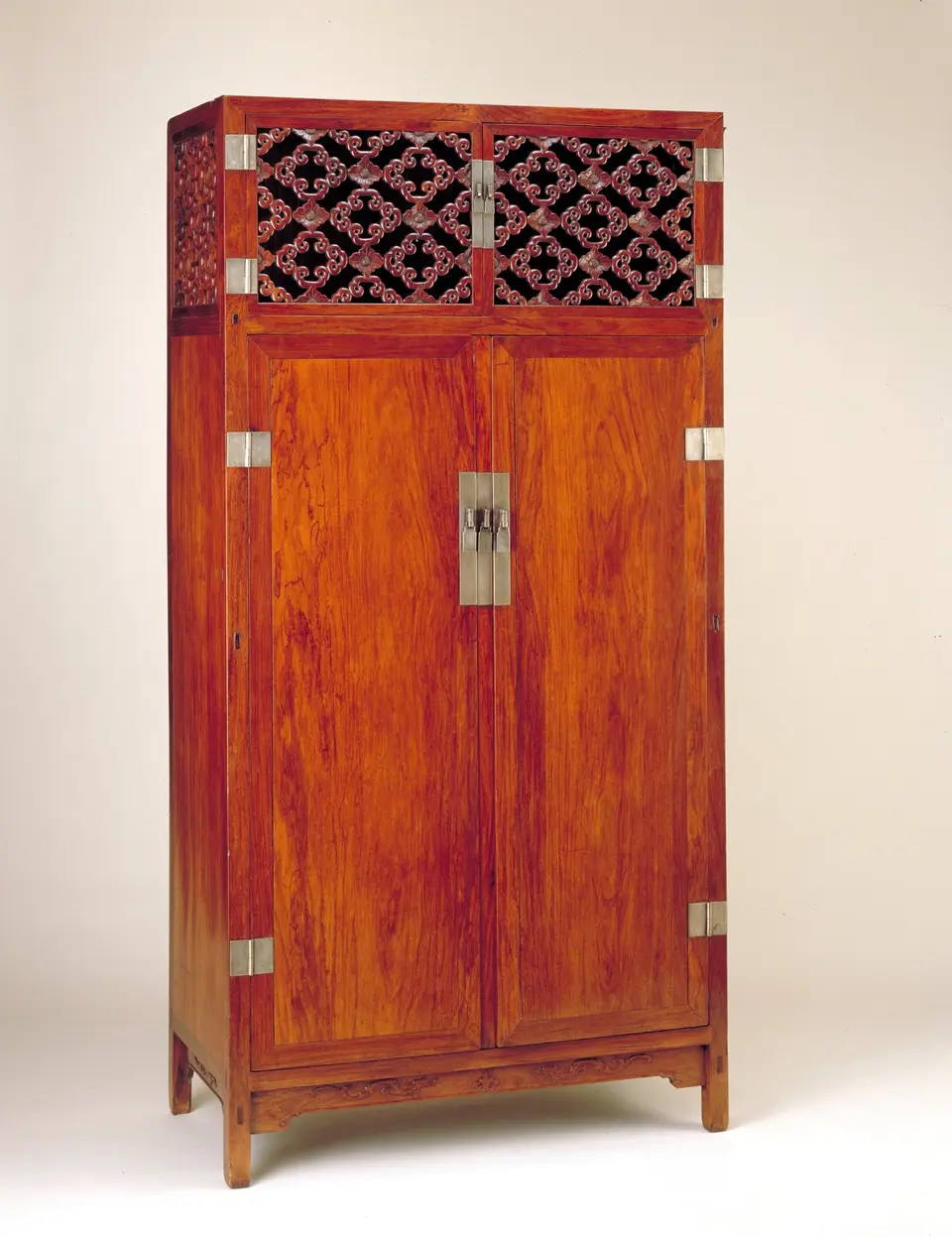
Minneapolis Institute of Art
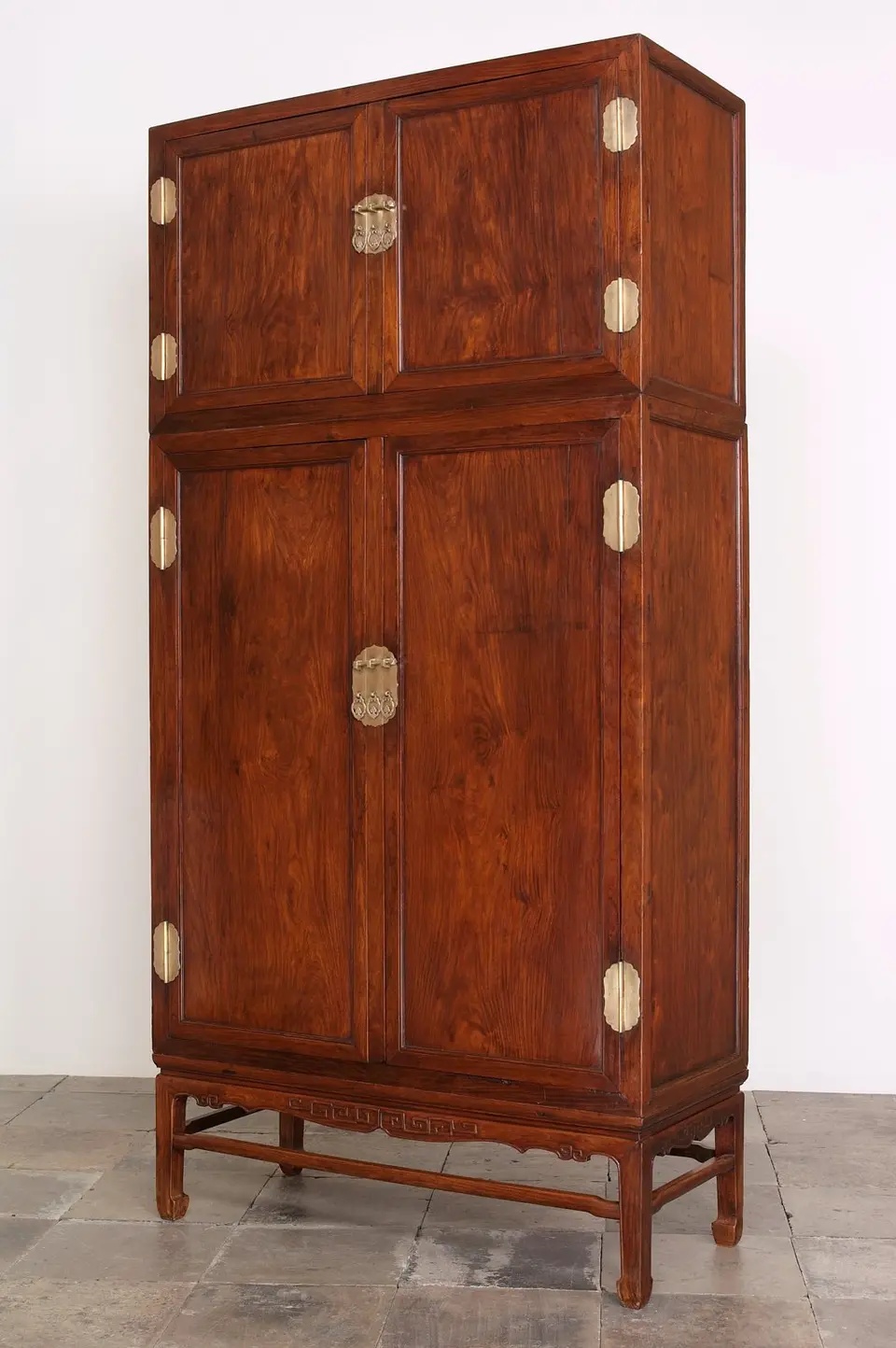
Minneapolis Institute of Art
Related joints
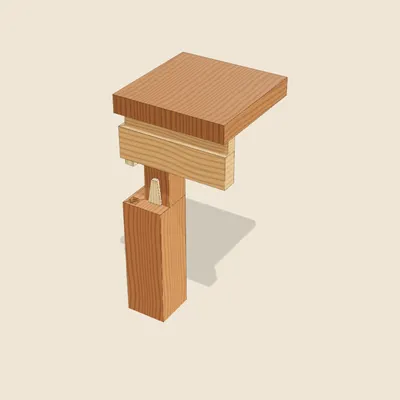
Questions
What is a zongjiao joint?
The zongjiao sun (粽角榫) is a Chinese three-way mitre: a leg and two frame members meet at one corner, each mitred at 45°, and are held by a long and a short tenon on the leg.
Why is it called the rice-dumpling joint?
From any of its three outside faces the corner looks like the folded tip of a zongzi: three 45° lines meeting at a point.
Is the zongjiao joint strong?
It interlocks mechanically, and Andrew Hunter leaves his unglued. But it concentrates mortises at one point, so tables usually get extra bracing.
Should the tenons go through?
On table tops, no: keep them hidden. On tall cabinets and bookcases, through tenons are acceptable.
How is it different from the baojian joint?
The baojian joint belongs to waisted furniture, with the apron set below a recessed waist. The zongjiao joint meets everything flush at the outer corner of the top.
Further reading
- 榫卯结构 (entry 粽角榫), 科普中国
- 传统榫卯结构形式及使用综览, 木工刀具网
- 榫卯手工艺讲究相互避让, 中木商网 (citing Wang Shixiang)
- 粽角榫:这个'粽子'不好吃, 匠心猫
- Andrew Hunter, 'Super-Strong 3-Way Miter', Fine Woodworking #227 (2012)
- Ganeshan et al., MiGumi: Making Tightly Coupled Integral Joints Millable (SIGGRAPH Asia 2025)
- Jochen Gros & Friedrich Sulzer (HfG Offenbach), 50 Digital Wood Joints