
Three-Bar Crossing Joint (三根直材交叉): How Three Stretchers Cross at One Point
Three-way crossing · 三根直材交叉接合
A six-legged washbasin stand needs three stretchers crossing at its centre.
The three-bar crossing grows out of the simple cross halving.
- Chinese
- 三根直材交叉 · sān gēn zhícái jiāochā
- Joins
- Three straight bars at one point
- Found in
- Base stretchers of six-legged washbasin stands
- Signature parts
- ⅓ and ⅔ cuts · rectangular crossing section
- Compare
- Cross halving
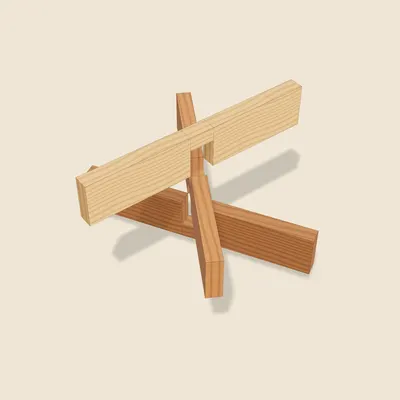
How it works
From two bars to three
Two crossing bars are each cut half away. With three, Wang Shixiang describes the middle bar losing a third of its height above and below, the upper bar losing two-thirds from its underside and the lower bar two-thirds from its top. Stacked, the three make the height of one bar.
Made tall
Because so much is cut away, the bars are made tall in section so that each keeps enough wood at the crossing, and the short length where they meet is left rectangular, not rounded, for strength.
Proportions in the model are illustrative.
How it's made
 Step 1
Crossing
Three bars cross at one point.
 Step 2
Middle
Middle bar: a third off top and bottom.
 Step 3
Upper
Upper bar: two-thirds off below.
 Step 4
Lower
Lower bar: two-thirds off above.
 Step 5
Stack
Stacked from below and above.
 Step 6
One height
Together: one bar’s height.
Variations
Two bars
The ordinary cross halving (十字枨) is the two-bar version.
Can you CNC this?
Yes, with small changes
Each bar has one rectangular notch cut straight down from the top or up from the bottom, so all three are simple pockets; only the notch angles differ. Round inside corners need dogbones or rounded edges.
Free STL downloads (one file per part)
- Lower bar 下枨 · sangen-jiaocha-bar-lower.stl
- Middle bar 中枨 · sangen-jiaocha-bar-middle.stl
- Upper bar 上枨 · sangen-jiaocha-bar-upper.stl
Before cutting or printing, read the CNC and 3D-printing notes on tool radius, scaling the STL files and their licence.
Related joints
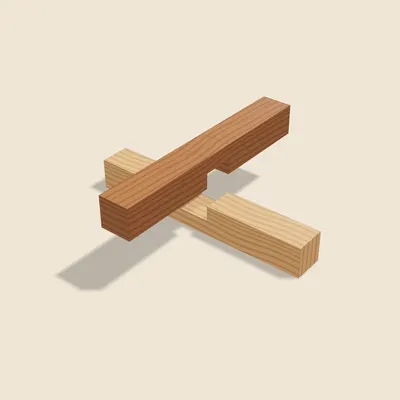
Cross-Halving Joint
shízì chéngTwo members cross, each cut away by half its depth, and drop together flush.
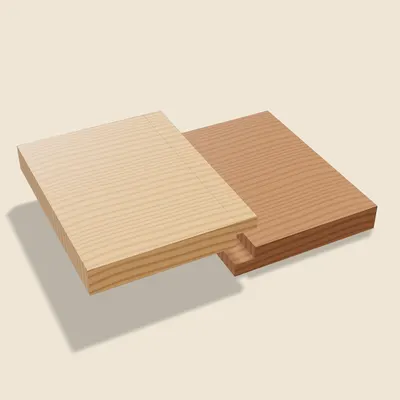
Shiplap Joint
qǐkǒu sǔnEach board edge keeps half its thickness as a lip; the lips overlap, so the seam never opens straight through.
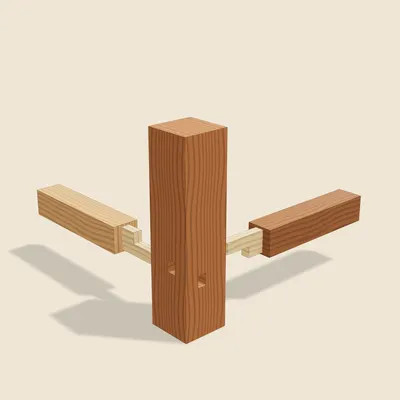
Interlocking Cabinet Stretchers
guìzi dǐchéng hùràngFront and side bottom stretchers meet the leg at the same height: one keeps the lower half of its tenon through, the other the upper half.
Questions
How much is cut away?
The middle bar loses ⅓ top and bottom; the others lose ⅔.
Why tall bars?
To keep enough wood at the crossing.
Where is it used?
Under six-legged washbasin stands.
Further reading
- 王世襄《明式家具研究》(Wang Shixiang, Research on Ming Furniture),第 106 页
- 王世襄《明式家具研究》(Wang Shixiang, Research on Ming Furniture),第 109 页,图 3.21