
Liangzhu Duimao (梁柱對卯): Two Beams Lapped Inside a Column and Pinned
Opposed tenons · 梁柱對卯 · 藕批搭掌 · 蕭眼穿串
When two beams meet at one column from opposite sides, each wants to pull the other out.
The Yingzao Fashi has them overlap inside the column and pins them.
- Chinese
- 梁柱对卯 · liáng zhù duìmǎo
- Joins
- Two beams and a column
- Found in
- Song-dynasty frames
- Signature parts
- Overlapping tenons · through-pin
- Compare
- Through key
How it works
The drawing
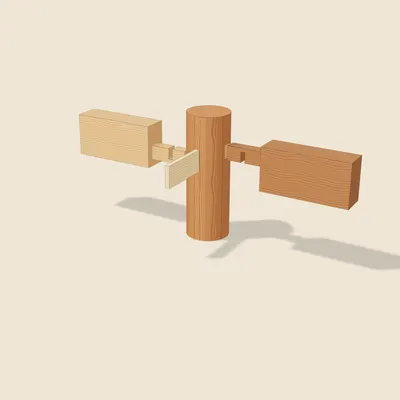
The third drawing on the same juan 30 plate is labelled 梁柱對卯, 藕批搭掌, 蕭眼穿串: opposed tenons; lapped with a slanted (藕批) cut; pierced holes threaded with a bar. It shows a round column with a square hole, two beam ends facing it, each with a square hole in its end, and a long square bar drawn above them.
How it works
Each beam ends in a tenon that reaches into the column, so the two meet inside it (對卯). There they overlap (搭掌), one over the other. A square bar (串) is then threaded through holes (蕭眼) in the column and both tenons, so neither beam can be pulled out without the other.
Inferred reconstruction (推断复原)
This joint is an inferred reconstruction. It is inferred from: the juan 30 drawing and its label. Inferred, not sourced: how deep the tenons reach, the flat lap (the slanted 藕批 cut is simplified), the direction and size of the bar, and all member sizes.
History
The drawing
The third drawing on the same juan 30 plate is labelled 梁柱對卯, 藕批搭掌, 蕭眼穿串: opposed tenons; lapped with a slanted (藕批) cut; pierced holes threaded with a bar. It shows a round column with a square hole, two beam ends facing it, each with a square hole in its end, and a long square bar drawn above them. (Yingzao Fashi juan 三十 (plate scan p. 29)).
Each beam ends in a tenon that reaches into the column, so the two meet inside it (對卯). There they overlap (搭掌), one over the other. A square bar (串) is then threaded through holes (蕭眼) in the column and both tenons, so neither beam can be pulled out without the other.
Inferred reconstruction (推断复原). This joint is an inferred reconstruction. It is inferred from: the juan 30 drawing and its label. Inferred, not sourced: how deep the tenons reach, the flat lap (the slanted 藕批 cut is simplified), the direction and size of the bar, and all member sizes.
Proportions
Inferred reconstruction (推断复原)
This joint is an inferred reconstruction. It is inferred from: the juan 30 drawing and its label. Inferred, not sourced: how deep the tenons reach, the flat lap (the slanted 藕批 cut is simplified), the direction and size of the bar, and all member sizes.
Proportions in the model are illustrative.
Common mistakes
Common mistakes
- Driving one beam through as a single through tenon. The plate shows two opposed tenons that overlap inside the column, then a pin through all three.
- Treating lap length, pin size, and the 藕批 slant as book figures. Juan 30 labels 藕批搭掌 and 蕭眼穿串 but gives no measurements; the model uses a flat lap and inferred sizes.
- Leaving out the through-pin. Without the pin the two beams can still pull apart; the drawing places square eyes on the column and both beam ends for the pin.
- Reading it as a single beam-to-column dovetail. One beam dropped into a slot is liangzhu-gumao; this page is two beams meeting through one column.
Related joints elsewhere
Related forms
Western and Japanese workshops have relatives that share a geometric idea (scarf, bridle, dovetail, halving, keyed splice) under other names; they are bridges for readers, not claims of descent.
Stay with the Chinese construction on this page before renaming a piece. See also Compare two joints when a look-alike is listed there.
How it's made
 Step 1
Joint
Two beams meet in one column.
 Step 2
Apart
Pull the pin, then the beams.
 Step 3
Lower half
One tenon keeps the lower half.
 Step 4
Upper half
The other keeps the upper half.
 Step 5
Lapped
They overlap inside the column.
 Step 6
Pinned
A pin threads column and both laps.
Variations
Dovetail into the column (梁柱鼓卯)
A single beam end dropped into a slot from above.
Qing through-tenon (透榫)
Later beams pass right through the column and are wedged.
Can you CNC this?
Possible, with design or setup changes
Tenons and the pin are straight cuts; the through-slot and pin hole in a round column need a cradle and two setups.
Free STL downloads (one file per part)
- Column 柱 · liangzhu-duimao-column.stl
- Beam with lower-half tenon 梁(下搭掌) · liangzhu-duimao-beam-lower-lap.stl
- Beam with upper-half tenon 梁(上搭掌) · liangzhu-duimao-beam-upper-lap.stl
- Through-pin 穿串 · liangzhu-duimao-through-pin.stl
Before cutting or printing, read the CNC and 3D-printing notes on tool radius, scaling the STL files and their licence.
Related joints
Beam-to-Column Dovetail
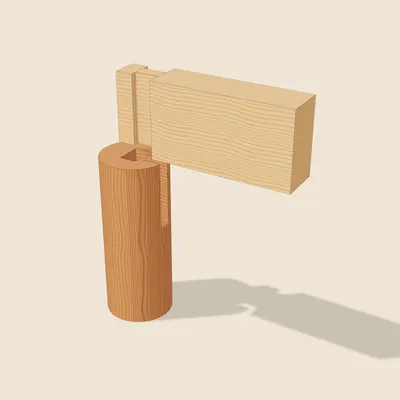
liáng zhù gǔmǎoThe beam end carries a dovetail, narrow at the neck and wide at the head, which drops from above into a slot of the same shape cut down the column top; it cannot be pulled out sideways.
Hidden Dowel
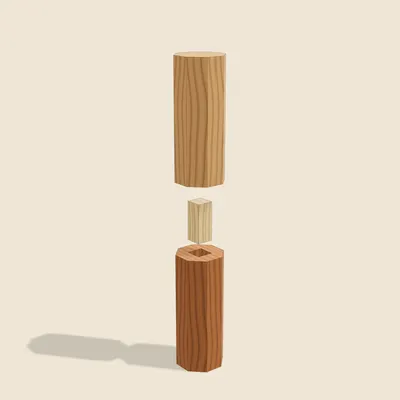
àn xiāoTwo lengths meet end to end and a square pin hidden inside the joint keeps them in line: nothing shows outside.
Sliding Key Through an Apron
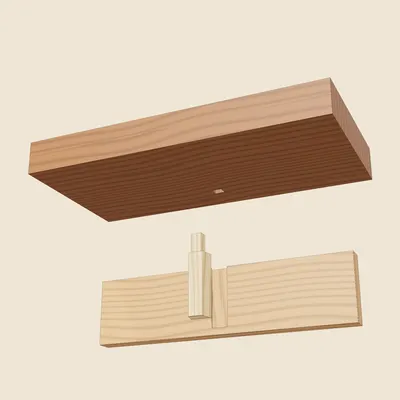
chuān xiāoA long key with a half-dovetail section slides through a groove in the back of an apron, its top tenoned into the frame above, holding the apron flat.
Questions
Why pin the laps?
So each beam holds the other in.
Is the slanted cut shown?
No, the lap is drawn flat.
Are the sizes sourced?
No, all are inferred.