Zaisun Pinban (栽榫拼板): Loose-Tenon Edge Joints
Loose-tenon edge joint · 厚板栽直榫拼合
Thin panels are edge-joined with tongues and grooves. Thick slabs, such as the tops of big tables, are another matter.
One way is to cut mortises in both edges and plant separate straight tenons between them.
- Chinese
- 栽榫拼板 · zāisǔn pīnbǎn
- Also called
- 厚板栽直榫拼合
- Joins
- Thick boards edge to edge
- Found in
- Thick tops and slabs
- Related
- Planted tenon (栽销)
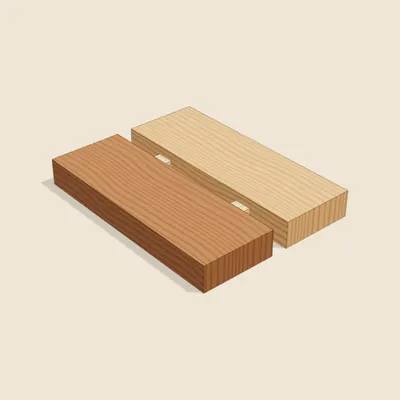
How it works
Mortises in both edges
Matching mortises are cut into the edges of both boards.
Planted tenons
Separate straight tenons are made and planted (栽) into the mortises of one board, then the other board is closed up onto them. Wang Shixiang’s drawings of joints include thick boards joined this way.
Why
The tenons keep the boards flush and in line along the seam. The same planted pieces are used between panel boards and between thick aprons and frames.
How it's made
 Step 1
Two boards
Lay two thick boards side by side.
 Step 2
Mortises
Cut mortises in one edge.
 Step 3
Matching mortises
Cut matching mortises in the other.
 Step 4
Straight tenons
Make separate straight tenons.
 Step 5
Plant and close
Plant the tenons and close the boards.
 Step 6
Flush
A flush, wide surface.
Variations
Sliding keys
Dovetailed sliding keys (走马销) can also join boards and come apart again.
Can you CNC this?
Yes, with small changes
Edge mortises in long boards need the board on edge or a horizontal setup; a domino-style handheld joiner may be easier than a 3-axis router. The loose tenons are simple strips with rounded edges.
General note: a round cutter cannot leave a sharp inside corner, so every recess keeps the tool radius. Round the mating edges or add dogbone reliefs. Sloping faces, undercuts and curves may need special bits, extra setups or more axes.
Free STL downloads (one file per part)
- Board A 厚板 A · zaisun-pinban-board-a.stl
- Loose tenons (2) 栽榫(2 枚) · zaisun-pinban-loose-tenons.stl
- Board B 厚板 B · zaisun-pinban-board-b.stl
Proportions are illustrative, not measured dimensions. The files are unitless: scale them to suit and check fits and allowances before cutting. Each file is a closed (watertight) solid with its mortises and slots already cut, exported in its assembled position, ready to import into CAM or modelling software. Licence: CC BY 4.0 (credit: Chinese Joinery).
Related joints
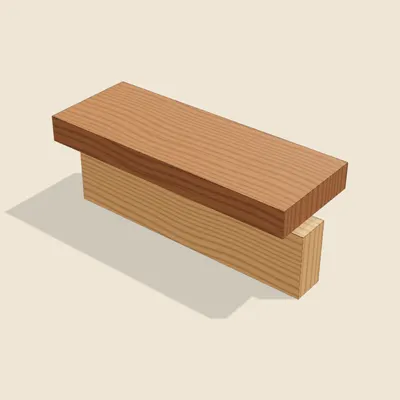
Loose Tenon
zāi xiāoThe tenon is a separate piece of wood planted into mortises in both parts, easy to replace if it wears.
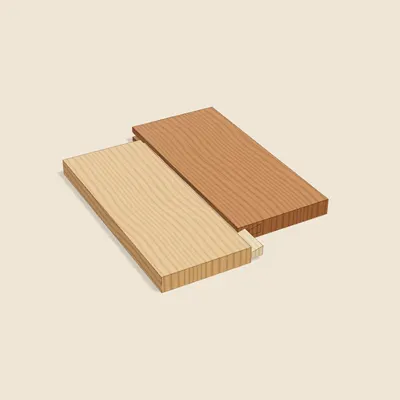
Longfeng Board Joint
lóngfèng sǔnA half-dovetail tongue on one board slides into a matching groove in the next, so the seam can neither step nor pull apart.
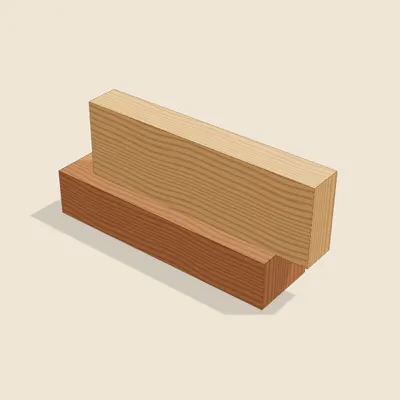
Sliding Locking Key
zǒumǎ xiāoA dovetailed key planted in one part drops into the wide end of a slot and slides to the narrow end to lock.
Questions
What is zaisun pinban?
Edge-joining thick boards with separate straight tenons in both edges.
Why not a tongue and groove?
For thick slabs, planted tenons keep the seam flush.
Is it glued?
The sources describe the tenons, not the glue; practice varies.