Yanwei Sun (燕尾榫): The Chinese Dovetail
Yanwei sun · Swallow-tail joint
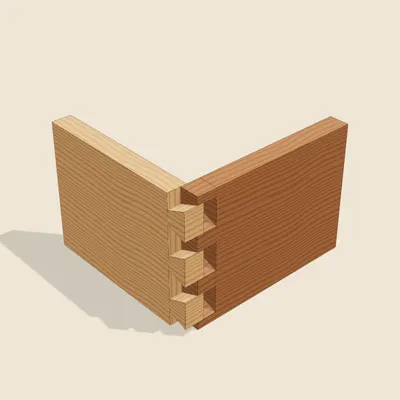
The Chinese name says it all: yanwei sun, the swallow-tail joint. A tenon flares like a swallow’s tail, wider at the tip than at the root, so once it is in, it can’t be pulled straight out.
Dovetails go back to the Neolithic site at Hemudu, and in China they turn up in every scale of woodwork, from a scholar’s document box to the beams of a palace hall.
- Chinese
- 燕尾榫 · yànwěi sǔn
- Joins
- Boards at a corner; beams to columns
- Found in
- Boxes, drawers, low tables, buildings
- Signature parts
- Flared tails · matching pins
- Forms
- Through · half-blind · fully hidden (闷榫)
How it works
Why the flare works
A tail is wider at its end than at its root. Pull along the board and the narrow root jams against the pins, so the joint holds against exactly the force that would pull a plain box corner apart. It goes together only one way.
Showing and hidden
Wang Shixiang describes three grades on drawer corners: the through joint, showing on both faces, which he found only on rough pieces; the half-blind dovetail, showing on one face; and the fully hidden joint (闷榫), where the corner closes to a single seam. Thick-board kang tables and even very thin drawer sides were made with the hidden version.
In buildings
Timber-frame buildings use dovetails to drop beam ends into the tops of columns, with or without a sleeve shoulder.
How it's made
 Step 1
Mark the tails
Lay out the tails on the end of the first board, wide at the end and narrow at the root.
 Step 2
Cut the tails
Saw and chop away the waste between the tails.
 Step 3
Cut the pins
Mark the second board from the tails and cut the pins to match.
 Step 4
Half pins at the edges
The outer pins are half pins.
 Step 5
Assemble
Slide the tail board in. It goes together in one direction only.
 Step 6
Check
Pulling along the board can’t open the joint.
Variations
Through dovetail
Shows on both faces.
Half-blind dovetail
Shows on one face only; used for drawer fronts and sides.
Fully hidden (闷榫)
Mitred outside so only one seam shows; used on fine boxes, kang tables and small drawers.
Butterfly key
A double dovetail key (银锭榫) across a board seam.
Can you CNC this?
Possible, with design or setup changes
Where the flare lies in the face of the board, the tails can be cut from above with a straight cutter, with rounded inside corners at the baseline. The pins, whose flare runs into the end grain, may need the board upright or a dovetail bit. Open dovetails on boxes are commonly cut this way; check the fit on test pieces.
General note: a round cutter cannot leave a sharp inside corner, so every recess keeps the tool radius. Round the mating edges or add dogbone reliefs. Sloping faces, undercuts and curves may need special bits, extra setups or more axes.
Free STL downloads (one file per part)
- Pin board 榫眼板 · yanwei-sun-pin-board.stl
- Tail board 燕尾板 · yanwei-sun-tail-board.stl
Proportions are illustrative, not measured dimensions. The files are unitless: scale them to suit and check fits and allowances before cutting. Each file is a closed (watertight) solid with its mortises and slots already cut, exported in its assembled position, ready to import into CAM or modelling software. Licence: CC BY 4.0 (credit: Chinese Joinery).
In museum collections
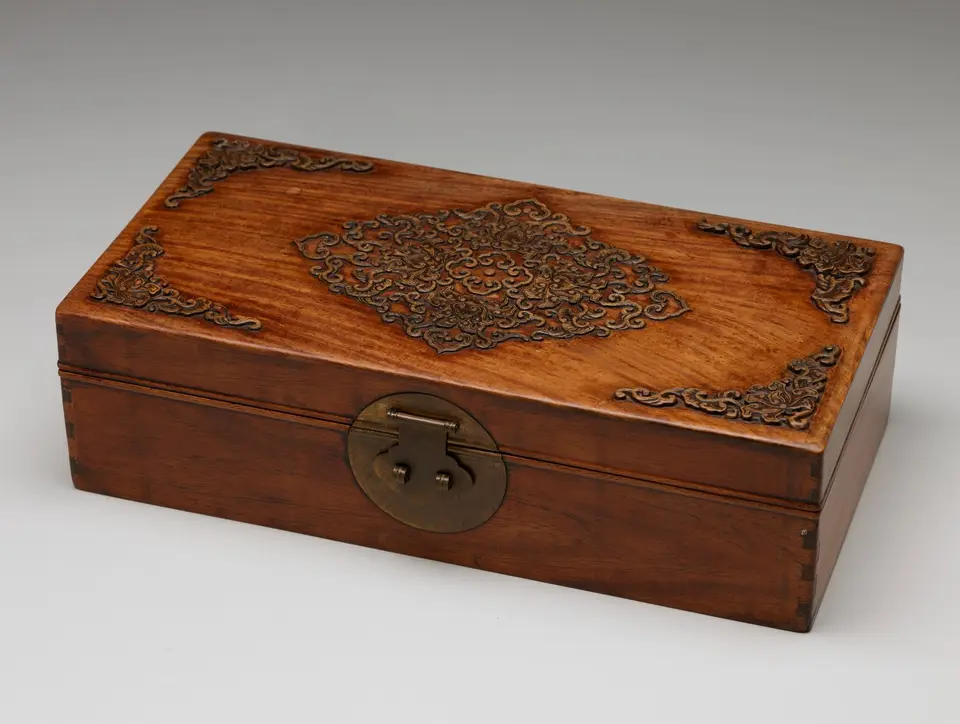
Minneapolis Institute of Art
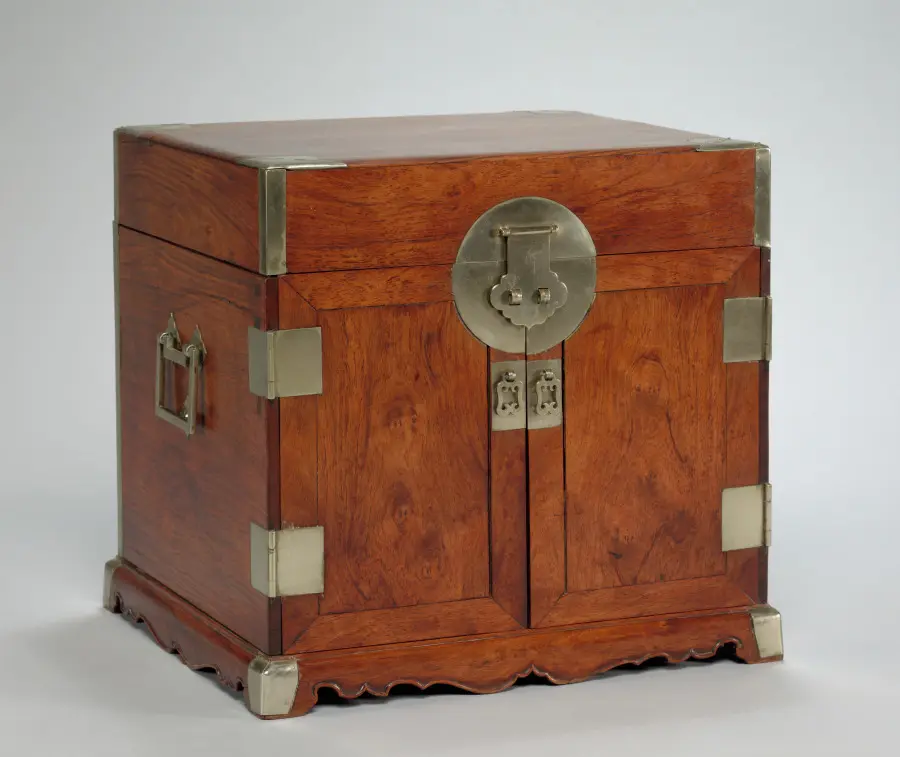
Cleveland Museum of Art
Related joints
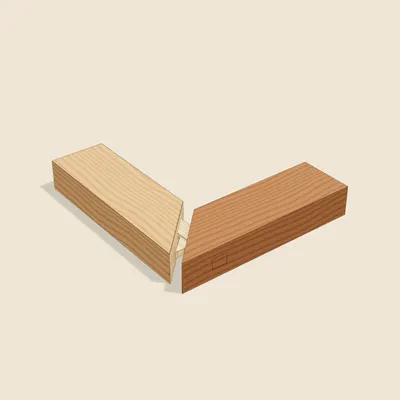
Mitred Frame Joint
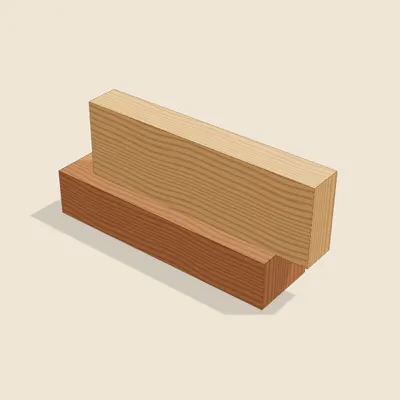
géjiǎo sǔnThe 45° corner of every Chinese frame-and-panel top: a tenon through the end plus a little triangular tongue.
Sliding Locking Key
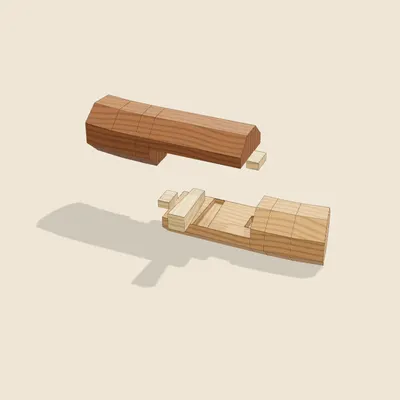
zǒumǎ xiāoA dovetailed key planted in one part drops into the wide end of a slot and slides to the narrow end to lock.
Wedged Scarf Joint
xiēdīng sǔnCurved pieces lapped with hooked tips and locked by a tapered key through the middle: how a horseshoe chair arm is built.
Questions
What is a yanwei joint?
The Chinese name for the dovetail: a tenon wider at its end than at its root, so it can’t be pulled out along the board.
Did Chinese furniture use visible dovetails?
Mostly not on fine pieces. Wang Shixiang found through dovetails only on rough work; better pieces used half-blind or fully hidden versions.
Are dovetails used in Chinese buildings?
Yes. Beam ends are dovetailed and dropped into the tops of columns.