Jiatou Sun (夹头榫): The Bridle Joint of Ming Tables
Jiatou sun · Clamping-head joint
The long, quiet tables of Ming China, painting tables and altar tables, stand on legs set in from the ends. Where each leg meets the top, it rises past a long apron and a pair of shaped spandrel heads.
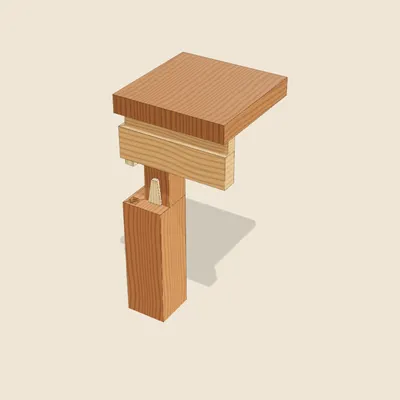
Inside that junction is the jiatou sun, the elongated bridle joint. The leg is slotted at the top and literally clamps the apron, so the whole underframe becomes one rigid ring.
- Chinese
- 夹头榫 · jiātóu sǔn
- Joins
- Leg, apron, spandrel heads and top
- Found in
- Recessed-leg tables: painting, altar and side tables
- Signature parts
- Slotted leg top · apron · spandrel heads (牙头)
- Look
- The leg stands proud of the apron
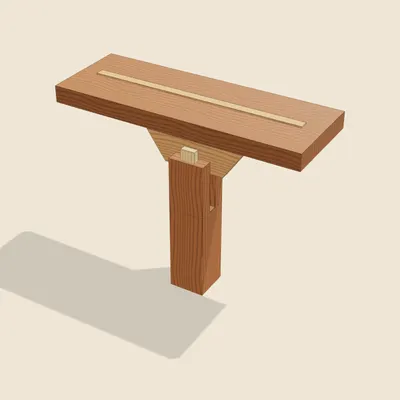
How it works
Borrowed from buildings
Wang Shixiang traced the joint to the Northern Song, when furniture makers borrowed from timber-frame buildings, where a column top is slotted to clamp a bracket. On tables the clamped pieces became one long apron, and spandrel heads were added beneath.
The slot
The top of the leg is sawn open. In the standard form the slot is long enough to clamp both the apron and the spandrel heads. The leg then tenons into the underside of the top.
Why it works
The apron gives the leg a much bigger grip on the top, so the angle between leg and top can’t easily change, and the weight of the top is spread evenly to all four legs.
How it's made
 Step 1
Slot the leg
Saw an open slot down the top of the leg, deep enough for the apron and the spandrel heads.
 Step 2
Tenon the leg top
Leave tenons on the leg top to go into the table top.
 Step 3
Shape the spandrel heads
Cut the spandrel heads to fit in the slot below the apron.
 Step 4
Drop in apron and spandrels
Lower the spandrel heads and the apron into the slot.
 Step 5
Set the top on
Fit the top over the leg tenons.
 Step 6
Check the look
The leg stands proud of the apron and spandrels on the outside.
Variations
Slot clamps the apron only
The spandrel heads are thin upright pieces set into grooves on either side of the leg.
Grooved, not slotted
The leg is only grooved and the apron is in sections. Wang called this showy but weak; it spread after the mid-Qing.
Can you CNC this?
Possible, with design or setup changes
The slot in the leg top and the tenon into the top are straightforward if the leg can be clamped upright or cut from the sides. The spandrel’s outline is a 2D profile; any carving on it is a separate 3D job.
General note: a round cutter cannot leave a sharp inside corner, so every recess keeps the tool radius. Round the mating edges or add dogbone reliefs. Sloping faces, undercuts and curves may need special bits, extra setups or more axes.
Free STL downloads (one file per part)
- Leg 腿足 · jiatou-sun-leg.stl
- Spandrel 牙头 · jiatou-sun-spandrel.stl
- Apron 牙条 · jiatou-sun-apron.stl
- Top 桌面 · jiatou-sun-top.stl
Proportions are illustrative, not measured dimensions. The files are unitless: scale them to suit and check fits and allowances before cutting. Each file is a closed (watertight) solid with its mortises and slots already cut, exported in its assembled position, ready to import into CAM or modelling software. Licence: CC BY 4.0 (credit: Chinese Joinery).
In museum collections
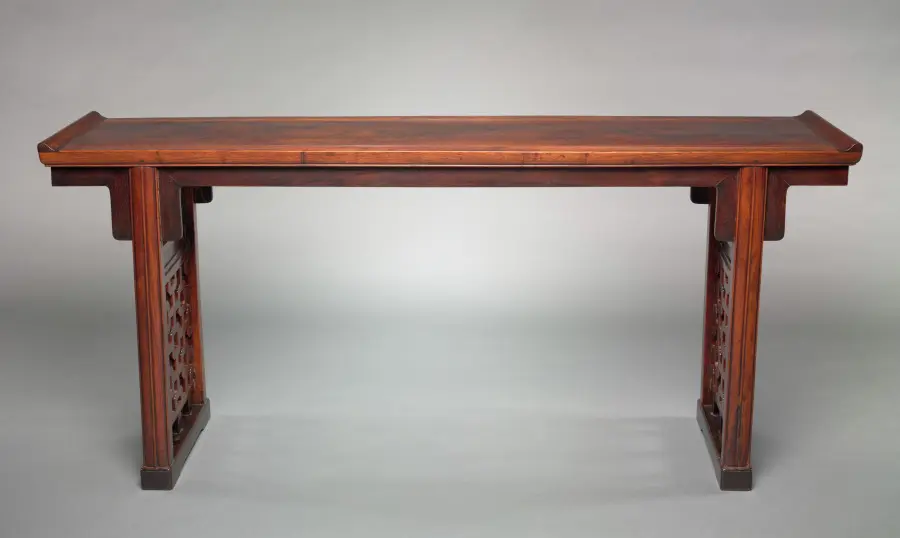
Cleveland Museum of Art

Cleveland Museum of Art
Related joints
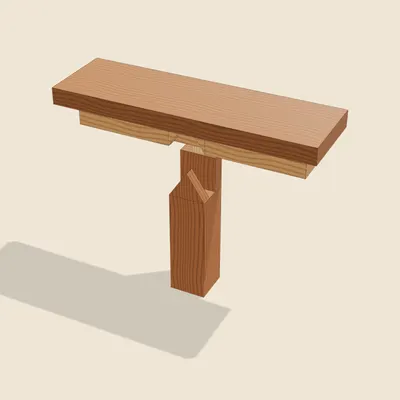
Inserted-Shoulder Joint
chājiān sǔnThe leg is cut to a pointed shoulder that the grooved apron straddles, finishing flush; the heavier the top, the tighter it grips.
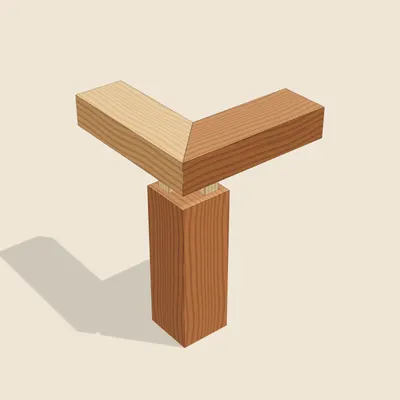
Long-and-Short Tenons
chángduǎn sǔnTwo tenons at right angles on the top of a leg: a long one for the long side, a short one for the end.
Baojian Joint
bàojiān sǔnThe hidden lock behind every waisted Ming table corner: a mitred shoulder, a triangular tenon and a tapered pin.
Questions
What is a jiatou joint?
The leg-to-top joint of Chinese recessed-leg tables: the leg top is slotted to clamp the apron and spandrel heads, and tenons into the top.
How is it different from the chajian joint?
In a jiatou joint the leg stands proud of the apron. In the chajian joint the leg is cut to a V shoulder and finishes flush with it.
Where does it come from?
Wang Shixiang traced it to Northern Song builders, who borrowed the slotted column head from timber architecture.