
Pocket hole joint
A pocket hole joint drives a screw through an angled pocket in one piece into the mating piece. It holds by the screw, and by glue if the meeting faces are glued. The wood itself does not interlock.
How a pocket hole joint works
The pocket is drilled on the hidden face of one member. The screw leaves that pocket at an angle and bites into the face of the next member. What you see on the show face is only the seam.
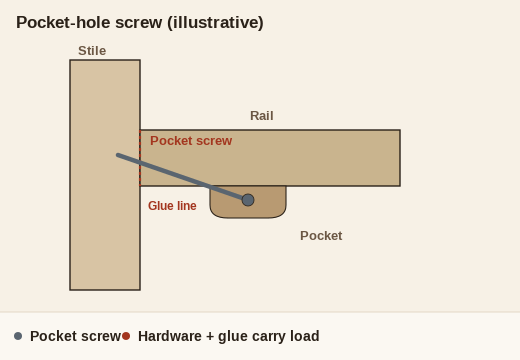
The joint relies on the screw, and on glue on the meeting faces when those faces are glued. It does not lock by a wedge, a flare or a shoulder.
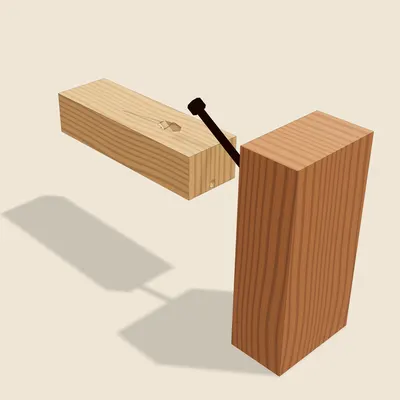
How strong is it?
The joint holds by the screw in the second piece and, if the faces are glued, by the glue on those faces. It is a poor choice where the pocket would show, or where the joint has to lock by its shape and come apart again without a screw.
How to make one
Clamp, drill the pocket on the hidden face, drive the screw, and glue the seam only if you want that glue line as well.
- Clamp the parts. Hold the end of one piece against the face it joins, square and tight.
- Drill the pocket on the hidden face. The pocket is an angled hole that starts on a face that will not show and aims into the mating piece. The screw has to land in that second piece, not stop in the first.
- Drive the screw. Drive the screw through the pocket into the mating piece.
- Glue the meeting faces if you want a glue line. Glue is optional. It does not change the fact that the joint is a screw, not a shaped lock.
When to use it
Pocket holes suit cabinets and face frames that can hide the pocket and that will stay screwed. For a joint that locks by shape, use a mortise and tenon, a dovetail or a half-lap. For an edge that is only glued, a biscuit or a dowel is a different way to keep the parts aligned.
The twelve Western joints, and every within-study result, are on types of wood joints. Related joints: butt, dowel, biscuit.