Potou Xie (破头楔): Wedging a Through Tenon
Split-head wedge · 破头榫 · wedged through tenon
On the underside of an old table top, the ends of through tenons sometimes show a thin sliver of a different wood across them.
That sliver is a potou xie, a “split-head wedge”, and it is what keeps the corner from ever working loose.
- Chinese
- 破头楔 · pòtóu xiē
- Also called
- 破头榫
- Joins
- Through tenon in its mortise
- Found in
- Corners of frame tops, chair seats and bed frames
- Compare
- Wedge beside the tenon (挤楔)
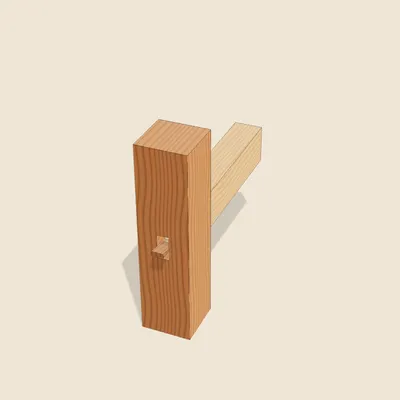
How it works
A kerf in the tenon
A saw cut is made into the end of a through tenon, near its outer side. It can also be cut with a chisel just before the wedge goes in.
Wedge after assembly
Once the tenon is through the mortise, a wedge is driven into the kerf. The tenon end grows and locks in the mortise.
Where
It is common on the through tenons at the four corners of frame-and-panel table tops, chair seats and bed frames.
The blind version
Used inside a blind mortise, the wedge spreads the tenon where it can never be reached again. It goes in easily and never comes out, so it cannot be repaired; craftsmen call it a “no-return job”.
How it's made
 Step 1
Through tenon
Cut a tenon that passes right through.
 Step 2
Kerf
Saw a kerf into its end near the outer side.
 Step 3
Drive it in
Drive the tenon through the mortise.
 Step 4
Wedge
Drive a wedge into the kerf.
 Step 5
Spread
The tenon end spreads and locks.
 Step 6
Where
Frame-top, seat and bed-frame corners.
Variations
Blind (半榫破头楔)
The wedge sits inside a blind mortise and spreads the tenon as it bottoms out; it cannot be taken apart.
Can you CNC this?
Yes, with small changes
The through mortise and tenon are ordinary 3-axis work with rounded corners. The kerf is a thin saw cut and is easier on a saw than with a small cutter. The wedge is a simple tapered strip.
General note: a round cutter cannot leave a sharp inside corner, so every recess keeps the tool radius. Round the mating edges or add dogbone reliefs. Sloping faces, undercuts and curves may need special bits, extra setups or more axes.
Free STL downloads (one file per part)
Proportions are illustrative, not measured dimensions. The files are unitless: scale them to suit and check fits and allowances before cutting. Each file is a closed (watertight) solid with its mortises and slots already cut, exported in its assembled position, ready to import into CAM or modelling software. Licence: CC BY 4.0 (credit: Chinese Joinery).
Related joints
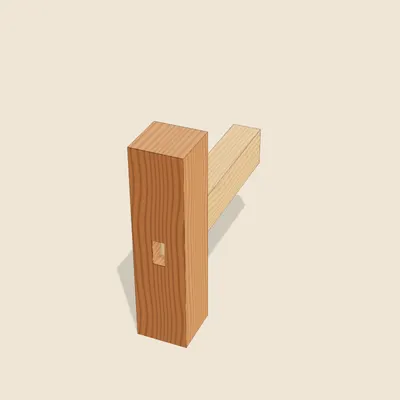
Through Tenon
tòu sǔnThe tenon runs right through and its end grain shows on the far side: strong, but less neat than a blind tenon.
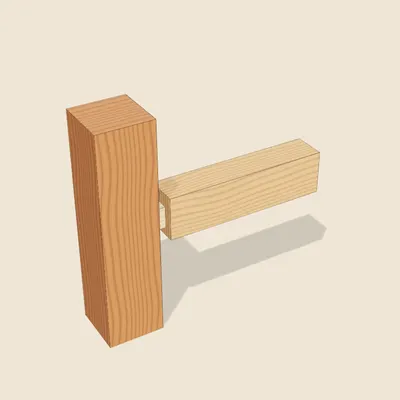
Tightening Wedge
jǐ xiēThe tenon is made slightly smaller than the mortise, and a thin tapered wedge is driven into the gap to squeeze the joint tight.
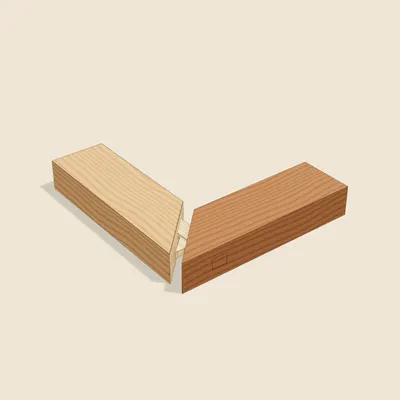
Mitred Frame Joint
géjiǎo sǔnThe 45° corner of every Chinese frame-and-panel top: a tenon through the end plus a little triangular tongue.
Questions
What is a potou xie?
A wedge driven into a kerf in a through tenon end to spread and lock it.
Where is it used?
Through tenons at the corners of frame tops, chair seats and bed frames.
Can it be taken apart?
The through version can be knocked out with care; the blind version cannot.