
Burr puzzle: how it works, types and a 3D solver
A burr puzzle is an interlocking puzzle of notched sticks that fit together into one three-dimensional knot. “Burr” is the general Western name; in China the same puzzles are called Luban locks (鲁班锁). The best known is the six-piece burr, also sold as the Puzzle Knot or Chinese Cross. Step the six-piece model below apart, then read how burrs are classified and where the bigger families go.
Take a six-piece burr apart
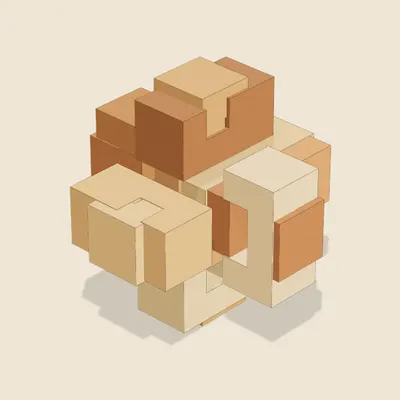
Six square sticks, two along each axis, meet in the middle. All the notches lie inside the crossing, so the outside shows only plain wood. In this set the key, the last stick in, has no notches at all and slides straight out; once it is gone the rest come apart in order. Use Back and Next to step through and drag to rotate. The six-step assembly with stills and free STL files is on the six-piece Luban lock page.
Assembled: six notched sticks, two along each axis, locking each other.
How a burr puzzle works
Every stick of a six-piece burr is a square bar at least three times as long as it is wide. Its notches can be described as small cubes removed from the middle of the bar, each with an edge half the stick’s width, and there are twelve such cubes per stick. Of the 4,096 ways to remove them, 837 give usable pieces once sticks that fall in two and duplicates are discarded. Bill Cutler’s computer analysis showed that these pieces combine into billions of assemblies, only a fraction of which can actually be put together and taken apart.
Burrs are grouped by what is inside. A solid burr has no empty space when assembled and opens with a single move, usually by sliding out a key. A holey burr has internal voids, and the number of moves needed to free the first piece is its level. Stewart Coffin found a level-3 design in 1979 and Cutler a level-5 one in 1985. Cutler’s complete analysis of notchable pieces, those whose notches can be cut with a saw, found that 5 is the highest level such a burr can reach with a unique solution.
Types of burr puzzles
| Family | Pieces | How it comes apart |
|---|---|---|
| Six-piece burr (Chinese cross) | 6 | A key slides out (solid), or several moves first (holey) |
| Three-piece burr | 3 | Needs special notches, such as a rounded piece that turns; square-notched sticks cannot assemble |
| Altekruse | 12 (also 6, 24, 36…) | Two halves slide in opposite directions; patented in 1890 |
| Chuck | U-shaped sticks of several lengths | Key pieces with an extra notch; patented by Edward Nelson in 1897 |
| Pagoda (Japanese crystal) | 9, 19, 33, 51… | An extension of the three-piece burr without special notches |
| Diagonal burr (“star”) | Varies | V-shaped notches at 45°, edges bevelled into a star |
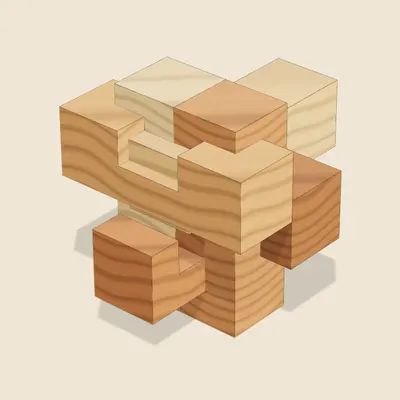
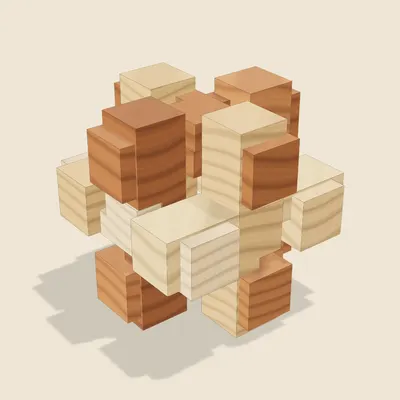
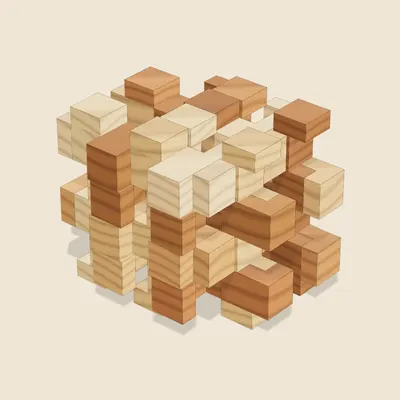
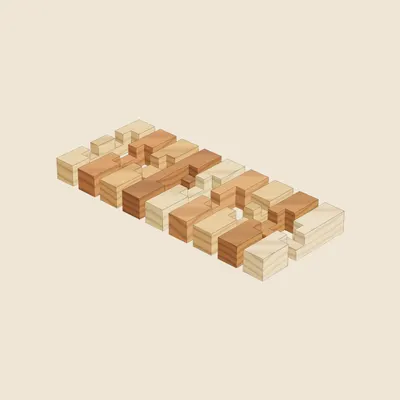
Chinese folk names usually count the sticks or describe the shape. The models below are the ones with a 3D take-apart and free STL:
-
-
-
-
-
Where burr puzzles come from
Nobody knows who invented them. The earliest known picture of a six-piece burr is in an engraving of 1698 by Sébastien Leclerc; German toy catalogues offered burrs from the late eighteenth century. In China the puzzles are attributed to the master carpenter Lu Ban, and a six-piece burr appears in Tang Yunzhou’s book of magic tricks of 1889. In Kerala they are called edakoodam. The word “burr” is in print in Edwin Wyatt’s Puzzles in Wood (1928), already as a familiar term, after the prickly seed head the assembled puzzle resembles.
For decades the six-piece burr was a stale novelty, nearly always opened by an easy key. Collectors and designers returned to it in the late 1970s, largely after Martin Gardner described Cutler’s analysis in his Scientific American column.
Burr puzzle or Luban lock?
They are the same puzzles under two naming traditions. Western collectors classify burrs by piece shape and level and identify six-piece pieces by number: the Chinese cross set in the model above is {1, 256, 824, 928, 975, 1024} in Jürg von Känel’s numbering. Chinese folk names count the sticks (六柱, six; 九柱, nine; 十二柱, twelve) or describe the shape (菠萝, “pineapple”). The Luban lock guide has the Chinese names, the six-step solution and every printable model; Rob Stegmann’s and Ishino Keiichiro’s catalogues cover the wider burr world.
Burrs and real joinery
A burr is a puzzle, not a furniture joint, but it works on the same principle as joinery: shaped wood locking shaped wood, with one part that has to move first. Its closest structural relatives are crossing joints such as the cross-halving and the three-bar crossing, where bars give up part of their depth to pass through one another. The Western form of that crossing is the half-lap joint. For the joints that hold up tables and roofs, see types of wood joints.