
Pingbanfang Dajiao (平板枋十字刻半搭交): How the Bracket-Set Plates Cross at a Corner
Plate cross-halving · 平板枋十字刻半 · 十字刻半榫
On a building with bracket sets, a flat plate runs along the top of the tie-beams and carries every set.
At the corner the two plates cross and lock, each cut by half.
- Chinese
- 平板枋十字刻半搭交 · píngbǎnfāng
- Joins
- Two plates at a corner; plate to tie-beam
- Found in
- Buildings with bracket sets
- Signature parts
- Half-laps · 1/10 lip · hidden pins
- Compare
- Hidden dowel
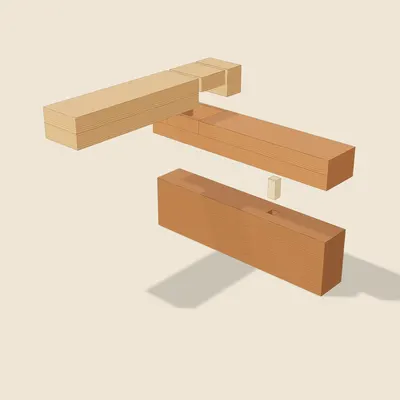
How it works
The plate
The plate (平板枋) sits on the outer tie-beams and carries the bracket sets. Ma Bingjian gives its section as 2 by 3 doukou (the bracket module): 2 high, 3 wide.
Cross-halving
Where the plates meet at a corner, each is cut away by half its height at the crossing. The plate on the front of the building is cut on top, and the plate on the side is cut underneath and laid over it: the side elevation sits on the front. Outside each cut a lip is left, one tenth of the plate’s width deep, so the joint closes neatly on the face.
Pins
Hidden pins join the underside of the plate to the tie-beam, two to four in each bay, and the top is drilled for the pins that hold the cap blocks of the bracket sets.
A rule from the Qing manuals
Where two lengths of plate meet end to end over a column, the Yingzao suanli (營造算例) joins them with a dovetail key (銀錠扣) at each end, half the plate’s own width long, and only a quarter of the width reaches past the column centre line.
Proportions in the model are illustrative.
How it's made
 Step 1
Corner
Two plates cross at the corner.
 Step 2
Front plate
Front plate: top half cut away.
 Step 3
Side plate
Side plate: bottom half cut away.
 Step 4
Lip
A lip of 1/10 the width is left.
 Step 5
Pins
Hidden pins into the tie-beam.
 Step 6
Side over front
The side plate sits on top.
Variations
Polygonal pavilions
On six- or eight-sided buildings the plates cross at the needed angle; alternate members are all cut on top or all cut below.
Can you CNC this?
Yes, with small changes
Both half-laps are straight pockets from one face, and the lips are simply left standing; pin holes are drilled. The plates are long, so the bed size limits it.
Free STL downloads (one file per part)
- Tie-beam 额枋 · pingbanfang-dajiao-tie-beam.stl
- Hidden pin 暗销 · pingbanfang-dajiao-hidden-pin.stl
- Plate, front (cut on top) 檐面平板枋(等口) · pingbanfang-dajiao-plate-front.stl
- Plate, side (cut below) 山面平板枋(盖口) · pingbanfang-dajiao-plate-side.stl
Before cutting or printing, read the CNC and 3D-printing notes on tool radius, scaling the STL files and their licence.
Related joints
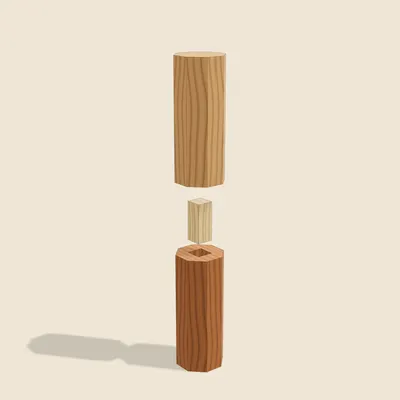
Hidden Dowel
àn xiāoTwo lengths meet end to end and a square pin hidden inside the joint keeps them in line: nothing shows outside.
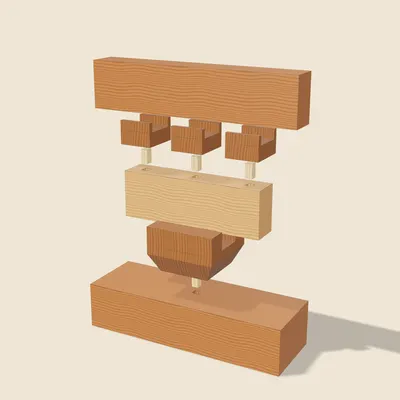
Bracket Set: One Block, Three Small Blocks
dǒugǒngThe simplest bracket set: a cap block on the plate, a bracket arm in its slot, three small blocks on the arm and a beam on top, pinned layer to layer.
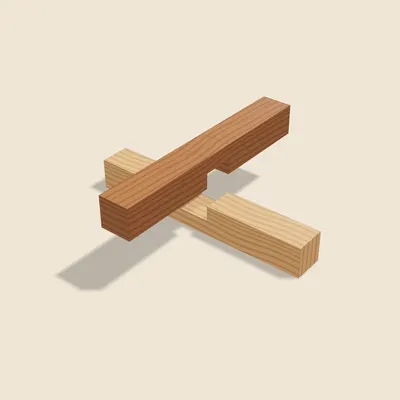
Cross-Halving Joint
shízì chéngTwo members cross, each cut away by half its depth, and drop together flush.
Questions
Which plate goes on top?
The one on the side of the building.
What is the lip for?
It closes the joint on the outside face.
How many pins?
Two to four per bay between plate and tie-beam.
Further reading
- 马炳坚《中国古建筑木作营造技术》第二版(Ma Bingjian, Timber Construction Techniques of Traditional Chinese Buildings, 2nd ed.),第 125 页,图 3-10
- 马炳坚《中国古建筑木作营造技术》第二版(Ma Bingjian, Timber Construction Techniques of Traditional Chinese Buildings, 2nd ed.),第 165–166 页,图 4-27
- 马炳坚《中国古建筑木作营造技术》第二版(Ma Bingjian, Timber Construction Techniques of Traditional Chinese Buildings, 2nd ed.),第 126 页,图 3-11
- 梁思成 編訂《營造算例》(Yingzao suanli):加榫條(NLC 掃描本 PDF 第 45 頁)