
Tongue and groove joint
Usually not. A tongue-and-groove edge is a shaped edge joint, and the USDA Wood Handbook finds that shaped edge joints typically do not produce higher strength than a flat glued edge. The tongue’s job is alignment.
How a tongue and groove works
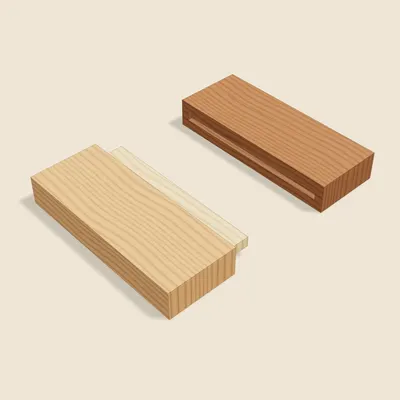
One edge carries a tongue. The other carries a groove that the tongue fills. The boards cannot step out of plane at the seam, which is the point of the shape. The glue is still an edge-grain glue line, the same kind of face a flat edge joint uses.
How strong is it?
The Handbook’s line is the whole result: shaped edge joints such as tongue and groove typically do not produce higher strength than flat edge-grain joints. Their advantage is alignment.
The tongue does not stop the boards moving across the grain as humidity changes. How far a species moves is on its page under wood. For a given width and moisture change, use the wood movement calculator. Hardness of the woods in the USDA Wood Handbook is on the Janka hardness chart.
How to cut one
Match the tongue to the groove, keep the faces flush, and glue the edges.
- Mark the tongue and the groove. The tongue is centered in the thickness and the groove matches it. The faces should land flush when the tongue is home.
- Cut the groove. Plow the groove along the edge, stopping at the same depth on the whole length.
- Cut the tongue. Saw or plane the waste off both faces of the mating edge until the tongue fits the groove without forcing the faces out of line.
- Glue the edges. Glue the meeting edges. The tongue keeps the faces aligned while the glue sets. It is not a substitute for a sound edge-glue line.
When to use it
Use it when the seam must stay flush: flooring, panel edges, back boards. If you only need glue strength, a flat edge joint is the Handbook’s baseline, and this shape does not beat it. A biscuit or a dowel is another way to keep edges in line.
The twelve Western joints, and every within-study result, are on types of wood joints. Related joints: butt, biscuit, dowel.