
Scarf joint
Among scarf slopes, a glued scarf of 1 in 12 or flatter gives the highest strength in the USDA Wood Handbook. A well-made scarf can reach up to 90% of the tensile strength of clear wood.
How a scarf joint works
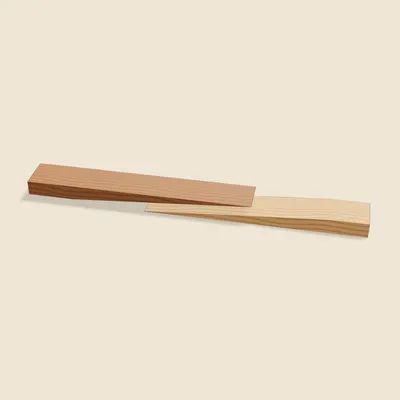
Two ends are cut on a long slope and glued face to face, so the splice can take tension along the board. Wood is much stronger in tension along the grain than in shear, which is why the glue face has to be large: the Handbook says at least 10 times the cross section.
How strong is it?
Slopes of 1 in 12 or flatter give the highest strength. A well-made scarf, finger or lap end joint can have up to 90% of the tensile strength of clear wood. Those sentences are about end joints, not a ranking of every joint in a chair. In plywood, a slope of 1 in 8 is typical for structural scarf and finger joints, which is a different product.
| Study | What was tested | Result in that study |
|---|---|---|
| USDA Wood Handbook (FPL-GTR-282, 2021), pp. 10-16 and 10-17 | Bonded joints: edge-grain, end-to-end, and end-to-edge. | Shaped edge joints such as tongue and groove typically do not produce higher strength than a flat glued edge; their advantage is alignment. End-grain butt joints are practically impossible to make strong enough for ordinary service; with special techniques they reach about 25% of the tensile strength parallel to the grain. A scarf or finger end joint needs a bonding area at least 10 times the cross section, and slopes of 1 in 12 or flatter give the highest strength. A well-made scarf, finger or lap end joint can have up to 90% of the tensile strength of clear wood. In plywood, a slope of 1 in 8 is typical for structural scarf and finger joints. Dowels, mortise and tenons, and rabbets are examples of end-to-edge joints made strong (Fig. 10-8). |
Each row is one study. Different woods, glues, shapes and loads mean the rows are not one ranking.
How to lay one out
Make the sloping face 12 times the thickness, or longer, and glue the whole face.
- Set the slope at 1 in 12 or flatter. The length of the sloping face is 12 times the thickness, or longer. A steeper face is not the Handbook’s highest-strength case.
- Mark both pieces as complements. The two slopes must meet on the whole face. A gap in the middle leaves the joint on the tips only.
- Saw and plane the face. Saw shy of the line and plane to it. The face should be flat, because that face is the glue line.
- Glue the long face. The bonding area of a scarf or finger end joint needs to be at least 10 times the cross section. The long slope is how a scarf gets there.
When to use it
Use a scarf to lengthen a board or a timber when the splice has to carry tension. A short slope wastes the idea. A half-lap end joint is the other end-to-end overlap; a box joint is the corner form of fingers, not this splice.
The twelve Western joints, and every within-study result, are on types of wood joints. Related joints: half-lap, butt, box joint.