
Low-back armchair (rose chair)
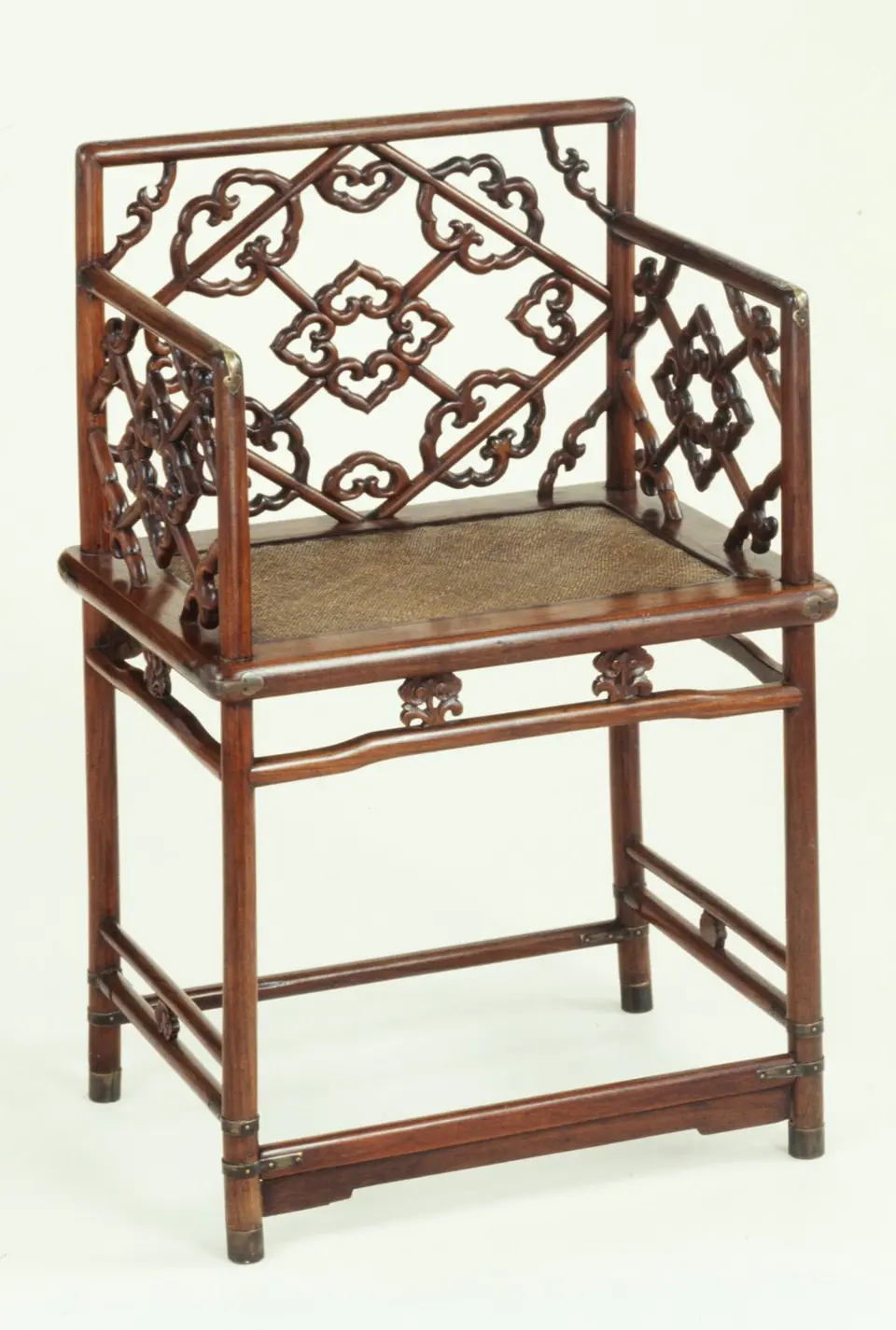
The Minneapolis Institute of Art calls this petite huanghuali low-back armchair a rose chair (玫瑰椅): lattice of ruyi heads and cloud scrolls fills the back and arms, carved lingzhi struts stand between the stretchers and the seat rails, and original metal mounts reinforce several delicate joints. Here is how chairs of this kind are usually joined, from the seat up.
1Seat frame
A mitred frame that either holds a floating panel or carries a woven soft seat laced through holes along its inner edge, over battens that bow slightly downward. Typical practice (Wang Shixiang p.110).
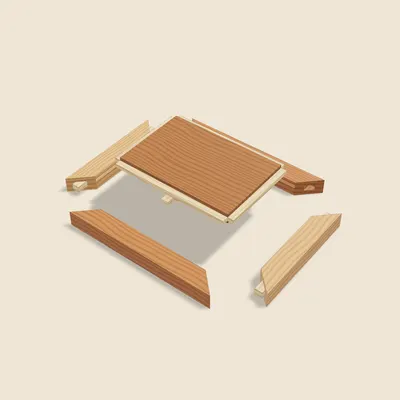
Frame and Floating Panel
cuánbiān dǎcáo zhuāngbǎnA mitred frame grooved on the inside, a thin panel with a tongued edge floating in the groove, and battens underneath.
Explore the joint →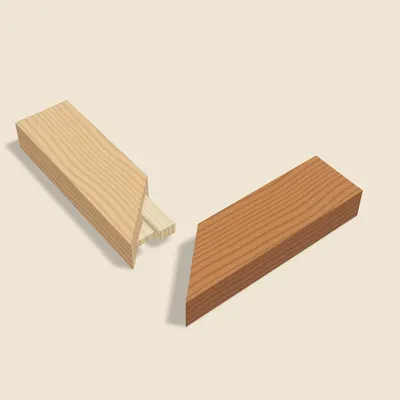
Mitred Frame Joint
géjiǎo sǔnThe 45° corner of every Chinese frame-and-panel top: a tenon through the end plus a little triangular tongue.
Explore the joint →2Legs through the seat
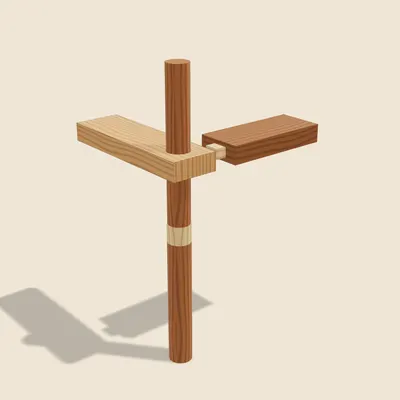
In an ordinary armchair the seat frame is bored at its four corners and the front and back legs pass through, so each upright runs on above the seat as a back or arm post. Typical practice (Wang Shixiang p.117).
3Back and arm corners
Where the top rail and arms of chairs such as rose chairs turn down into the posts, the corner is a concealed tenon joint: outside only a 45° mitre shows, or the rail end bends down over a tenon on the post (the “pipe-bowl” corner). Typical practice (Wang Shixiang pp.105–106).
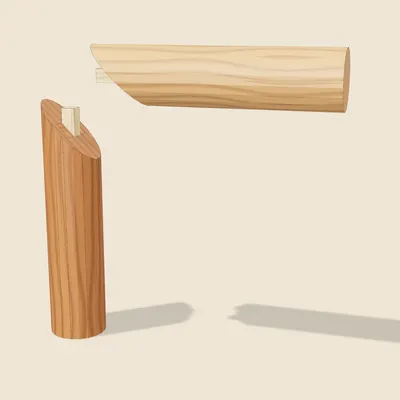
Hidden Corner in Round Stock
yuáncái mènsǔnTwo round members meet in a 45° mitre; the tenons are not exposed. Methods include a single tenon on each end, a single ingot tenon on one end, or a double ingot tenon on one end.
Explore the joint →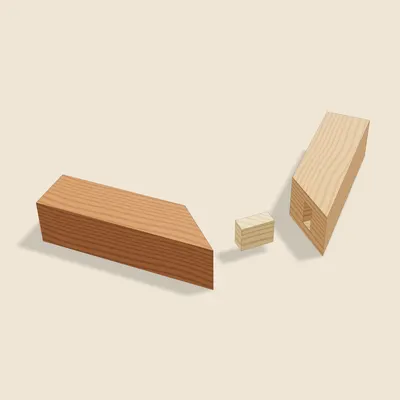
Hidden Mitre With a Loose Block
fāngcái mènsǔn jiǎo jiēhéBoth members are cut to 45°, a socket is cut in each mitre face, and a rectangular block is glued into both: only a mitre line shows.
Explore the joint →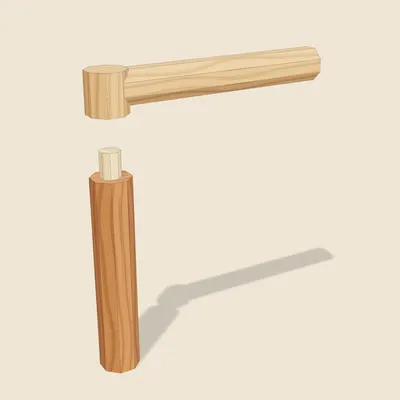
Pipe-Bowl Joint
wā yāndàiguō sǔnThe crest-rail or arm end is turned down, a rectangular or square mortise is cut in it, and it meets the tenon at the top of the leg.
Explore the joint →4Stretchers
Chairs usually have four stretchers: the front one sits low as a footrest and the others at different heights, so the mortises do not meet at one spot; fine chairs mitre the shoulders on all four faces. Typical practice (Wang Shixiang p.105).
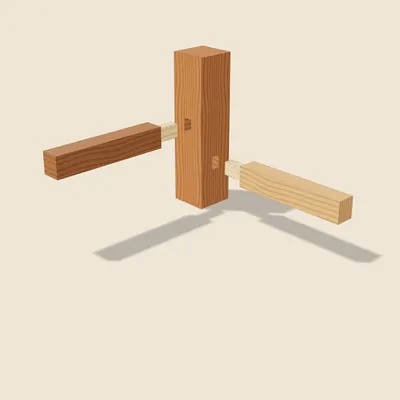
Staggered Stretchers
gǎn chéngStretchers from the front and side meet a leg at different heights, so their mortises never weaken it at one spot.
Explore the joint →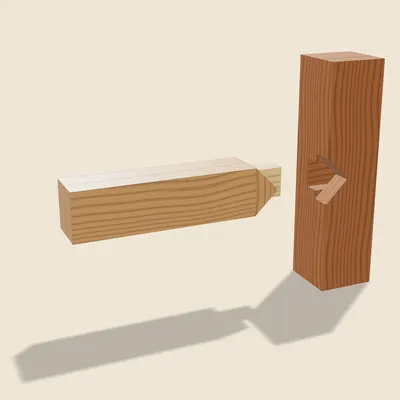
Mitred-Shoulder Joint
géjiān sǔnWhere a rail meets a post, its outer face is cut to a point that fits a matching notch, so mouldings meet cleanly.
Explore the joint →5Short struts
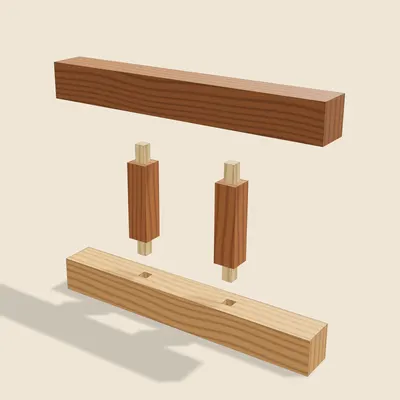
The museum notes carved lingzhi struts between the stretchers and the seat rails. On waistless pieces such struts usually meet the stretcher with a mitred-shoulder tenon and the frame above with a plain butt shoulder. Typical practice (Wang Shixiang p.114).
References
- Minneapolis Institute of Art, Low-Back Armchair 95.32.1 (Public Domain)
- 王世襄《明式家具研究》(Wang Shixiang, Research on Ming Furniture),第 105–106 页;图 3.14a、3.14b、3.16a–c 见第 107 页
- 王世襄《明式家具研究》(Wang Shixiang, Research on Ming Furniture),第 110 页;第 114 页;第 117 页;图 3.38a 见第 116 页
The object in the museum
- Title
- Low-Back Armchair
- Date
- 18th century
- Material
- Huanghuali hardwood
- Dimensions
- 31 5/16 × 20 5/16 × 15 3/16 in. · 79.54 × 51.6 × 38.58 cm (converted from inches)
- Collection
- Minneapolis Institute of Art · 95.32.1
The museum notes that although both men and women used the form, the so-called rose chair—small and evocatively named—has traditionally been linked with women and the women’s quarters, and that this petite armchair in slender huanghuali members reads as delicate. The lattice in the back and arms is made of addorsed, linked ruyi heads and cloud scrolls; carved lingzhi fungi form the struts between the stretchers and the seat rails; and the metal mounts that reinforce several of the delicate joints are original.
More furniture
Waisted square table →Waisted stool →High-waisted table →One-leg-three-aprons table →Waistless square table →Luohan bed (couch-bed) →Square-corner cabinet →Roundback armchair →Waisted kang table →Recessed-leg table →Everted-end altar table →Corner-leg painting table →Compound wardrobe →Small chest with drawers →Yokeback armchair (official’s hat chair) →Folding stool (jiaowu) →Incense stand →Daybed →Barrel-form stool (zuodun) →Display cabinet (liangge cabinet) →Portable long table (everted-end table) →Continuous-yoke armchair (southern official’s hat chair) →Round-corner cabinet (tapered) →Six-post canopy bed →Folding roundback armchair →Book-carrying cabinet →Meditation stool →Lute table (qin table) →Two-drawer table →Recessed-leg stool →Clothes rack →Cosmetic case and mirror stand →Table-top chest (seal chest) →Four-sides-square long table →