
Folding stool (jiaowu)
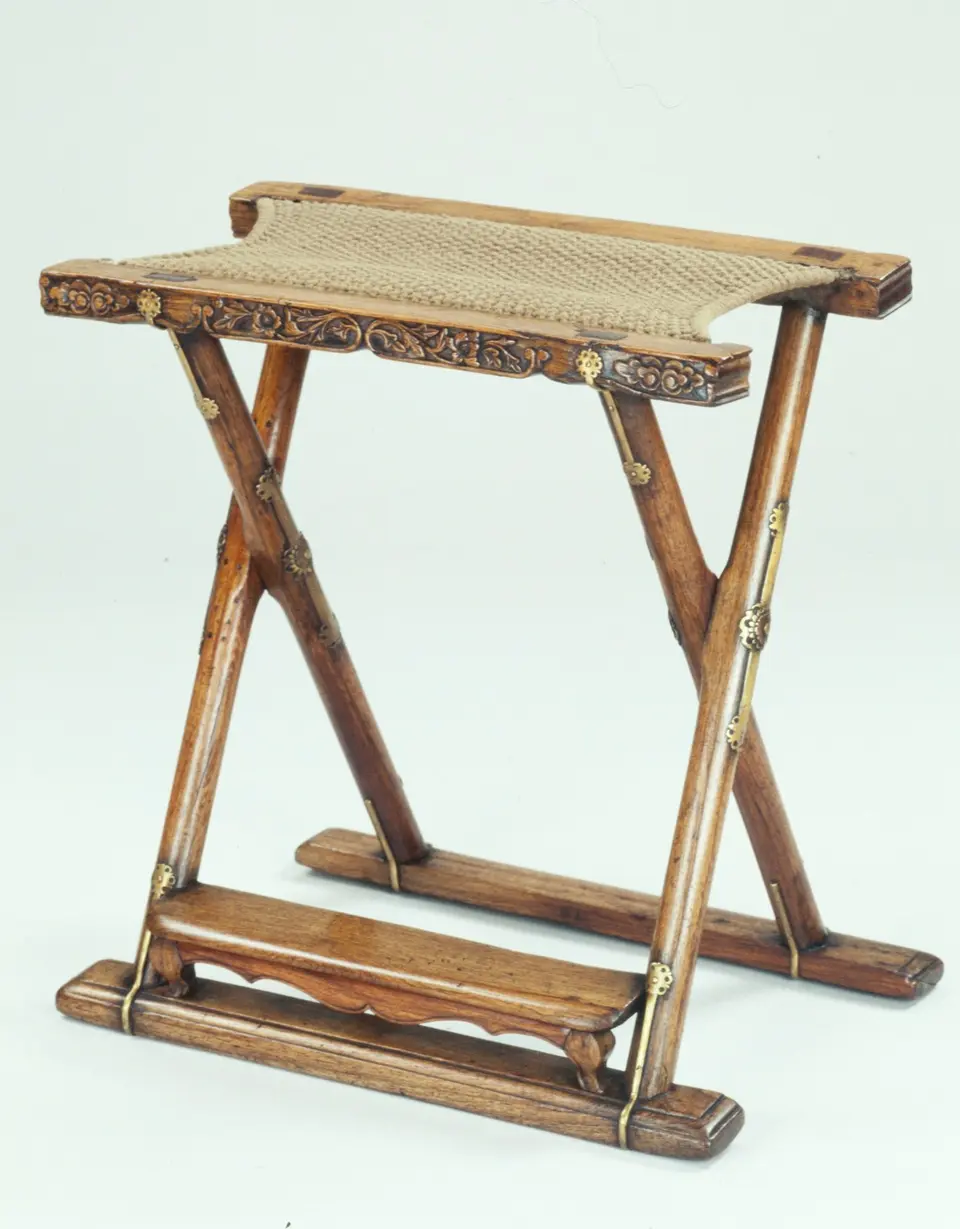
The Minneapolis Institute of Art traces the folding stool to the so-called Barbarian seat brought by northern and western nomads in the Han; light and easy to carry, it was used by officials and military officers on journeys. Wang Shixiang calls the form 交杌, a stool whose legs cross, commonly known as 马闸 and in antiquity as the 胡床 (Wang Shixiang p.33). It folds on a metal pivot rather than on a wood joint. Here is how such stools are usually put together.
1Crossed legs and pivot
The two leg frames cross and turn on metal pivot rivets. The legs are round, but where the rivet passes they are left square in section, keeping more wood for strength; some examples add washers where the rivets pass and iron mounts where member ends project. Typical practice (Wang Shixiang p.33).
2Seat and foot rails
Four horizontal members, at the seat and below the feet, are of square stock. The seat is laced with cord or leather straps; finer stools have a seat woven of silk. Typical practice (Wang Shixiang p.33).
3Footrest
Some folding stools have a footrest: a board left with a round pivot at each end, set into holes at the ends of the legs, so it can be removed or turned up. Typical practice (Wang Shixiang p.33).
References
- Minneapolis Institute of Art, Folding Stool 95.77 (Public Domain)
- 王世襄《明式家具研究》(Wang Shixiang, Research on Ming Furniture),第 33 页
The object in the museum
- Title
- Folding Stool
- Date
- 16th–17th century
- Material
- Huanghuali hardwood
- Dimensions
- 18 5/16 × 18 1/8 × 9 3/8 in. · 46.5 × 46 × 23.8 cm (converted from inches)
- Collection
- Minneapolis Institute of Art · 95.77
According to the museum, the folding stool is one of the most enduring Chinese furniture forms: introduced by nomadic peoples of the north and west during the Han as the so-called Barbarian seat, simple, light, economical and highly portable, it had spread to every level of society by the Tang and is still used today. At home it was not a seat for important people, but on journeys officials and military officers used it for temporary seating. Folding wooden furniture takes heavy wear and breaks easily, so few decorated hardwood examples datable to the Ming survive.
More furniture
Waisted square table →Waisted stool →High-waisted table →One-leg-three-aprons table →Waistless square table →Luohan bed (couch-bed) →Square-corner cabinet →Roundback armchair →Waisted kang table →Recessed-leg table →Everted-end altar table →Corner-leg painting table →Low-back armchair (rose chair) →Compound wardrobe →Small chest with drawers →Yokeback armchair (official’s hat chair) →Incense stand →Daybed →Barrel-form stool (zuodun) →Display cabinet (liangge cabinet) →Portable long table (everted-end table) →Continuous-yoke armchair (southern official’s hat chair) →Round-corner cabinet (tapered) →Six-post canopy bed →Folding roundback armchair →Book-carrying cabinet →Meditation stool →Lute table (qin table) →Two-drawer table →Recessed-leg stool →Clothes rack →Cosmetic case and mirror stand →Table-top chest (seal chest) →Four-sides-square long table →