
Chair Leg Through the Seat (椅子后足穿过椅盘): Ming Chair Construction
Leg through the seat · 腿足贯穿面子
Above the seat it is a back post; below it, a leg. In a Ming chair they are one piece of wood.
The seat frame is threaded onto it.
- Chinese
- 腿足贯穿面子 · tuǐzú guànchuān miànzi
- Joins
- Leg and seat frame
- Found in
- Armchairs, some stands and lamp stands
- Signature parts
- Continuous leg · holes in the seat frame
- Compare
- Through tenon
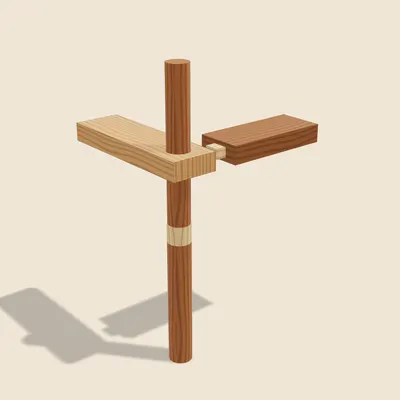
How it works
One piece from floor to back
In an ordinary armchair the seat frame is mitred and tenoned together and bored at its four corners; the front and back legs pass through these holes. The parts above and below the seat look separate, but each upright is continuous. Wang Shixiang calls this the strongest arrangement.
Round above, square below
Some chairs are round above the seat and square below. Most seats are slid down over the legs from the top, but in a few chairs a squared section of the leg locks into a square hole, so the seat frame must be opened to take it apart.
Proportions in the model are illustrative.
How it's made
 Step 1
One piece
Leg and back post are one piece.
 Step 2
Continuous
A continuous back leg.
 Step 3
Hole
A hole at the seat corner.
 Step 4
Frame
The seat frame is joined first.
 Step 5
Slide down
The seat slides down over the leg.
 Step 6
Through
The leg carries straight through.
Variations
Square lock
A squared section of the leg locks into a square hole in the frame.
Separate arm post
Sometimes the front arm post is a separate piece; this is weaker.
Can you CNC this?
Possible, with design or setup changes
The round holes in the seat frame are simple to bore. The continuous curved back leg is long and may need a 4th axis or a lathe for its round section.
Free STL downloads (one file per part)
- Back leg (one piece) 后足(一木连做) · yizi-houzu-back-leg.stl
- Seat frame long side 椅盘大边 · yizi-houzu-seat-side.stl
- Seat frame end 椅盘抹头 · yizi-houzu-seat-end.stl
Before cutting or printing, read the CNC and 3D-printing notes on tool radius, scaling the STL files and their licence.
In museum collections
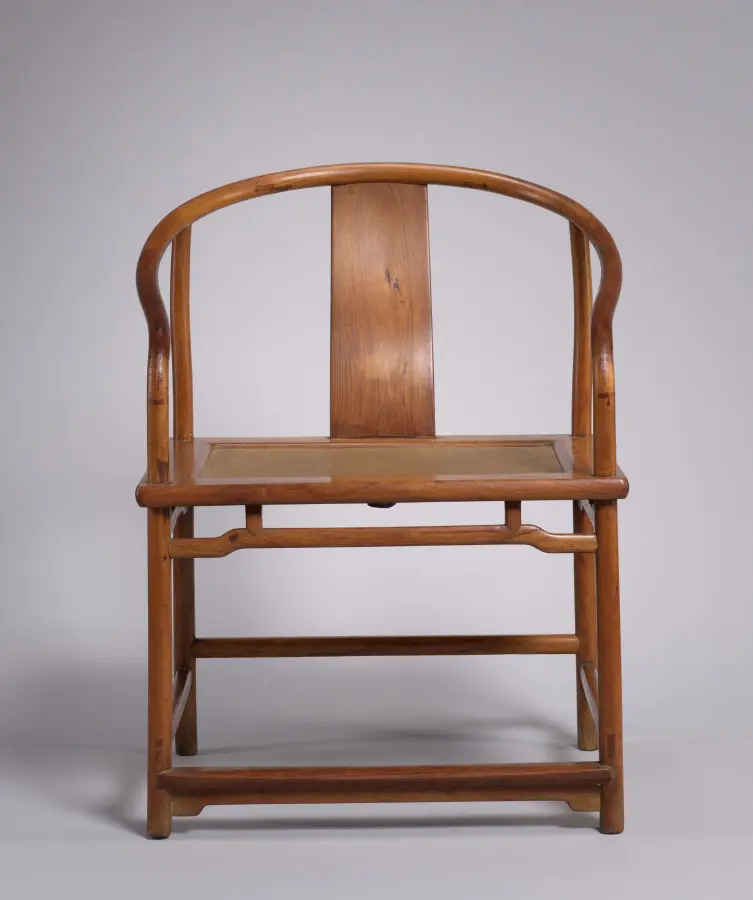
Cleveland Museum of Art
Where you’ll see it
- Roundback armchair · Legs through the seat: Back legs run up through the seat frame and tenon into the yoke; the front posts do the same, each cut from one piece.
Related joints
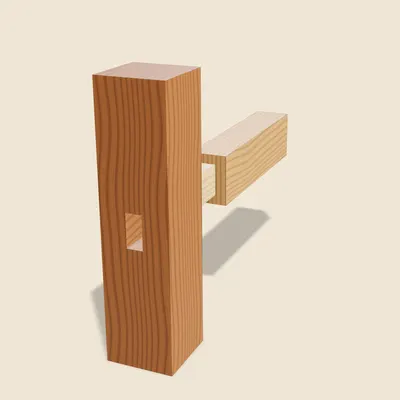
Through Tenon
tòu sǔnThe tenon runs right through and its end grain shows on the far side: strong, but less neat than a blind tenon.
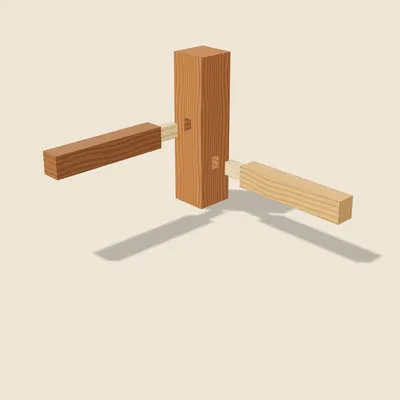
Staggered Stretchers
gǎn chéngStretchers from the front and side meet a leg at different heights, so their mortises never weaken it at one spot.
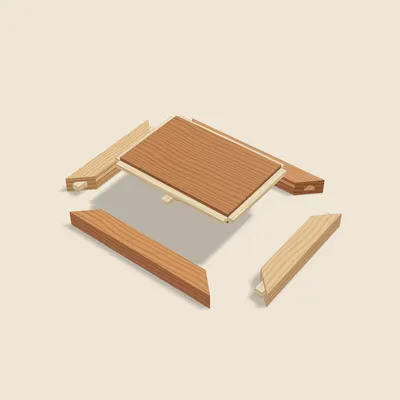
Frame and Floating Panel
cuánbiān dǎcáo zhuāngbǎnA mitred frame grooved on the inside, a thin panel with a tongued edge floating in the groove, and battens underneath.
Questions
Is the back post a separate piece?
No, it is the same timber as the leg.
How does the seat go on?
It is bored and slid down over the legs.
Is it strong?
It is the strongest arrangement for a chair.
Further reading
- Roundback armchair, 1600s–1700s, Cleveland Museum of Art (collection record)
- 王世襄《明式家具研究》(Wang Shixiang, Research on Ming Furniture),第 117 页
- 王世襄《明式家具研究》(Wang Shixiang, Research on Ming Furniture),第 116 页,图 3.38a、3.38b