
Six-post canopy bed
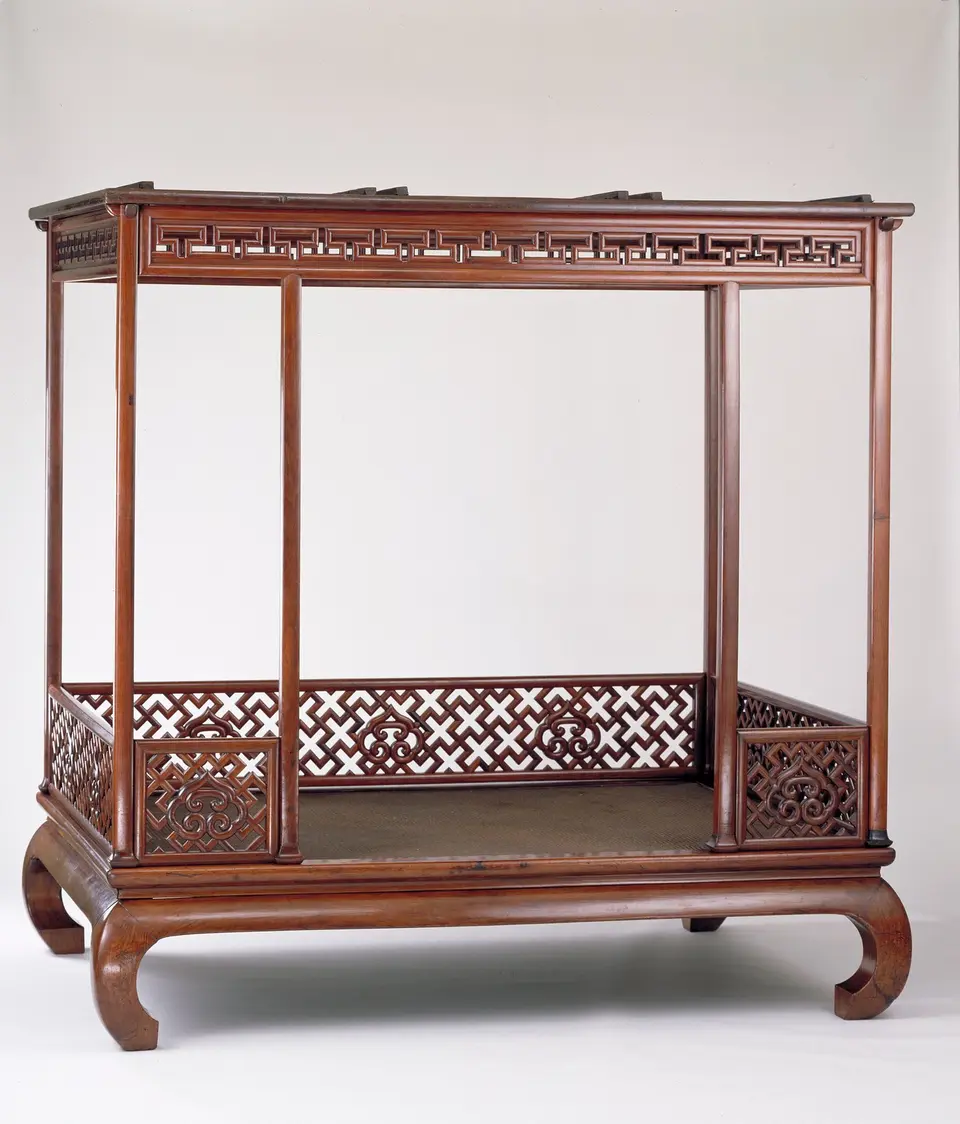
The Minneapolis Institute of Art calls the canopy bed one of the most important pieces of furniture in a Chinese household, generally ornamented with symbols of a long and happy marriage. Curtains hung inside the canopy made a private room within a room; with the curtains drawn back, the bed served as a formal couch from which the woman of the house held audience and conducted business, and with low tables added it was used for board games, informal dining or tea with guests. In the Suzhou area a canopy bed with door posts is called a six-post bed, after its six uprights (Wang Shixiang p.180). Here is how beds of this kind are usually joined.
1Door posts
On a six-post canopy bed the two posts set midway along the front are the door posts, and the short railings between them and the corner posts are the door railings (Wang Shixiang p.181).
2Lattice railings
The museum notes railings decorated with heart-shaped ruyi set against a pattern of Buddhist swastikas, signifying “ten thousand”. Swastika and similar railings on luohan and canopy beds are built up from short straight members, mostly joined at the corners with through or blind tenons; where thin members cross, each is cut away by half its depth and they usually meet with a small mitred shoulder; and railing patterns built up in this way are often assembled with loose tenons. Typical practice (Wang Shixiang p.106; p.119).
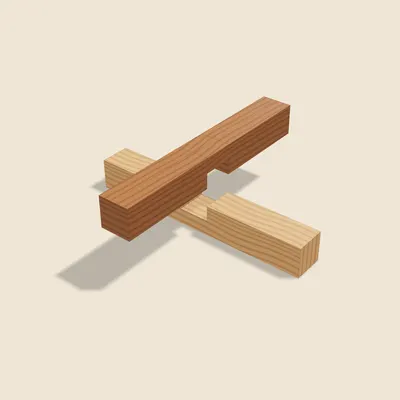
Cross-Halving Joint
shízì chéngTwo members cross, each cut away by half its depth, and drop together flush.
Explore the joint →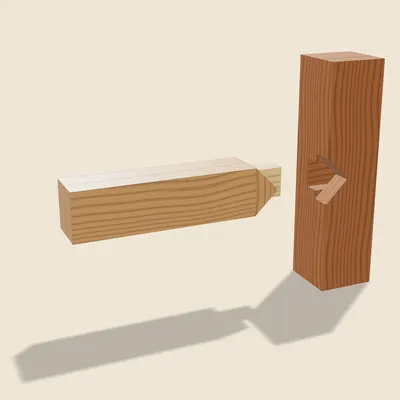
Mitred-Shoulder Joint
géjiān sǔnWhere a rail meets a post, its outer face is cut to a point that fits a matching notch, so mouldings meet cleanly.
Explore the joint →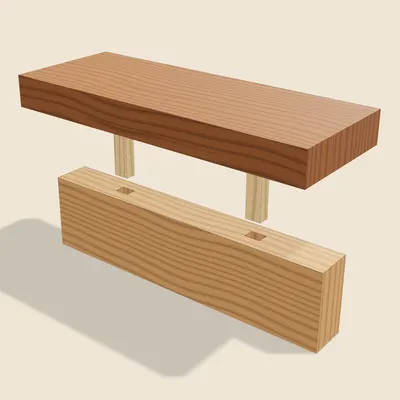
Loose Tenon
zāi xiāoThe tenon is a separate piece of wood planted into mortises in both parts, easy to replace if it wears.
Explore the joint →3Platform frame
Bed platforms with a woven soft seat use a mitred frame; under the weave two battens tenoned into the long sides bow slightly downward, and the palm cord or cane is laced through holes along the inner edge of the frame. Typical practice (Wang Shixiang p.110).
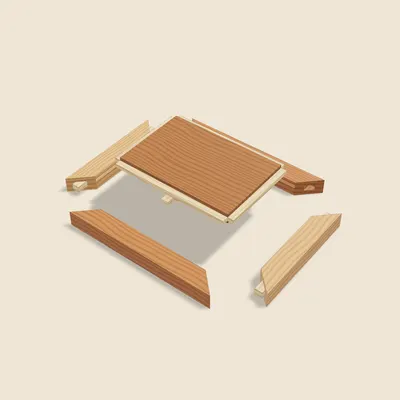
Frame and Floating Panel
cuánbiān dǎcáo zhuāngbǎnA mitred frame grooved on the inside, a thin panel with a tongued edge floating in the groove, and battens underneath.
Explore the joint →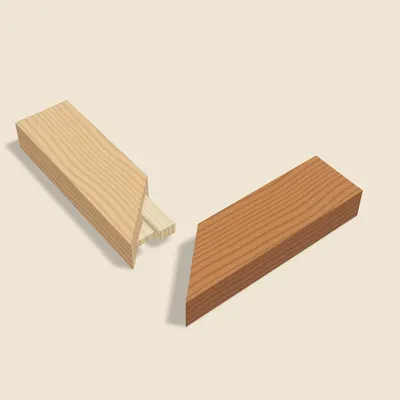
Mitred Frame Joint
géjiǎo sǔnThe 45° corner of every Chinese frame-and-panel top: a tenon through the end plus a little triangular tongue.
Explore the joint →References
- Minneapolis Institute of Art, Six-Post Canopy Bed 96.11.1a-ee (Public Domain)
- 王世襄《明式家具研究》(Wang Shixiang, Research on Ming Furniture),第 106 页;图 3.17、3.20a 见第 108 页,图 3.20b 见第 109 页;第 119 页
- 王世襄《明式家具研究》(Wang Shixiang, Research on Ming Furniture),第 110 页;图 3.23a、3.23b 见第 109 页
- 王世襄《明式家具研究》(Wang Shixiang, Research on Ming Furniture),第 180 页(名词术语简释:六柱床);第 181 页(名词术语简释:门柱、门围子)
The object in the museum
- Title
- Six-Post Canopy Bed
- Date
- early 17th century
- Material
- Huanghuali hardwood
- Dimensions
- 89 3/4 × 91 3/4 × 67 in. · 227.97 × 233.05 × 170.18 cm (converted from inches)
- Collection
- Minneapolis Institute of Art · 96.11.1a-ee
The museum notes that the canopy bed was one of the most important pieces of furniture in a Chinese household, generally ornamented with symbols of a long and happy marriage. Here the railings are decorated with heart-shaped ruyi, the mythical wish-fulfilling symbol, set against a pattern of Buddhist swastikas signifying “ten thousand”, which granted the owner the fulfilment of ten thousand wishes. Curtains hung inside the canopy created, when closed, a private room within a room. With the curtains drawn back, canopy beds were used as formal couches from which the woman of the house held audience and conducted business; with low tables added, they served for board games, informal dining or drinking tea with guests.
More furniture
Waisted square table →Waisted stool →High-waisted table →One-leg-three-aprons table →Waistless square table →Luohan bed (couch-bed) →Square-corner cabinet →Roundback armchair →Waisted kang table →Recessed-leg table →Everted-end altar table →Corner-leg painting table →Low-back armchair (rose chair) →Compound wardrobe →Small chest with drawers →Yokeback armchair (official’s hat chair) →Folding stool (jiaowu) →Incense stand →Daybed →Barrel-form stool (zuodun) →Display cabinet (liangge cabinet) →Portable long table (everted-end table) →Continuous-yoke armchair (southern official’s hat chair) →Round-corner cabinet (tapered) →Folding roundback armchair →Book-carrying cabinet →Meditation stool →Lute table (qin table) →Two-drawer table →Recessed-leg stool →Clothes rack →Cosmetic case and mirror stand →Table-top chest (seal chest) →Four-sides-square long table →