
Lute table (qin table)
The Minneapolis Institute of Art says this extremely rare lute table captures the essence of literati taste. Made in Suzhou around 1600, in the golden age of Chinese furniture making, it owes its simplicity, fluidity and superb balance to extremely advanced, concealed joinery, which allows a minimal use of material and elegant proportions. The lute (qin) has been the most important symbolic musical instrument throughout Chinese history: since Confucian times playing it was a sign of enlightenment, and by the Ming merely owning one marked a literatus’s intellect and refinement. Broadly, 琴桌 means long tables of various sizes; strictly, a table made for playing the qin (Wang Shixiang p.183).
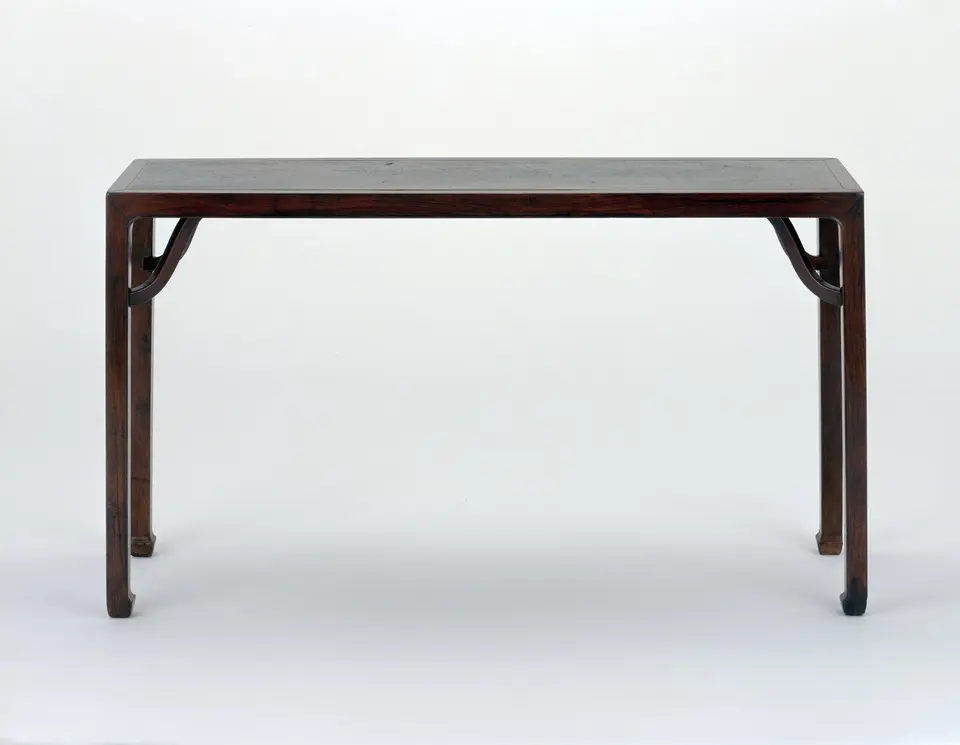
1Concealed joinery
The museum notes that the table’s simplicity, fluidity and balance are made possible by extremely advanced, concealed joinery, which allows a minimal use of material and elegant proportions. It does not say which joints are used.
References
- Minneapolis Institute of Art, Lute table 96.123.1 (Public Domain)
- 王世襄《明式家具研究》(Wang Shixiang, Research on Ming Furniture),第 183 页(名词术语简释:琴桌)
The object in the museum
- Title
- Lute table
- Date
- c. 1600
- Material
- Huanghuali hardwood and cedar
- Dimensions
- 28 1/2 × 50 3/8 × 14 3/16 in. · 72.39 × 127.95 × 36.04 cm (converted from inches)
- Collection
- Minneapolis Institute of Art · 96.123.1
The museum says this extremely rare lute table captures the essence of literati taste. Made in Suzhou around 1600, it exemplifies the sophisticated designs of the golden age of Chinese furniture making; its simplicity, fluidity and superb balance, made possible by extremely advanced, concealed joinery, allow a minimal use of material and elegant proportions. The lute (qin) has been the most important symbolic musical instrument throughout Chinese history; since Confucian times (6th century BCE) playing it was regarded as a sign of enlightenment, and by the Ming dynasty (1368–1644) the literati saw merely owning one as a mark of intellect and refinement.
More furniture
Waisted square table →Waisted stool →High-waisted table →One-leg-three-aprons table →Waistless square table →Luohan bed (couch-bed) →Square-corner cabinet →Roundback armchair →Waisted kang table →Recessed-leg table →Everted-end altar table →Corner-leg painting table →Low-back armchair (rose chair) →Compound wardrobe →Small chest with drawers →Yokeback armchair (official’s hat chair) →Folding stool (jiaowu) →Incense stand →Daybed →Barrel-form stool (zuodun) →Display cabinet (liangge cabinet) →Portable long table (everted-end table) →Continuous-yoke armchair (southern official’s hat chair) →Round-corner cabinet (tapered) →Six-post canopy bed →Folding roundback armchair →Book-carrying cabinet →Meditation stool →Two-drawer table →Recessed-leg stool →Clothes rack →Cosmetic case and mirror stand →Table-top chest (seal chest) →Four-sides-square long table →