
Daybed
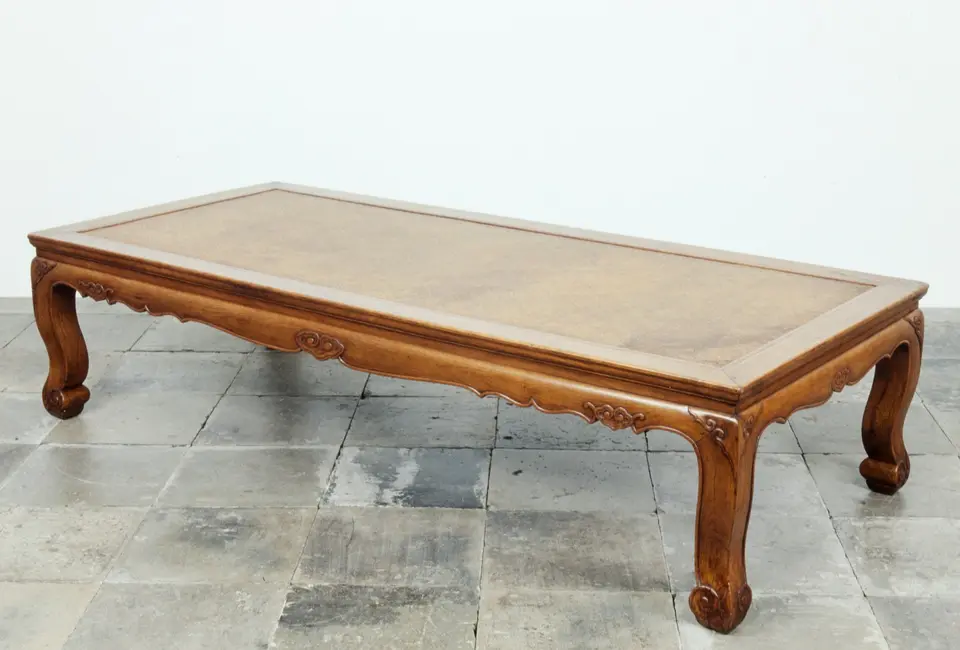
The Minneapolis Institute of Art describes the daybed as a seat by day and a bed by night; unlike the couch-bed it has no railings. This rare huanghuali example has cabriole legs, curving aprons carved with lingzhi-like clouds, ruyi lappets at the leg shoulders and scrolled feet. Here is how a waisted platform of this kind is usually joined.
1Platform frame
Couch and daybed platforms with a woven soft seat use a mitred frame; under the weave two battens tenoned into the long sides bow slightly downward, and the palm cord or cane is laced through holes along the inner edge of the frame. Typical practice (Wang Shixiang p.110).
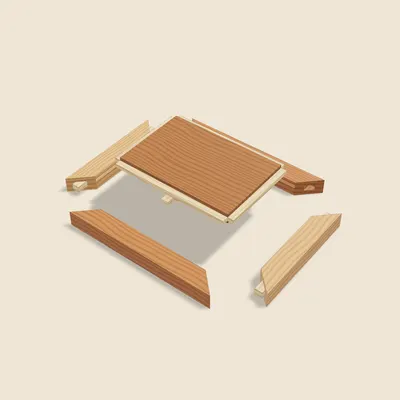
Frame and Floating Panel
cuánbiān dǎcáo zhuāngbǎnA mitred frame grooved on the inside, a thin panel with a tongued edge floating in the groove, and battens underneath.
Explore the joint →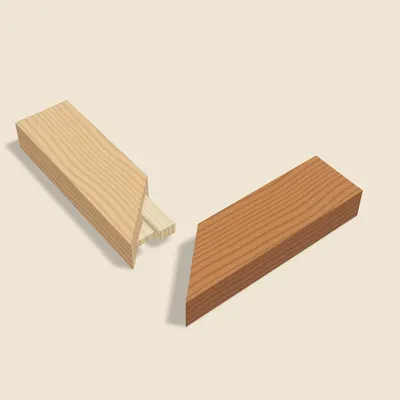
Mitred Frame Joint
géjiǎo sǔnThe 45° corner of every Chinese frame-and-panel top: a tenon through the end plus a little triangular tongue.
Explore the joint →2Waist, legs and apron
The museum notes cabriole legs and curving carved aprons. On waisted furniture the leg top carries long-and-short tenons into the frame, and below the waist a 45° shoulder with a triangular mortise takes the mitred apron end: the baojian joint. Typical practice (Wang Shixiang p.111).
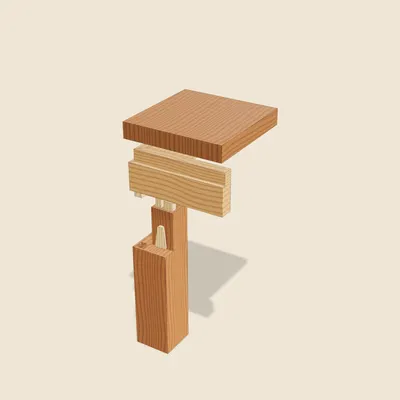
Baojian Joint
bàojiān sǔnThe hidden lock behind every waisted Ming table corner: a mitred shoulder, a triangular tenon and a tapered pin.
Explore the joint →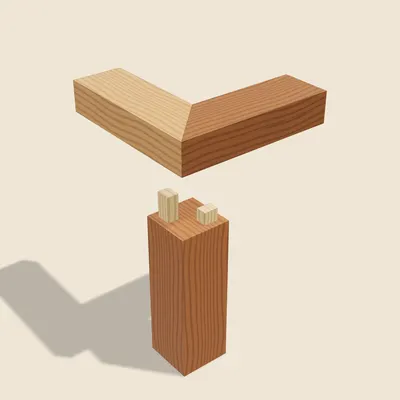
Long-and-Short Tenons
chángduǎn sǔnTwo tenons at right angles on the top of a leg: a long one for the long side, a short one for the end.
Explore the joint →References
- Minneapolis Institute of Art, Daybed 2000.32 (Public Domain)
- 王世襄《明式家具研究》(Wang Shixiang, Research on Ming Furniture),第 110 页;第 111 页;图 3.30 见第 112 页
The object in the museum
- Title
- Daybed
- Date
- late 16th–early 17th century
- Material
- Huanghuali hardwood
- Dimensions
- 21 1/2 × 87 3/16 × 38 3/16 in. · 54.61 × 221.46 × 97 cm (converted from inches)
- Collection
- Minneapolis Institute of Art · 2000.32
The museum describes the daybed as a seating platform by day and a bed by night; with a small armrest or low table it served for lounging, reading or drinking tea. This rare cabriole-leg daybed, made of massive timber, shows the restrained grandeur of late Ming aristocratic taste: the curving aprons carry relief lingzhi-like cloud motifs, each leg shoulder a ruyi cloud lappet, and each leg ends in a scrolled foot with a sprouting leaf; it is the only huanghuali daybed known with these motifs. In antiquity the daybed, smaller than the railed couch-bed, was mainly for sitting; raised, widened and lengthened like this one, it became an important piece of studio furniture for sitting, reclining, reading, meditating, conversation and board games.
More furniture
Waisted square table →Waisted stool →High-waisted table →One-leg-three-aprons table →Waistless square table →Luohan bed (couch-bed) →Square-corner cabinet →Roundback armchair →Waisted kang table →Recessed-leg table →Everted-end altar table →Corner-leg painting table →Low-back armchair (rose chair) →Compound wardrobe →Small chest with drawers →Yokeback armchair (official’s hat chair) →Folding stool (jiaowu) →Incense stand →Barrel-form stool (zuodun) →Display cabinet (liangge cabinet) →Portable long table (everted-end table) →Continuous-yoke armchair (southern official’s hat chair) →Round-corner cabinet (tapered) →Six-post canopy bed →Folding roundback armchair →Book-carrying cabinet →Meditation stool →Lute table (qin table) →Two-drawer table →Recessed-leg stool →Clothes rack →Cosmetic case and mirror stand →Table-top chest (seal chest) →Four-sides-square long table →