
Round-corner cabinet (tapered)
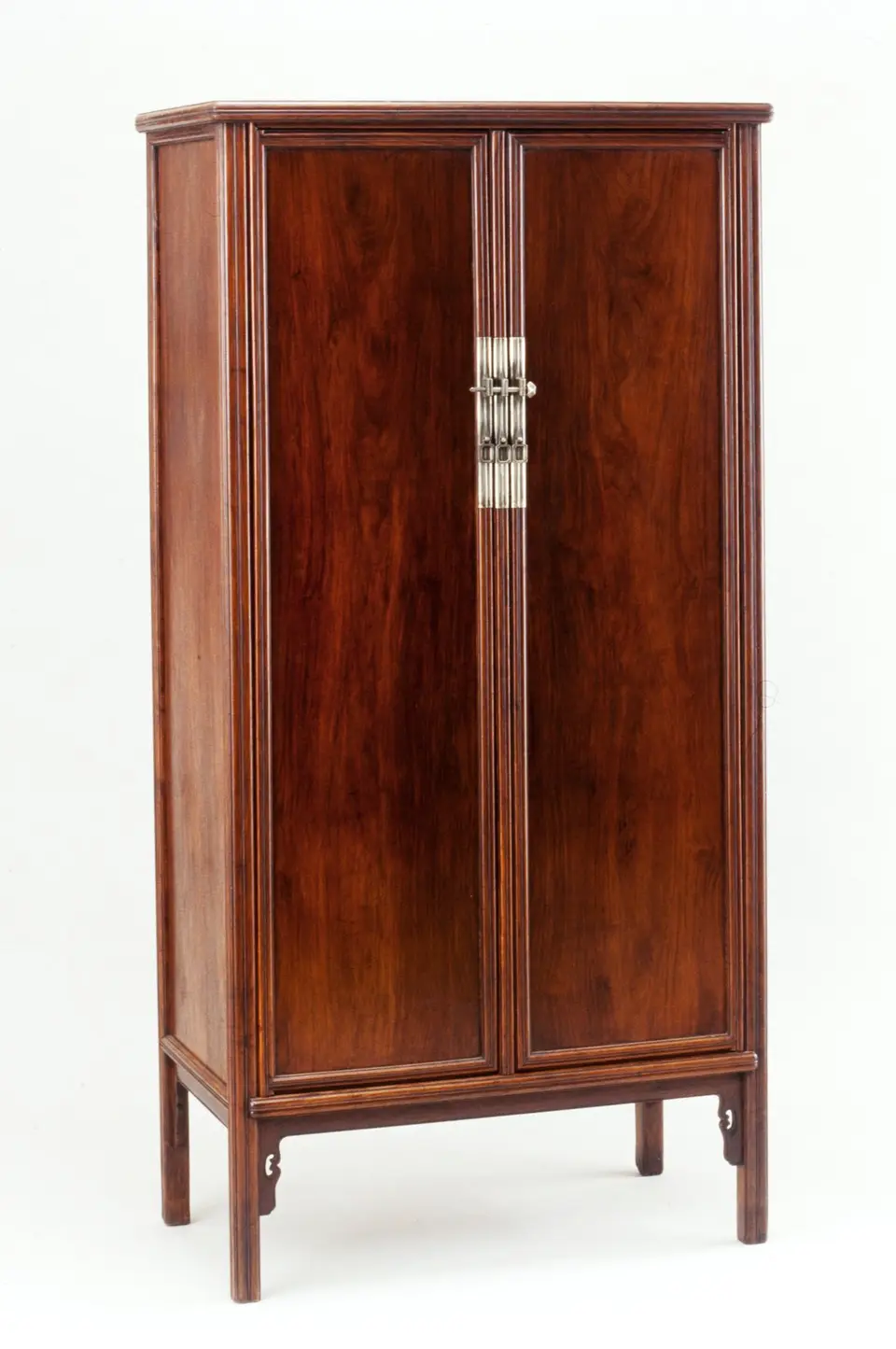
The Minneapolis Institute of Art calls the tall, tapered, round-corner cabinet the essence of Ming-style furniture: exposed framework, simple floating panels, minimal hardware, an inward taper and pronounced verticality, and the legs of this example are among the highest known. Traditional Chinese homes had no closets, so cabinets and chests stored clothing in the bedroom. A cabinet whose top has rounded corners, usually with wooden-pivot doors and a marked splay, is called 圆角柜 (Wang Shixiang p.190). Here is how such a cabinet is usually joined.
1Splayed corner stiles
The museum notes that the rounded corner stiles splay slightly outward from the top, giving a feeling of balance and stability. A marked splay is one of the marks of a round-corner cabinet (Wang Shixiang p.190).
2Door pivots
The museum notes that the corner door rails have extended dowels top and bottom that fit into sockets in the upper and lower frame, allowing the doors to pivot; this frees the body of surface-mounted metal hinges. The part of a wooden-pivot door that projects top and bottom into its sockets is called the door pivot (Wang Shixiang p.181).
3Doors and sides
Door and side frames are grooved for floating panels, and the battens under each panel are tenoned into the long frame members. Typical practice (Wang Shixiang p.110).
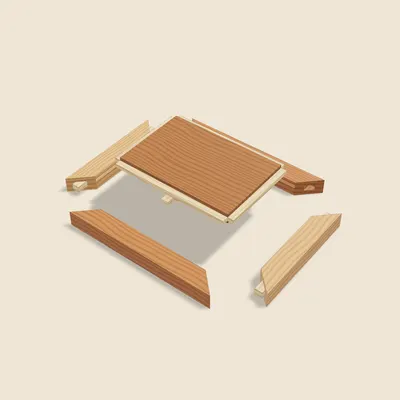
Frame and Floating Panel
cuánbiān dǎcáo zhuāngbǎnA mitred frame grooved on the inside, a thin panel with a tongued edge floating in the groove, and battens underneath.
Explore the joint →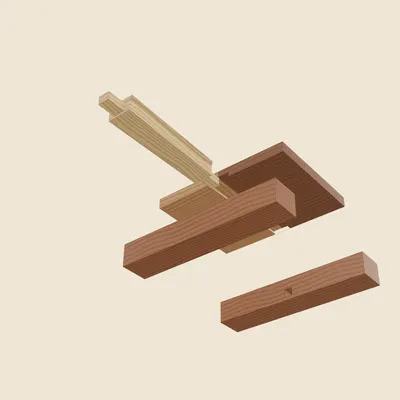
Sliding Dovetail Batten
chuāndàiA tapered dovetail batten driven across the back of a panel, its ends tenoned into the frame: the reason old tabletops stay flat.
Explore the joint →4Rails into the stiles
Rails meet the uprights of large cabinets at T-joints; square members usually take a mitred shoulder so the faces run on, and tenons on the show faces are mostly blind. Typical practice (Wang Shixiang p.103; p.105).
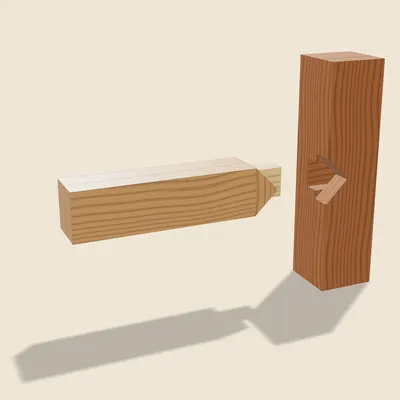
Mitred-Shoulder Joint
géjiān sǔnWhere a rail meets a post, its outer face is cut to a point that fits a matching notch, so mouldings meet cleanly.
Explore the joint →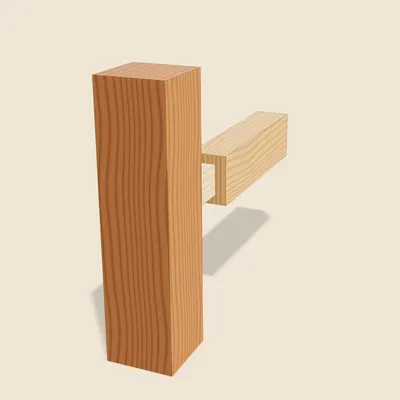
Blind Tenon
bàn sǔnThe tenon stops inside the post, so nothing shows on the outside: neat, a little less strong than a through tenon.
Explore the joint →5Bottom stretchers
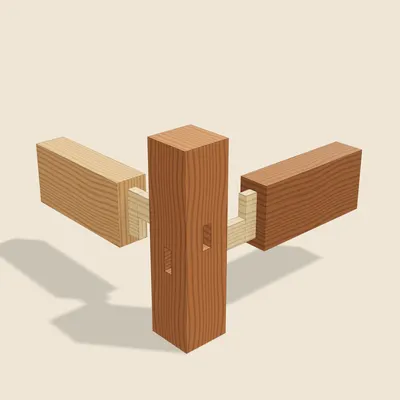
On cabinets raised on legs, the front and side bottom stretchers meet each leg at the same height, so both tenons are cut “big in, small out” and pass each other. Typical practice (Wang Shixiang p.105).
References
- Minneapolis Institute of Art, Large Tapered Cabinet 97.25.2a-g (Public Domain)
- 王世襄《明式家具研究》(Wang Shixiang, Research on Ming Furniture),第 103 页;第 105 页;图 3.15a 见第 107 页;第 110 页,图 3.24
- 王世襄《明式家具研究》(Wang Shixiang, Research on Ming Furniture),第 181 页(名词术语简释:门轴、木轴门);第 190 页(名词术语简释:圆角柜)
The object in the museum
- Title
- Large Tapered Cabinet
- Date
- early 17th century
- Material
- Huanghuali hardwood and pai-tung hardware
- Dimensions
- 73 7/8 × 36 1/8 × 19 3/4 in. · 187.64 × 91.76 × 50.17 cm (converted from inches)
- Collection
- Minneapolis Institute of Art · 97.25.2a-g
The museum calls the classic tall, tapered, round-corner cabinet the essence of Ming-style furniture: its exposed framework, simple floating panels, minimal hardware, inward taper and pronounced verticality give an impression of serene calm and balance. The legs of this example, among the highest known, lend lightness to a rather large form. Traditional Chinese homes had no closets, so cabinets and chests were needed to store clothing in the bedroom. The rounded corner stiles splay slightly outward from the top, giving balance and stability. The corner door rails have extended dowels top and bottom that fit into sockets in the upper and lower frame so that the doors pivot; this simple, ingenious device frees the body of surface-mounted metal hinges and keeps its lines clean and vertical.
More furniture
Waisted square table →Waisted stool →High-waisted table →One-leg-three-aprons table →Waistless square table →Luohan bed (couch-bed) →Square-corner cabinet →Roundback armchair →Waisted kang table →Recessed-leg table →Everted-end altar table →Corner-leg painting table →Low-back armchair (rose chair) →Compound wardrobe →Small chest with drawers →Yokeback armchair (official’s hat chair) →Folding stool (jiaowu) →Incense stand →Daybed →Barrel-form stool (zuodun) →Display cabinet (liangge cabinet) →Portable long table (everted-end table) →Continuous-yoke armchair (southern official’s hat chair) →Six-post canopy bed →Folding roundback armchair →Book-carrying cabinet →Meditation stool →Lute table (qin table) →Two-drawer table →Recessed-leg stool →Clothes rack →Cosmetic case and mirror stand →Table-top chest (seal chest) →Four-sides-square long table →