
Corner-leg painting table
The Minneapolis Institute of Art describes this large flush-sided corner-leg table (四面平画桌) as a scholar’s painting desk, and notes that the form relies mainly on mortise-and-tenon joints between the legs and the four corners of the top, with S-curved giant’s-arm braces added for stability. Here is what holds such a table together, from the top down.
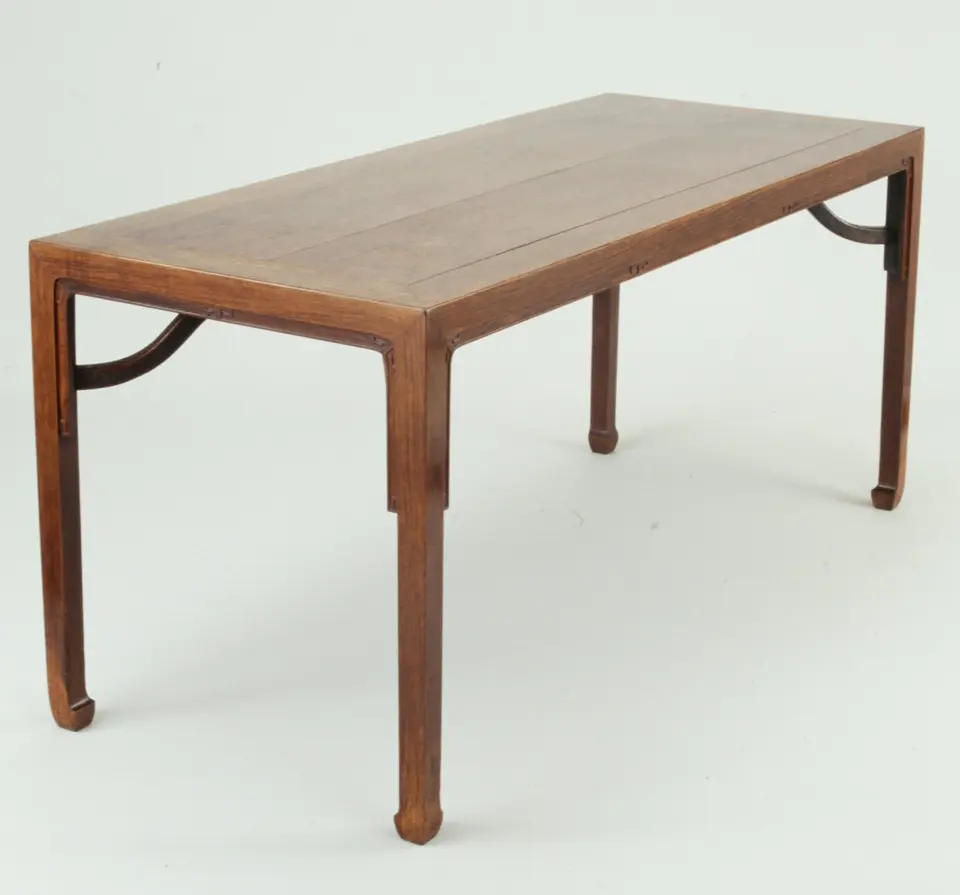
1Top frame
On flush-sided tables of this build the top is a separate frame-and-panel unit: mitred long sides and ends, grooved for the floating panel, with mortises cut under the four corners. Typical practice (Wang Shixiang p.113; p.110).
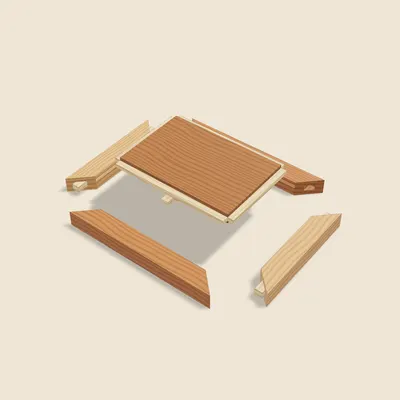
Frame and Floating Panel
cuánbiān dǎcáo zhuāngbǎnA mitred frame grooved on the inside, a thin panel with a tongued edge floating in the groove, and battens underneath.
Explore the joint →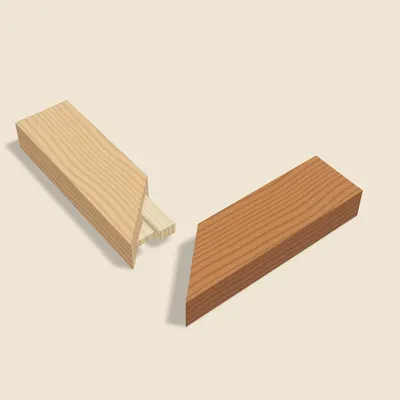
Mitred Frame Joint
géjiǎo sǔnThe 45° corner of every Chinese frame-and-panel top: a tenon through the end plus a little triangular tongue.
Explore the joint →2Panel
Thin boards are edge-joined into the panel, and battens under it are tenoned into the long sides. Typical practice (Wang Shixiang ch. 3, sec. A ‘Basic joints’; figs 3.1b, 3.2 on p.102; p.110).
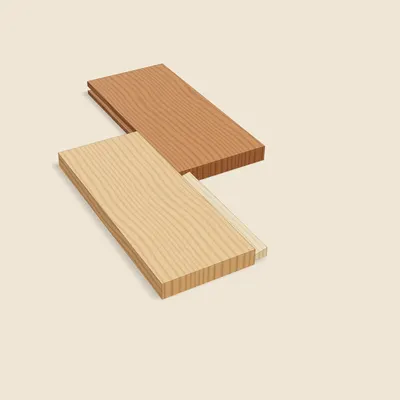
Longfeng Board Joint
lóngfèng sǔnA half-dovetail tongue on one board slides into a matching groove in the next, so the seam can neither step nor pull apart.
Explore the joint →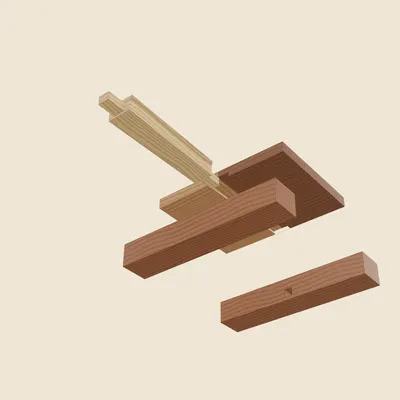
Sliding Dovetail Batten
chuāndàiA tapered dovetail batten driven across the back of a panel, its ends tenoned into the frame: the reason old tabletops stay flat.
Explore the joint →3Leg into the top
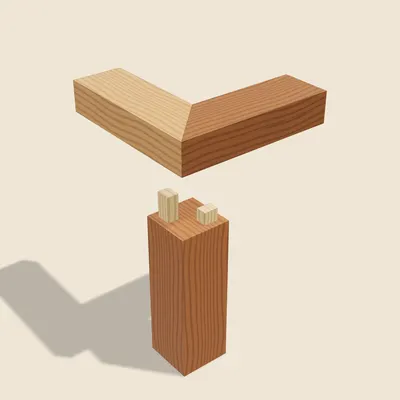
The museum notes that the table relies mainly on mortise-and-tenon joints between the legs and the four corners of the top. In this build each leg top carries long-and-short tenons into the frame. Typical practice (Wang Shixiang p.113).
4Flush corner
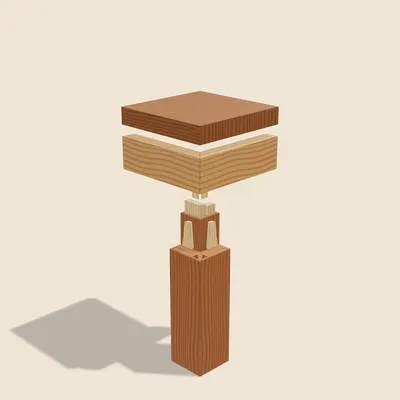
With no waist, the leg is mitred just below its tenons and a half-dovetail pin on each face hooks the apron, so leg, apron and top stay flush. Typical practice (Wang Shixiang p.113).
5Giant’s-arm braces
The museum notes S-curved giant’s-arm braces added for stability. Such a brace holds a panel batten at its upper end, fixed with a pin, and hooks into the leg at its lower end. Typical practice (Wang Shixiang p.114).
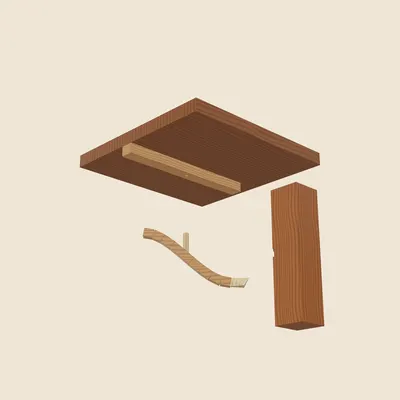
Giant’s-Arm Brace
bàwáng chéngAn S-curved brace from the leg up to the underside of the top, hooked into the leg and locked with a wedge.
Explore the joint →Sliding Dovetail Batten
chuāndàiA tapered dovetail batten driven across the back of a panel, its ends tenoned into the frame: the reason old tabletops stay flat.
Explore the joint →References
- Minneapolis Institute of Art, Corner-leg Painting Table 97.26.1 (Public Domain)
- 王世襄《明式家具研究》(Wang Shixiang, Research on Ming Furniture),第三章甲节「基本接合」;图 3.1b、3.2 见第 102 页;第 110 页,图 3.24;图 3.23a、3.23b 见第 109 页
- 王世襄《明式家具研究》(Wang Shixiang, Research on Ming Furniture),第 113 页;图 3.33 见第 114 页;第 114 页;图 3.37 见第 116 页
The object in the museum
- Title
- Corner-leg Painting Table
- Date
- late 17th century
- Material
- Huanghuali hardwood
- Dimensions
- 33 1/2 × 74 × 30 1/2 in. · 85.09 × 187.96 × 77.47 cm (converted from inches)
- Collection
- Minneapolis Institute of Art · 97.26.1
The museum describes this large corner-leg table as a scholar’s studio desk for painting, writing materials and calligraphy, praised for its elegant profile, refined proportions and restrained key-fret carving on the narrow apron and the spandrels that continue a third of the way down the legs. It notes that a flush-sided corner-leg table is not strong in itself: it relies mainly on mortise-and-tenon joints between the legs and the four corners of the top, with S-curved giant’s-arm braces added for stability.
More furniture
Waisted square table →Waisted stool →High-waisted table →One-leg-three-aprons table →Waistless square table →Luohan bed (couch-bed) →Square-corner cabinet →Roundback armchair →Waisted kang table →Recessed-leg table →Everted-end altar table →Low-back armchair (rose chair) →Compound wardrobe →Small chest with drawers →Yokeback armchair (official’s hat chair) →Folding stool (jiaowu) →Incense stand →Daybed →Barrel-form stool (zuodun) →Display cabinet (liangge cabinet) →Portable long table (everted-end table) →Continuous-yoke armchair (southern official’s hat chair) →Round-corner cabinet (tapered) →Six-post canopy bed →Folding roundback armchair →Book-carrying cabinet →Meditation stool →Lute table (qin table) →Two-drawer table →Recessed-leg stool →Clothes rack →Cosmetic case and mirror stand →Table-top chest (seal chest) →Four-sides-square long table →