
Cosmetic case and mirror stand
The Minneapolis Institute of Art calls this spectacular mirror stand, distinguished by its imposing size, a showcase of the decorative tradition of Ming-style furniture. Its back imitates a five-panel screen of the kind set behind thrones; a round mirror rested on an S-shaped easel, and five deep drawers held hairpins, combs and cosmetics. The many dragons and phoenixes, imperial imagery, suggest that it once belonged to a woman of the royal household. A 镜台 is a dressing stand with drawers in its base and a support for a bronze mirror that can be raised or folded (Wang Shixiang p.178); one whose upper part is decorated like a standing screen is called 屏风式镜台 (p.182).
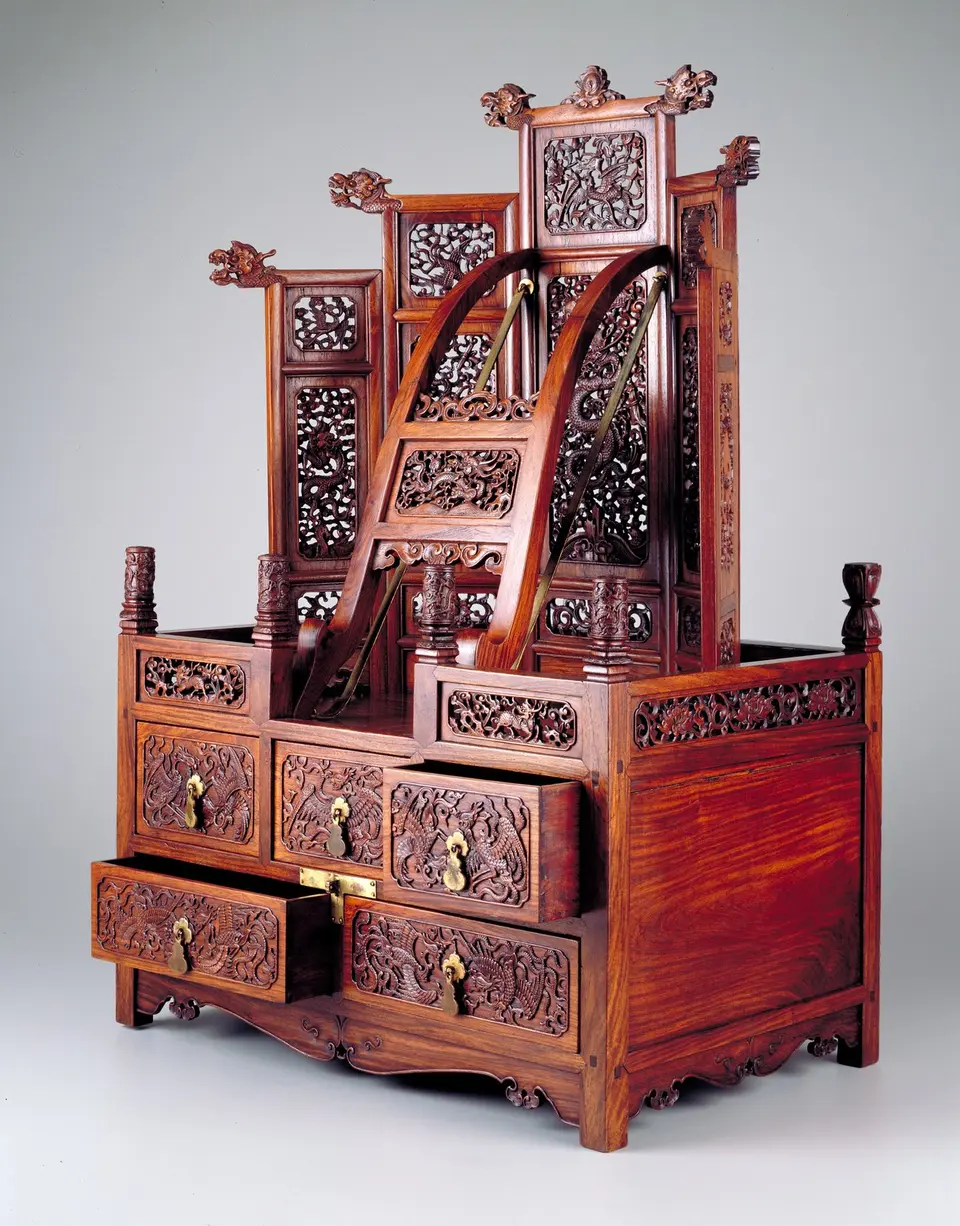
1Screen-like back
The museum notes that the back imitates a five-panel screen of the type used as a backdrop for thrones; each panel has dragon-head terminals, and the openwork carving shows sinuous dragons and phoenixes among clouds.
2Drawers
The museum notes five deep drawers that would have held hairpins, combs and cosmetics, embellished with auspicious flowers and phoenixes.
3Railing posts
The museum notes that the railing posts terminate in dragons and lotus blossoms.
4Mirror easel
The museum notes that a round mirror would have rested on the S-shaped easel, whose central openwork panel shows a four-clawed, horned dragon.
References
- Minneapolis Institute of Art, Cosmetic Case and Mirror Stand 94.8a-r (Public Domain)
- 王世襄《明式家具研究》(Wang Shixiang, Research on Ming Furniture),第 178 页(名词术语简释:镜台);第 182 页(名词术语简释:屏风式镜台)
The object in the museum
- Title
- Cosmetic Case and Mirror Stand
- Date
- early 17th century
- Material
- Huanghuali hardwood
- Dimensions
- 31 1/2 × 20 7/8 × 13 3/8 in. · 80.01 × 53.02 × 33.97 cm (converted from inches)
- Collection
- Minneapolis Institute of Art · 94.8a-r
The museum notes that, distinguished by its imposing size, this spectacular mirror stand demonstrates the decorative tradition of Ming-style furniture. The back simulates a five-panel screen of the type used as the backdrop for thrones; the panels each have dragon-head terminals, and their openwork carving shows sinuous dragons and phoenixes amid clouds. The drawers are embellished with auspicious flowers and phoenixes, while the railing posts terminate in dragons and lotus blossoms. A round mirror would have rested on the S-shaped easel, whose central openwork panel displays a four-clawed, horned dragon. The five deep drawers would have held hairpins, combs and cosmetics. The extensive use of dragons and phoenixes, imperial imagery, indicates that this dressing cabinet once belonged to a woman of the royal household.
More furniture
Waisted square table →Waisted stool →High-waisted table →One-leg-three-aprons table →Waistless square table →Luohan bed (couch-bed) →Square-corner cabinet →Roundback armchair →Waisted kang table →Recessed-leg table →Everted-end altar table →Corner-leg painting table →Low-back armchair (rose chair) →Compound wardrobe →Small chest with drawers →Yokeback armchair (official’s hat chair) →Folding stool (jiaowu) →Incense stand →Daybed →Barrel-form stool (zuodun) →Display cabinet (liangge cabinet) →Portable long table (everted-end table) →Continuous-yoke armchair (southern official’s hat chair) →Round-corner cabinet (tapered) →Six-post canopy bed →Folding roundback armchair →Book-carrying cabinet →Meditation stool →Lute table (qin table) →Two-drawer table →Recessed-leg stool →Clothes rack →Table-top chest (seal chest) →Four-sides-square long table →