
Meditation stool
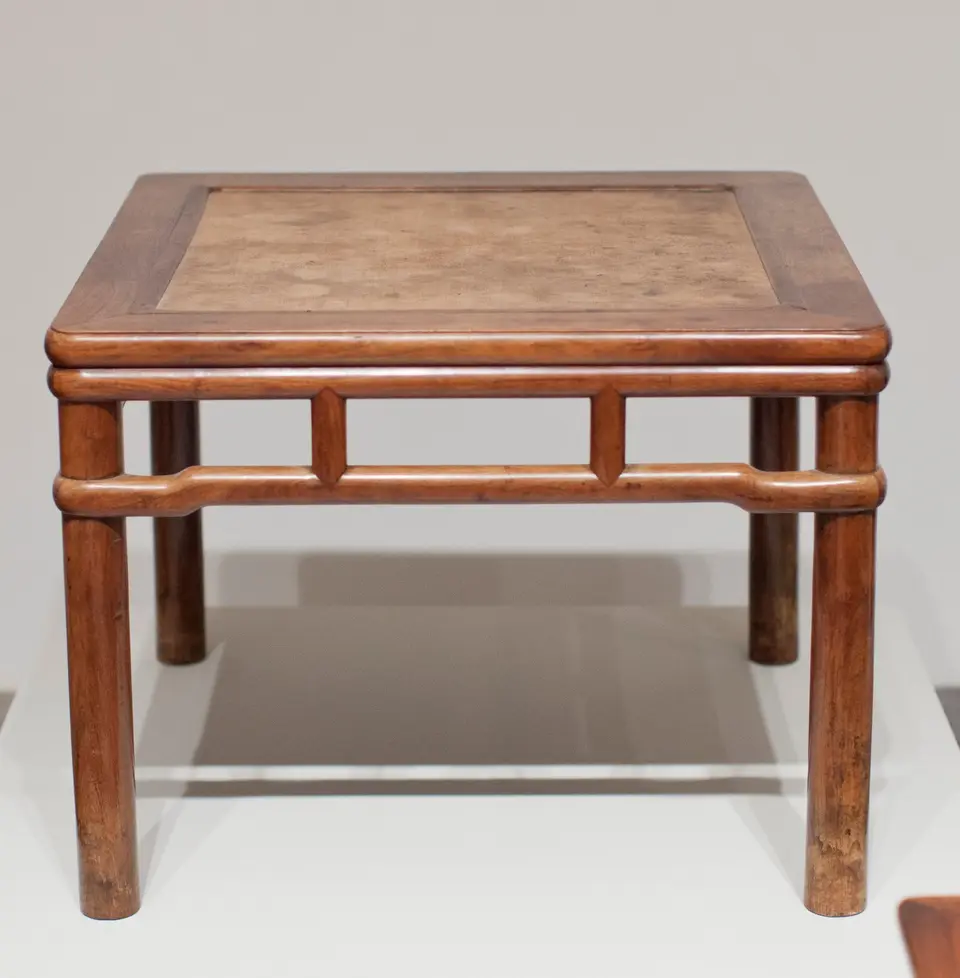
The Minneapolis Institute of Art explains that meditation platforms began in antiquity as seats of honour for rulers, sages and important members of society, and that Buddhism, arriving in the second century with its focus on meditation, created a demand for wide, raised seats on which a person could sit in the lotus position. The design of this large, square stool is inspired by bamboo furniture: every member is round, and the seat frame has round corners. Furniture built with wrap-around stretchers is called 裹腿做 (“wrapped-leg work”), a style Wang Shixiang traces to imitations of bamboo furniture (p.176). Here is how such a stool is usually joined.
1Round members
The museum notes that, in imitation of bamboo, all members of the stool are round and the seat frame has round corners.
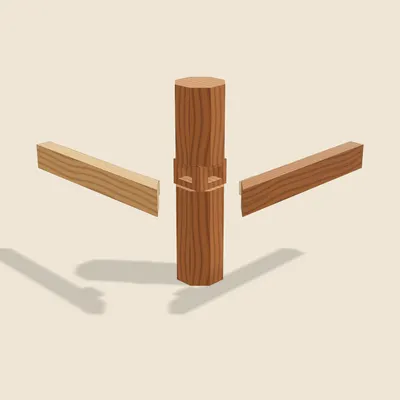
2Wrap-around stretchers
The museum describes leg-encircling stretchers that appear to wrap around each leg, a direct reference to bamboo furniture, in which single lengths of bamboo were bent around all four legs with the aid of steam or heat. In a wrap-around stretcher the stretchers stand proud of the leg and meet in a mitre at the corner; the short stretch of leg they cross is pared square, and the inner part of each stretcher end is left as a tenon into the leg. Typical practice (Wang Shixiang p.105; fig. 3.13a on p.106, fig. 3.13b on p.107).
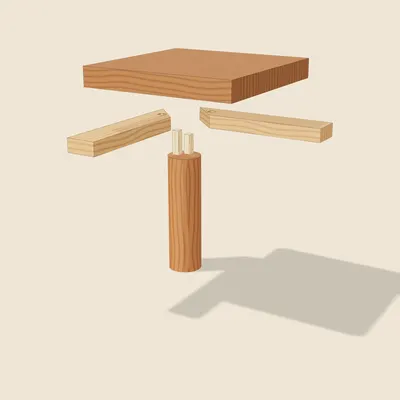
3Legs into the seat
Wrapped-leg stools are waistless: long-and-short tenons at the leg top go into mortises at the corners of the seat frame. Typical practice (Wang Shixiang p.111; fig. 3.29 on p.112).
References
- Minneapolis Institute of Art, Meditation Stool 2001.156.1 (Public Domain)
- 王世襄《明式家具研究》(Wang Shixiang, Research on Ming Furniture),第 105 页;图 3.13a 见第 106 页,图 3.13b 见第 107 页;第 111 页;图 3.29 见第 112 页
- 王世襄《明式家具研究》(Wang Shixiang, Research on Ming Furniture),第 176 页(名词术语简释:裹腿做)
The object in the museum
- Title
- Meditation Stool
- Date
- 17th century
- Material
- Huanghuali hardwood
- Dimensions
- 20 15/16 × 27 1/2 × 27 1/2 in. · 53.2 × 69.9 × 69.9 cm (converted from inches)
- Collection
- Minneapolis Institute of Art · 2001.156.1
The museum explains that meditation platforms evolved from Chinese antiquity as seats of honour for rulers, sages and important members of society; the arrival of Buddhism in the second century, with its focus on meditation, created a new demand for wide, elevated platforms on which a person could sit in the lotus position. The basic design of this large, square stool is inspired by bamboo furniture, and features of bamboo construction carry over into the hardwood frame: all members are round, and the round corners of the seat frame and the leg-encircling stretchers that seem to wrap around each leg refer directly to bamboo furniture, in which single lengths of bamboo were bent around all four legs with steam or heat. The simple design suits the purity, clarity and humility of meditation.
More furniture
Waisted square table →Waisted stool →High-waisted table →One-leg-three-aprons table →Waistless square table →Luohan bed (couch-bed) →Square-corner cabinet →Roundback armchair →Waisted kang table →Recessed-leg table →Everted-end altar table →Corner-leg painting table →Low-back armchair (rose chair) →Compound wardrobe →Small chest with drawers →Yokeback armchair (official’s hat chair) →Folding stool (jiaowu) →Incense stand →Daybed →Barrel-form stool (zuodun) →Display cabinet (liangge cabinet) →Portable long table (everted-end table) →Continuous-yoke armchair (southern official’s hat chair) →Round-corner cabinet (tapered) →Six-post canopy bed →Folding roundback armchair →Book-carrying cabinet →Lute table (qin table) →Two-drawer table →Recessed-leg stool →Clothes rack →Cosmetic case and mirror stand →Table-top chest (seal chest) →Four-sides-square long table →