Wa Yandaiguo (挖烟袋锅): The Pipe-Bowl Chair Joint
Pipe-bowl joint · 烟袋锅榫
On a southern official’s hat chair the crest rail and arms don’t stick out past the posts. They curve down and seem to flow into them.
The joint behind that soft corner is named after a long tobacco pipe: wa yandaiguo, “hollowing the pipe bowl”.
- Chinese
- 挖烟袋锅榫 · wā yāndàiguō sǔn
- Joins
- Crest rail or arm to a post
- Found in
- Southern official’s hat chairs (南官帽椅)
- Signature parts
- Post tenon · down-turned, hollowed rail end
- Compare
- Four-cornered chairs, where the rail runs past the post
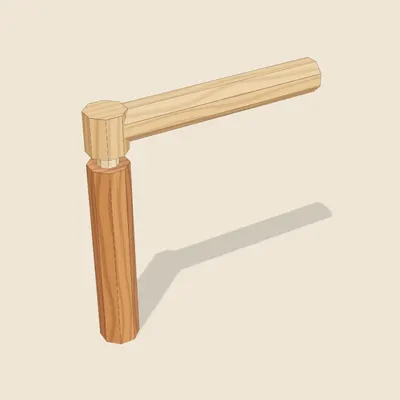
How it works
A tenon on the post
The top of the back leg (or the front post) is cut to a tenon.
A hollowed, turned-down end
The end of the crest rail or arm turns down and is hollowed out from below to take the tenon, like the bowl at the end of a pipe. Auction and museum descriptions of these chairs say the crest rail and arms join the back legs and front posts “by the pipe-bowl method”.
Why
The corner becomes one smooth curve with no projecting end. That is the difference between a southern official’s hat chair and a “four-cornered” one, whose rail and arms run past the posts.
How it's made
 Step 1
Post tenon
Cut a tenon on top of the post.
 Step 2
Turn the rail down
Shape the rail end to curve down.
 Step 3
Hollow it
Hollow a mortise into the end from below.
 Step 4
Set it on
Set the rail onto the post.
 Step 5
Smooth corner
A rounded corner, nothing sticking out.
 Step 6
Where
Typical of southern official’s hat chairs.
Variations
Arms
The arms join the front posts the same way.
Can you CNC this?
Hard on a 3-axis machine as drawn
Hard: the rail end turns down and is hollowed from below to sit over the post’s tenon, a curved, enclosed shape. It may need a 4th axis or 3D surfacing in several setups, with hand fitting.
General note: a round cutter cannot leave a sharp inside corner, so every recess keeps the tool radius. Round the mating edges or add dogbone reliefs. Sloping faces, undercuts and curves may need special bits, extra setups or more axes.
Free STL downloads (one file per part)
- Post 竖材 · wa-yandaiguo-post.stl
- Rail with hollowed end 端头挖空的横材 · wa-yandaiguo-rail.stl
Proportions are illustrative, not measured dimensions. The files are unitless: scale them to suit and check fits and allowances before cutting. Each file is a closed (watertight) solid with its mortises and slots already cut, exported in its assembled position, ready to import into CAM or modelling software. Licence: CC BY 4.0 (credit: Chinese Joinery).
Related joints
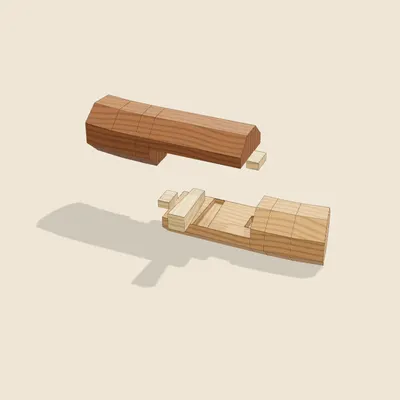
Wedged Scarf Joint
xiēdīng sǔnCurved pieces lapped with hooked tips and locked by a tapered key through the middle: how a horseshoe chair arm is built.
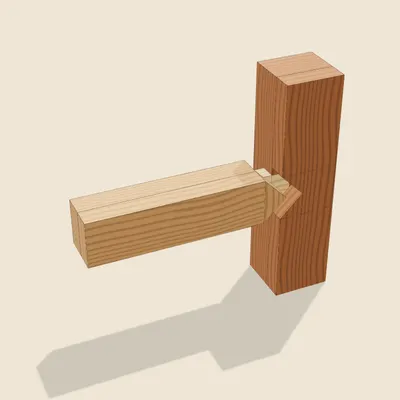
Mitred-Shoulder Joint
géjiān sǔnWhere a rail meets a post, its outer face is cut to a point that fits a matching notch, so mouldings meet cleanly.
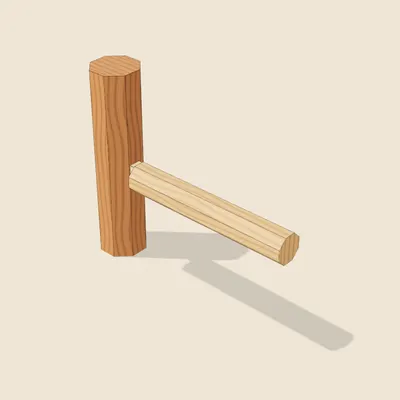
Flying Shoulder
piāo jiānRound stretcher flush with a round leg: tenon on the inner half, the outer half a shoulder that “floats” over the curve.
Questions
What is the pipe-bowl joint?
A rail end turned down and hollowed from below to sit on a post tenon, giving a rounded corner.
Which chairs use it?
Southern official’s hat chairs, whose crest rail and arms don’t project.
Why the name?
The hollowed, turned-down end looks like a tobacco-pipe bowl.