
Barrel-form stool (zuodun)
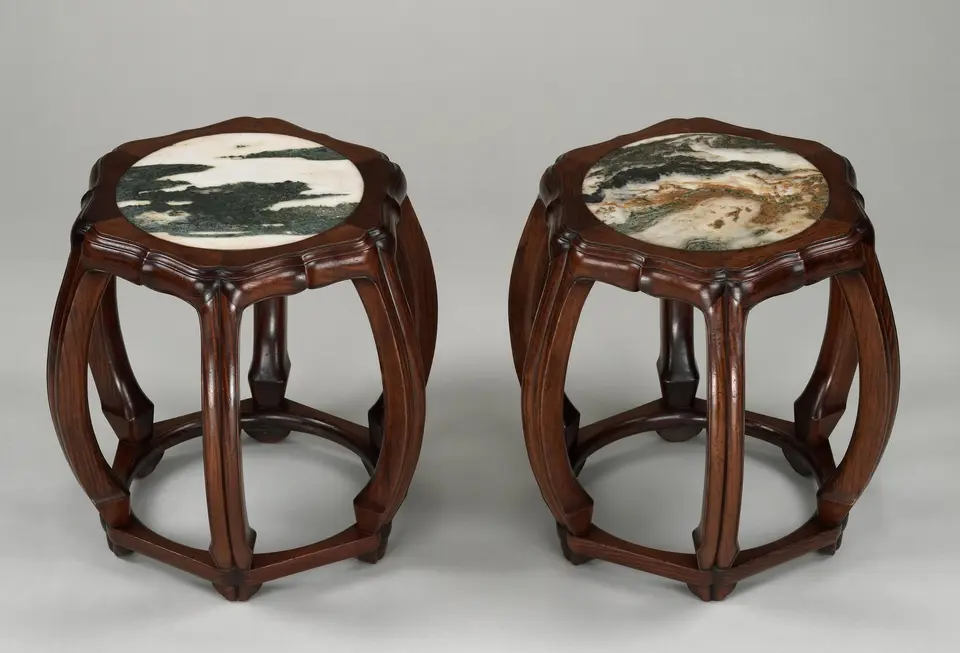
The Minneapolis Institute of Art calls barrel-form stools with four, five or six openings among the most pleasing forms of classical Chinese furniture: slender ribs, large openings and unobtrusive joinery make a light space-frame, and this pair has round marble seats. Wang Shixiang calls the form 坐墩; it is also named 绣墩, after the embroidered covers laid on it, and 鼓墩, because it looks like a drum (Wang Shixiang p.32). Here is how such stools are usually joined.
1Stone seat
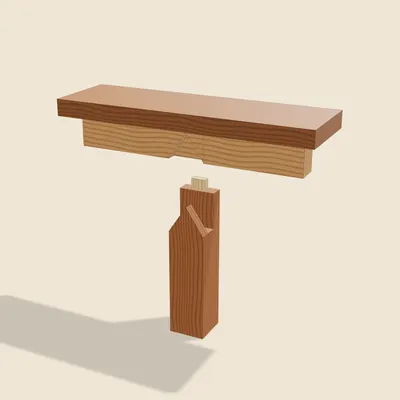
The museum notes round marble seats. A stone panel in a frame rests on cross battens rather than on battens tenoned through the frame; its edge is bevelled, wide below and narrow above, and drops into a matching bevelled rebate in the frame, which holds the stone fast. Typical practice (Wang Shixiang p.110).
2Curved legs and rings
The museum notes highly refined bridle-and-tenon joinery, each curved section fitting the next with remarkable accuracy. On some round pieces such as barrel stools, the lower ends of the legs are cut as inserted-shoulder joints into the ring below; that ring sits where a base frame would, but it is one with the legs, so the lower half repeats the construction of the upper. In the stool Wang takes as most representative of the basic Ming form, the legs are mitred above and below and meet the aprons with inserted-shoulder joints. Typical practice (Wang Shixiang p.119; p.32).
References
- Minneapolis Institute of Art, Round Stool with Stone Seat, one of a pair 2001.32.2.1 (Public Domain)
- 王世襄《明式家具研究》(Wang Shixiang, Research on Ming Furniture),第 32 页;第 189 页(名词术语简释:绣墩)
- 王世襄《明式家具研究》(Wang Shixiang, Research on Ming Furniture),第 110 页;第 119 页
The object in the museum
- Title
- Round Stool with Stone Seat, one of a pair
- Date
- late 17th century
- Material
- Huanghuali hardwood and ta-li marble
- Dimensions
- 17 × 18 1/8 × 17 in. · 43.2 × 46.0 × 43.2 cm (converted from inches)
- Collection
- Minneapolis Institute of Art · 2001.32.2.1
The museum describes barrel-form stools with four, five or six openings as very popular in the Ming and among the most pleasing forms of classical Chinese furniture: slender ribs, large openings and unobtrusive joinery make an elegant, light, airy space-frame. Few pairs in fine hardwood survive; this rare, exceptionally well-made set stands out for its round marble seats, whose bold natural patterns recall mountain landscapes. The museum calls its bridle-and-tenon joinery highly refined, each curved section fitting the next with remarkable accuracy.
More furniture
Waisted square table →Waisted stool →High-waisted table →One-leg-three-aprons table →Waistless square table →Luohan bed (couch-bed) →Square-corner cabinet →Roundback armchair →Waisted kang table →Recessed-leg table →Everted-end altar table →Corner-leg painting table →Low-back armchair (rose chair) →Compound wardrobe →Small chest with drawers →Yokeback armchair (official’s hat chair) →Folding stool (jiaowu) →Incense stand →Daybed →Display cabinet (liangge cabinet) →Portable long table (everted-end table) →Continuous-yoke armchair (southern official’s hat chair) →Round-corner cabinet (tapered) →Six-post canopy bed →Folding roundback armchair →Book-carrying cabinet →Meditation stool →Lute table (qin table) →Two-drawer table →Recessed-leg stool →Clothes rack →Cosmetic case and mirror stand →Table-top chest (seal chest) →Four-sides-square long table →