
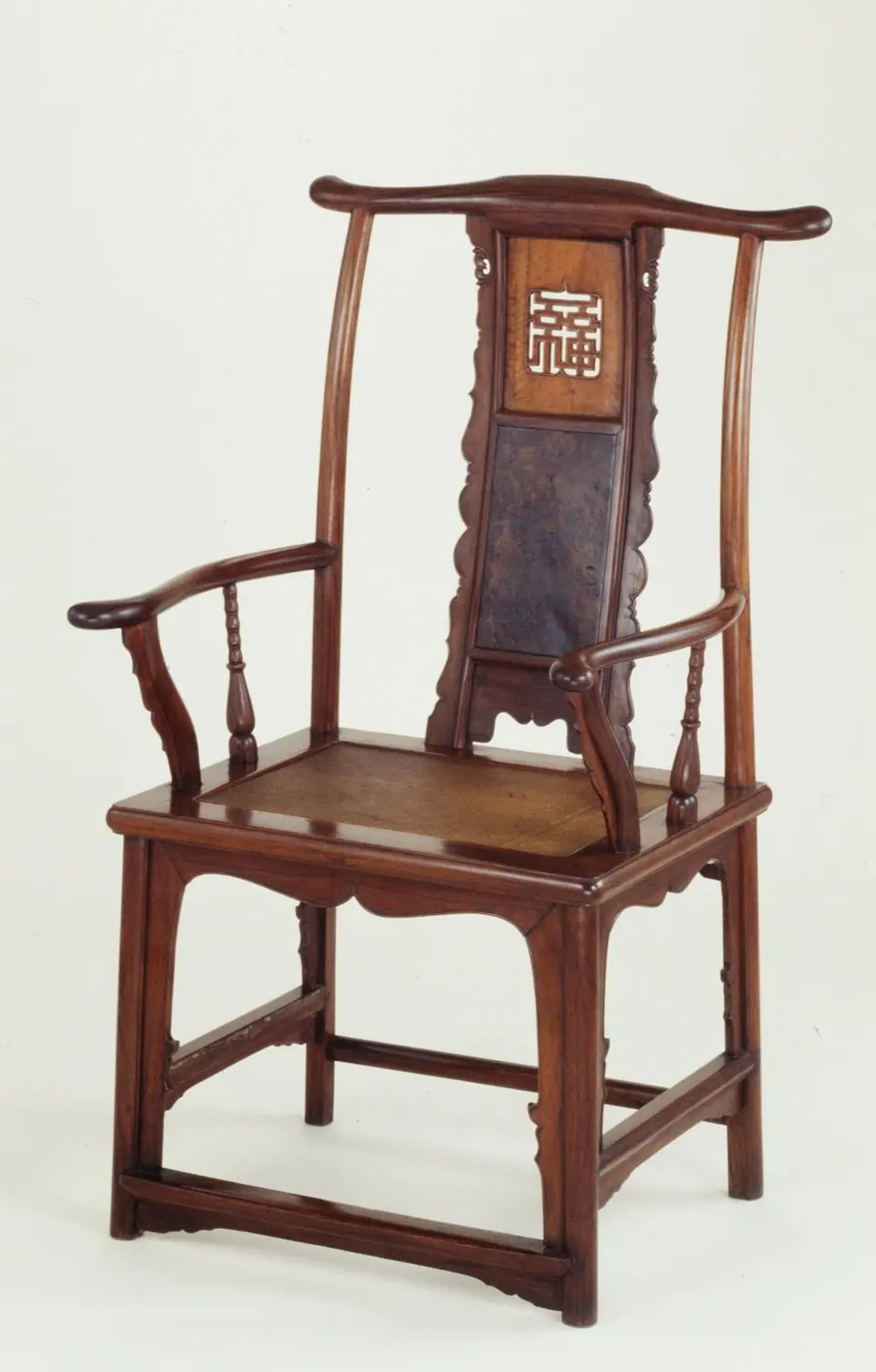
Yokeback armchair (official’s hat chair)
The Minneapolis Institute of Art counts this tall huanghuali yokeback armchair among the oldest pieces in its Chinese furniture collection: a fu character is carved in the upper part of the divided splat, and the turned arm supports take the form of bamboo in vases. An armchair whose crest-rail ends and arm ends both run past the posts is called in Chinese a four-ends-projecting official’s hat chair, 四出头官帽椅 (Wang Shixiang p.185). Here is how chairs of this kind are usually joined.
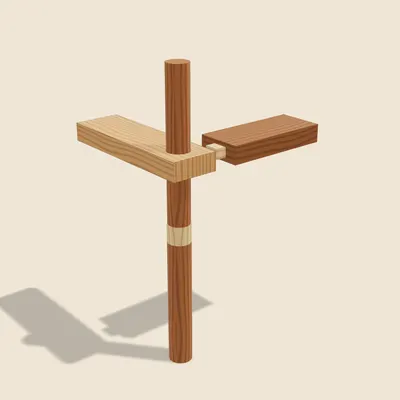
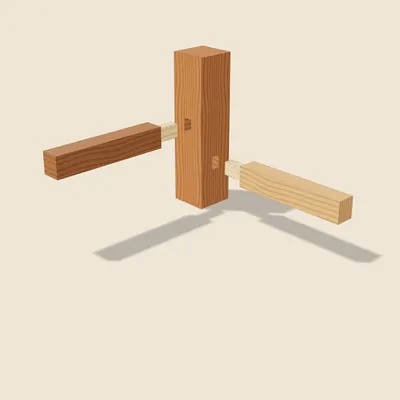
1Crest rail and arms into the posts
Because the crest-rail ends and arm ends run on past the posts, these are T-joints rather than corner joints. Where rail and post are round and equally thick, the shoulder is cut on both the inner and outer faces and the tenon sits in the centre. Typical practice (Wang Shixiang p.103).
2Arm supports
The museum notes turned arm supports shaped as bamboo stalks in vases. On armchairs this short upright stands under the arm, between the front post and the back leg; it is set into the seat below and joined to the arm above. Typical practice (Wang Shixiang p.180).
3Legs through the seat
In an ordinary armchair the seat frame is bored at its four corners and the front and back legs pass through, so each upright runs on above the seat as a back or arm post. Typical practice (Wang Shixiang p.117).
4Seat frame
A mitred frame that either holds a floating panel or carries a woven soft seat laced through holes along its inner edge, over battens that bow slightly downward. Typical practice (Wang Shixiang p.110).
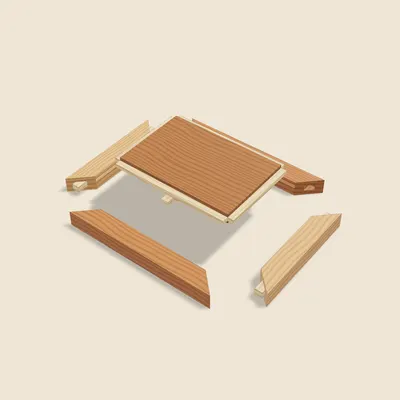
Frame and Floating Panel
cuánbiān dǎcáo zhuāngbǎnA mitred frame grooved on the inside, a thin panel with a tongued edge floating in the groove, and battens underneath.
Explore the joint →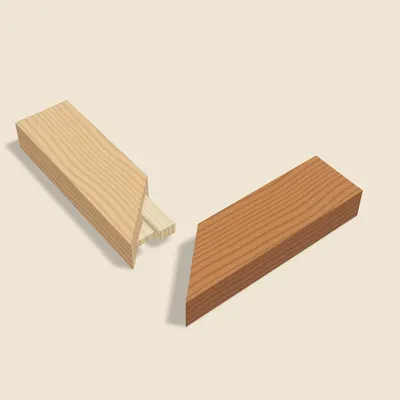
Mitred Frame Joint
géjiǎo sǔnThe 45° corner of every Chinese frame-and-panel top: a tenon through the end plus a little triangular tongue.
Explore the joint →5Stretchers
Chairs usually have four stretchers: the front one sits low as a footrest and the others at different heights, so the mortises do not meet at one spot. Typical practice (Wang Shixiang p.105).
References
- Minneapolis Institute of Art, Yokeback Armchair 95.93.1 (Public Domain)
- 王世襄《明式家具研究》(Wang Shixiang, Research on Ming Furniture),第 103 页;图 3.8a–c 见第 104 页;第 105 页;图 3.14a、3.14b 见第 107 页
- 王世襄《明式家具研究》(Wang Shixiang, Research on Ming Furniture),第 110 页;第 117 页;图 3.38a 见第 116 页
- 王世襄《明式家具研究》(Wang Shixiang, Research on Ming Furniture),第 180 页(名词术语简释:联帮棍);第 185 页(名词术语简释:四出头官帽椅)
The object in the museum
- Title
- Yokeback Armchair
- Date
- c. 1550
- Material
- Huanghuali hardwood and burlwood
- Dimensions
- 45 1/2 × 25 1/2 × 24 3/4 in. · 115.57 × 64.77 × 62.87 cm (converted from inches)
- Collection
- Minneapolis Institute of Art · 95.93.1
The museum calls this grand armchair one of the oldest pieces in its Chinese furniture collection, sharing construction features and carved details with six nearly identical chairs in Chinese and Western collections: a fu character (happiness and good fortune) in the upper part of the carved, divided splat, and turned arm supports shaped as bamboo stalks in vases, a rebus for peace and virtue. Tall armchairs were reserved for the most important members of a family and for guests of high status.
More furniture
Waisted square table →Waisted stool →High-waisted table →One-leg-three-aprons table →Waistless square table →Luohan bed (couch-bed) →Square-corner cabinet →Roundback armchair →Waisted kang table →Recessed-leg table →Everted-end altar table →Corner-leg painting table →Low-back armchair (rose chair) →Compound wardrobe →Small chest with drawers →Folding stool (jiaowu) →Incense stand →Daybed →Barrel-form stool (zuodun) →Display cabinet (liangge cabinet) →Portable long table (everted-end table) →Continuous-yoke armchair (southern official’s hat chair) →Round-corner cabinet (tapered) →Six-post canopy bed →Folding roundback armchair →Book-carrying cabinet →Meditation stool →Lute table (qin table) →Two-drawer table →Recessed-leg stool →Clothes rack →Cosmetic case and mirror stand →Table-top chest (seal chest) →Four-sides-square long table →