
Yuancai Mensun (圆材闷榫): the Hidden Mitred Corner of Round Chair Parts
Round-stock hidden corner · 圆材闷榫角接合 · 出榫一单一双
Where a chair’s top rail turns down into the back leg, the corner can be made in one smooth bend.
The hidden corner does it with a mitre and tenons you never see.
- Chinese
- 圆材闷榫角接合 · yuáncái mènsǔn
- Joins
- Two round members at a corner
- Found in
- Chair top rails and back legs, arms and front posts
- Signature parts
- 45° mitre · one tenon and a pair · hidden
- Compare
- Square-stock hidden corner
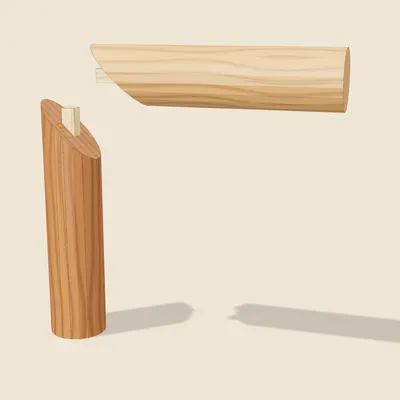
How it works
A hidden corner
Where a top rail meets the back legs, or an arm meets the front posts, the two members are cut to 45° and meet in a mitre. The tenons stay inside, so the joint has to be glued.
One and two
Wang Shixiang describes two ways: each end puts out a single tenon, or one end puts out one tenon and the other a pair. Fitted together, the tenons stop the members being pulled apart in a straight line.
How it's made
 Step 1
Corner
Two round members turn a corner.
 Step 2
Mitre
Both ends cut to 45°.
 Step 3
Single
One end: a single tenon.
 Step 4
Pair
The other: a pair.
 Step 5
Together
Each enters the other member.
 Step 6
Hidden
Only the mitre line shows.
Variations
Single tenons
Each end puts out one tenon (square stock: see the square-stock hidden corner).
Pipe-bowl corner
The rail turns down over a tenon on the leg (挖烟袋锅).
Can you CNC this?
Hard on a 3-axis machine as drawn
The tenons and mortises sit on 45° end faces of round stock, so each part needs a jig that holds it round and at an angle; the hidden mortises are deep, narrow pockets.
Free STL downloads (one file per part)
- Round post with one tenon 竖材(出单榫) · yuancai-mensun-post.stl
- Round rail with two tenons 横材(出双榫) · yuancai-mensun-rail.stl
Before cutting or printing, read the CNC and 3D-printing notes on tool radius, scaling the STL files and their licence.
Related joints
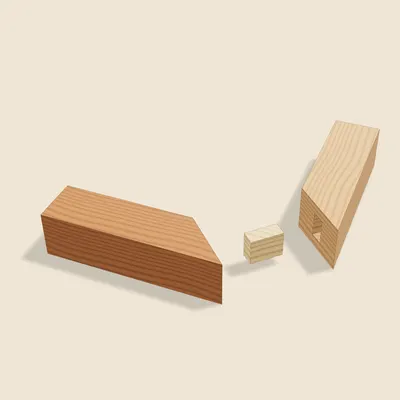
Hidden Mitre With a Loose Block
fāngcái mènsǔn jiǎo jiēhéBoth members are cut to 45°, a socket is cut in each mitre face, and a rectangular block is glued into both: only a mitre line shows.
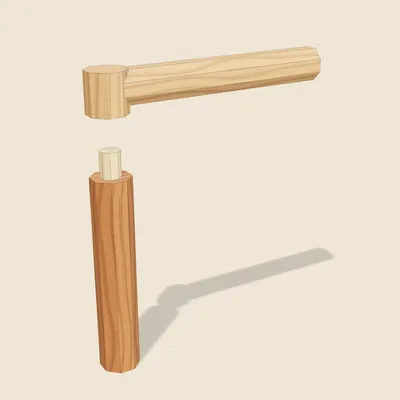
Pipe-Bowl Joint
wā yāndàiguō sǔnThe rail end turns down and is hollowed from below like a pipe bowl to sit on the post’s tenon: a rounded corner with no projecting end.
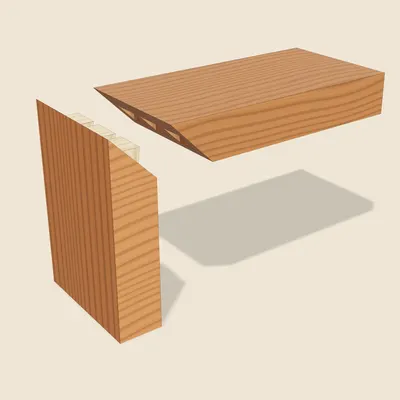
Hidden Mitred Dovetail
mèn sǔnDovetails hidden inside a mitred corner: once closed, only a single seam line shows.
Questions
Why hide the tenons?
So the corner looks like one smooth bend.
Why one and two?
The tenons interlock so the parts cannot be pulled straight apart.
Where is it used?
Chair top rails and arms.
Further reading
- 王世襄《明式家具研究》(Wang Shixiang, Research on Ming Furniture),第 106 页
- 王世襄《明式家具研究》(Wang Shixiang, Research on Ming Furniture),第 107 页,图 3.16b