
Clothes rack
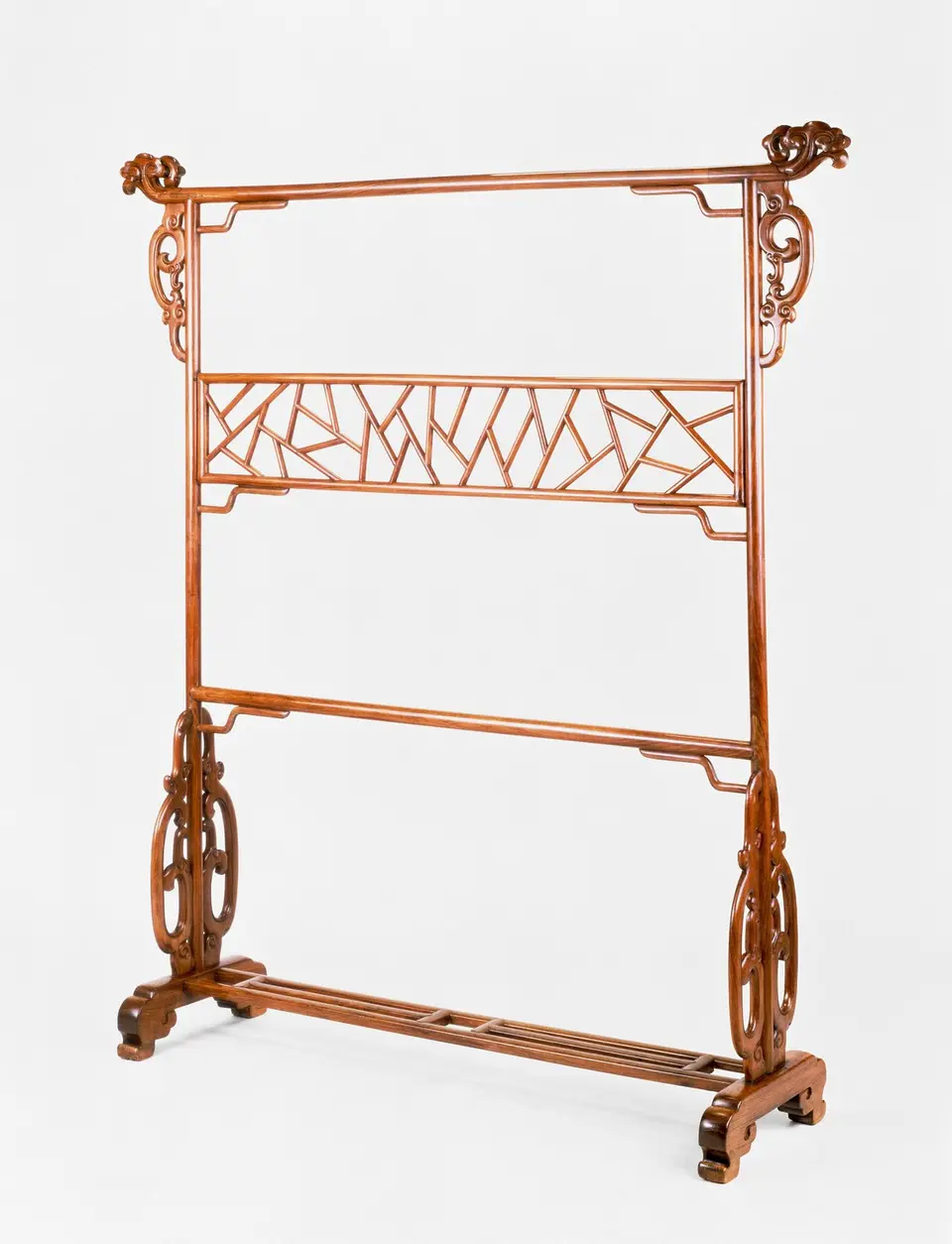
The Minneapolis Institute of Art explains that the traditional Chinese house had no closets, so the clothes rack served as a temporary one, letting several layers of clothing be taken off or put back on with ease, and also displayed fashionable garments. Clothes racks were common in the sleeping quarters of both men and women, yet only a few hardwood examples survive. Despite several old repairs, this one keeps its extremely simple design. Wang Shixiang defines 衣架 as a stand for hanging clothes over (p.189).
1Top rail
The museum notes that the top rail is decorated at each end with the lingzhi, the fungus of immortality.
2Central panel
The museum notes that the central panel is made up of the so-called cracked-ice pattern. The panel set in the middle of a clothes rack is called 中牌子 (Wang Shixiang p.191); the cracked-ice pattern imitates cracking ice, for example as a lattice of short straight pieces (Wang Shixiang p.171).
References
- Minneapolis Institute of Art, Clothes Rack 96.120.5 (Public Domain)
- 王世襄《明式家具研究》(Wang Shixiang, Research on Ming Furniture),第 171 页(名词术语简释:冰裂纹、冰绽纹);第 189 页(名词术语简释:衣架);第 191 页(名词术语简释:中牌子)
The object in the museum
- Title
- Clothes Rack
- Date
- 17th century
- Material
- Huanghuali hardwood
- Dimensions
- 71 1/2 × 65 × 17 3/4 in. · 181.61 × 165.1 × 45.09 cm (converted from inches)
- Collection
- Minneapolis Institute of Art · 96.120.5
The museum explains that the traditional Chinese house had no closets, but the clothes rack served as a temporary closet, allowing several layers of clothing to be shed or put back on with convenience, and also displayed fashionable clothing. While a clothes rack was a common piece of furniture in the sleeping quarters of both men and women, only a few hardwood examples have survived. In spite of several old repairs, this stand has kept its extremely simple design. The top rail is decorated at each end with the lingzhi fungus of immortality, and the central panel is made up of the so-called cracked-ice pattern.
More furniture
Waisted square table →Waisted stool →High-waisted table →One-leg-three-aprons table →Waistless square table →Luohan bed (couch-bed) →Square-corner cabinet →Roundback armchair →Waisted kang table →Recessed-leg table →Everted-end altar table →Corner-leg painting table →Low-back armchair (rose chair) →Compound wardrobe →Small chest with drawers →Yokeback armchair (official’s hat chair) →Folding stool (jiaowu) →Incense stand →Daybed →Barrel-form stool (zuodun) →Display cabinet (liangge cabinet) →Portable long table (everted-end table) →Continuous-yoke armchair (southern official’s hat chair) →Round-corner cabinet (tapered) →Six-post canopy bed →Folding roundback armchair →Book-carrying cabinet →Meditation stool →Lute table (qin table) →Two-drawer table →Recessed-leg stool →Cosmetic case and mirror stand →Table-top chest (seal chest) →Four-sides-square long table →