
Folding roundback armchair
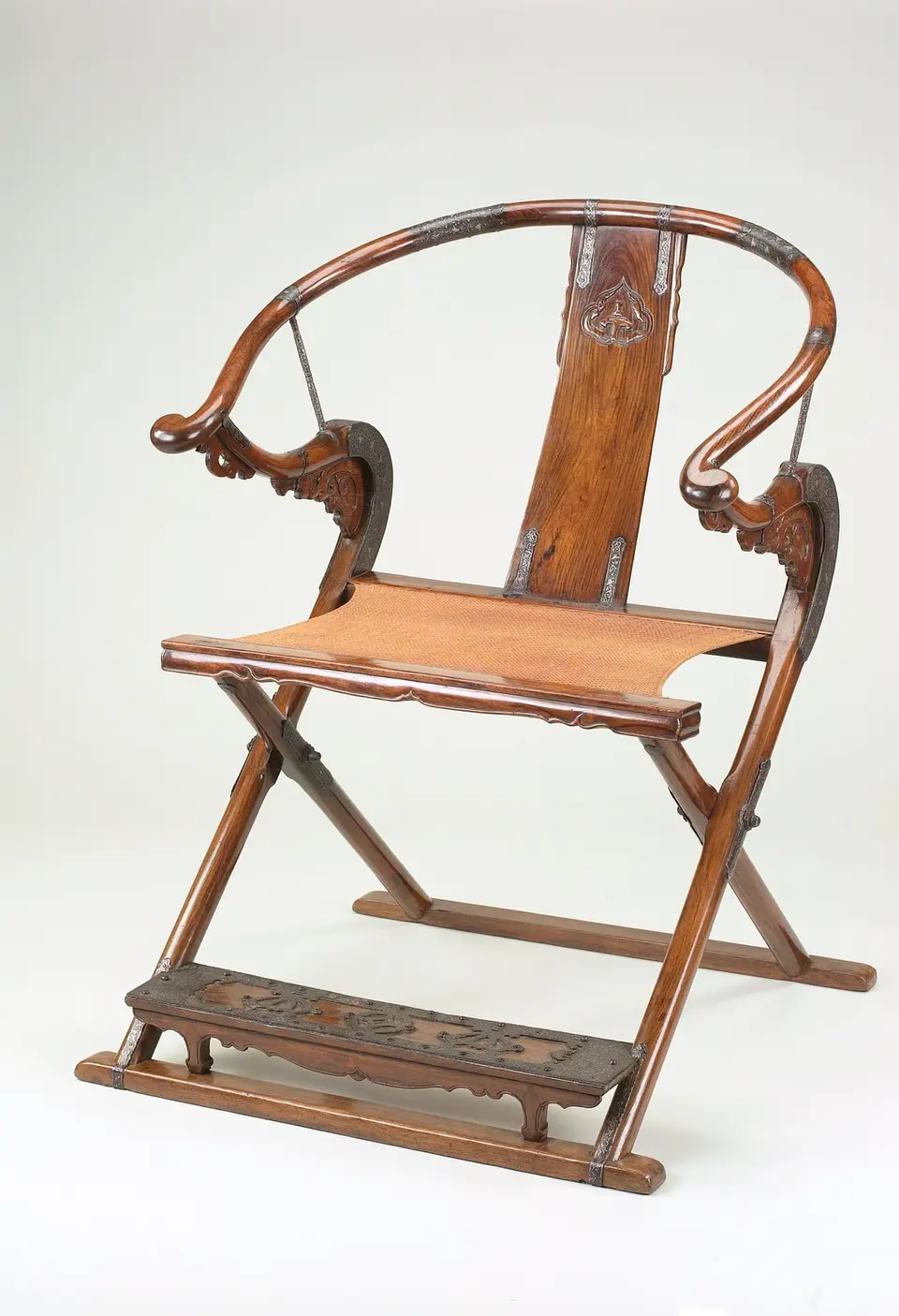
The Minneapolis Institute of Art calls the round-back folding armchair one of the most elegant designs of Chinese cabinetmakers, a combination of utility and ceremonial grandeur. This chair is an exact mate to one in the Shanghai Museum and keeps its original patina, its carving and most of its iron fittings. Comfortable and portable, such chairs were reserved for persons of high rank, and paintings often show them before solid screens as the seat of honour for greeting important guests. A folding chair whose back is like that of a roundback armchair is called 圆后背交椅 (Wang Shixiang p.190). Here is how chairs of this kind are usually joined.
1Curved arm rail
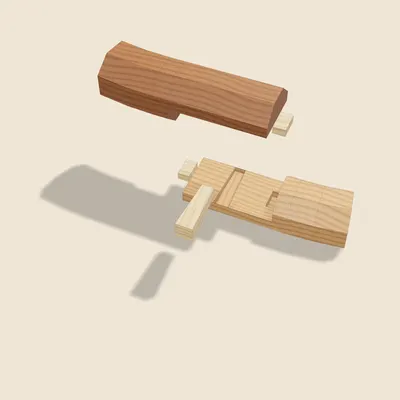
This folding chair has a back like a roundback armchair (Wang Shixiang p.190). The round arm rail of a roundback armchair, the “crescent armrest”, is made of curved pieces joined end to end, sometimes with a wedged scarf joint: the two ends are lapped half over half, small tongues lock them, and a square tapering wedge is driven through the lap; some add two round wooden pins. Because the rail is round and thin, this joint must be made with particular care. Typical practice (Wang Shixiang p.106).
2Crossed legs and pivot
The museum notes that the chair keeps most of its iron fittings, which are inlaid with a scrolling lotus design. On folding stools and folding chairs an iron pin passes through the front and back legs as the pivot (Wang Shixiang p.191). The pivot is a metal pin, not a wooden joint, so no joint guide is linked here.
3Footrest
The museum notes an openwork iron plaque bearing auspicious Buddhist “treasure” emblems, attached to the footrest with iron bosses.
References
- Minneapolis Institute of Art, Folding round-back armchair 98.80.3 (Public Domain)
- 王世襄《明式家具研究》(Wang Shixiang, Research on Ming Furniture),第 106 页;图 3.22a、3.22b 见第 109 页
- 王世襄《明式家具研究》(Wang Shixiang, Research on Ming Furniture),第 190 页(名词术语简释:圆后背交椅、月牙扶手);第 191 页(名词术语简释:轴钉)
The object in the museum
- Title
- Folding round-back armchair
- Date
- late 16th century
- Material
- Huanghuali hardwood with iron hardware
- Dimensions
- 41 3/16 × 30 1/8 × 30 in. · 104.62 × 76.52 × 76.2 cm (converted from inches) (unfolded)
- Collection
- Minneapolis Institute of Art · 98.80.3
The museum notes that many consider the round-back folding armchair one of the most elegant designs created by Chinese cabinetmakers, a unique combination of utility and ceremonial grandeur. This large, harmoniously proportioned chair is an exact mate to one now in the Shanghai Museum. It retains its original patina, its decorative carving and most of its iron fittings, which are inlaid with a scrolling lotus design. An openwork iron plaque bearing auspicious Buddhist “treasure” emblems is attached to the footrest with iron bosses. Both comfortable and portable, folding chairs like this were reserved for persons of high rank; paintings often show them in front of solid screens as the seat of honour from which to greet important guests at formal gatherings.
More furniture
Waisted square table →Waisted stool →High-waisted table →One-leg-three-aprons table →Waistless square table →Luohan bed (couch-bed) →Square-corner cabinet →Roundback armchair →Waisted kang table →Recessed-leg table →Everted-end altar table →Corner-leg painting table →Low-back armchair (rose chair) →Compound wardrobe →Small chest with drawers →Yokeback armchair (official’s hat chair) →Folding stool (jiaowu) →Incense stand →Daybed →Barrel-form stool (zuodun) →Display cabinet (liangge cabinet) →Portable long table (everted-end table) →Continuous-yoke armchair (southern official’s hat chair) →Round-corner cabinet (tapered) →Six-post canopy bed →Book-carrying cabinet →Meditation stool →Lute table (qin table) →Two-drawer table →Recessed-leg stool →Clothes rack →Cosmetic case and mirror stand →Table-top chest (seal chest) →Four-sides-square long table →