Ji Xie (挤楔): The Tightening Wedge in Chinese Joinery
Tightening wedge · 楔子
A tenon cut to fit perfectly today may be loose after a few humid summers and dry winters.
Chinese makers often made the tenon a little small on purpose and closed the gap with a ji xie, a squeezing wedge.
- Chinese
- 挤楔 · jǐ xiē
- Also called
- 楔子
- Joins
- Tenon to mortise
- Found in
- Many furniture joints
- Compare
- Wedge in the tenon end (破头楔)
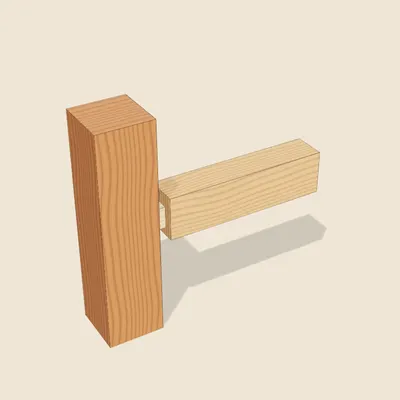
How it works
A thin, tapered wedge
The wedge is a triangular sliver of wood, thick at one end and thin at the other.
Tenon a little small
The tenon is made smaller than the mortise. After assembly the gap between them is filled by driving in the wedge, which squeezes the joint tight.
Also for adjusting
Because the wedge can be driven further on one side or the other, it also helps adjust the position of the parts.
How it's made
 Step 1
Tenon a little small
Cut the tenon slightly smaller than the mortise.
 Step 2
Room for a wedge
The mortise leaves room for a wedge.
 Step 3
The wedge
Make a thin wedge, wide at one end.
 Step 4
Fit the rail
Fit the rail first.
 Step 5
Drive the wedge
Drive the wedge into the gap.
 Step 6
Tight
The joint is squeezed tight.
Variations
Through tenons
On through tenons the wedge can go into the end instead: see the split-head wedge.
Can you CNC this?
Yes, with small changes
Mortise and tenon are cut as usual with rounded corners, the mortise a little larger. The tapered wedge can be cut from a board lying flat.
General note: a round cutter cannot leave a sharp inside corner, so every recess keeps the tool radius. Round the mating edges or add dogbone reliefs. Sloping faces, undercuts and curves may need special bits, extra setups or more axes.
Free STL downloads (one file per part)
Proportions are illustrative, not measured dimensions. The files are unitless: scale them to suit and check fits and allowances before cutting. Each file is a closed (watertight) solid with its mortises and slots already cut, exported in its assembled position, ready to import into CAM or modelling software. Licence: CC BY 4.0 (credit: Chinese Joinery).
Related joints
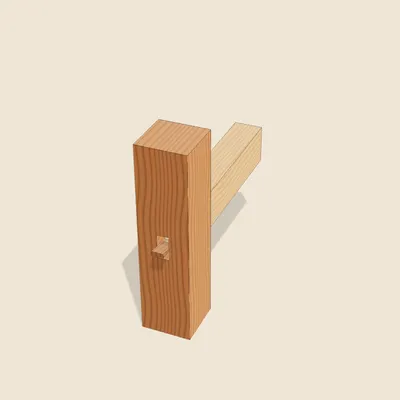
Wedged Through Tenon
pòtóu xiēA kerf is sawn into the end of a through tenon; once the tenon is in, a wedge is driven in and spreads it tight.
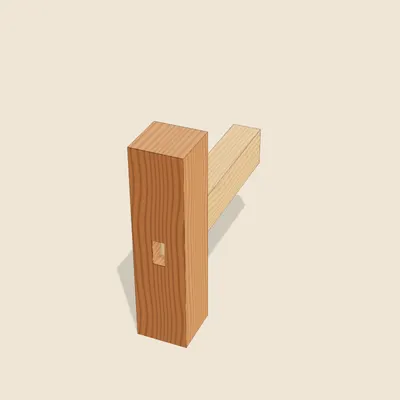
Through Tenon
tòu sǔnThe tenon runs right through and its end grain shows on the far side: strong, but less neat than a blind tenon.
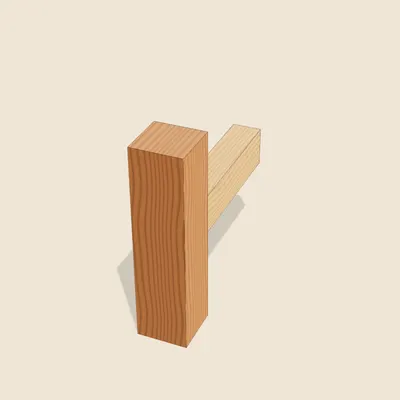
Blind Tenon
bàn sǔnThe tenon stops inside the post, so nothing shows on the outside: neat, a little less strong than a through tenon.
Questions
What is a ji xie?
A tapered wedge driven between tenon and mortise to tighten the joint.
Why not just cut a tight tenon?
The wedge closes the gap after assembly and lets the position be adjusted.
Where is the wedge?
In the gap beside the tenon, here drawn above it.