Simian Ping (四面平): The Flush Table Corner
Four sides flush · 挂肩四面平榫
Some Ming tables look like a plain box on four legs: leg, apron and top all lie in one flat face on every side.
That is the four sides flush form, and it needs its own corner joint.
- Chinese
- 四面平 · sì miàn píng
- Also called
- 挂肩四面平榫
- Joins
- Leg, aprons and top
- Found in
- Flush-sided tables, beds and stools
- Compare
- Waisted corner · Three-way mitre
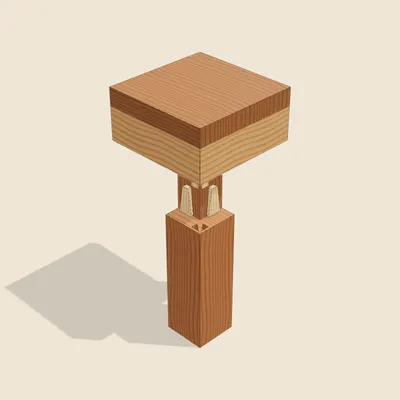
How it works
Two ways to build it
Wang Shixiang describes two constructions for flush-sided tables: one with the top fitted separately, and one using the three-way mitre (粽角榫). Because the first is not seen on other furniture, he calls it the “flush-sided joint”.
No waist
The leg has no waist. Right under its long-and-short tenons it is cut with a mitred shoulder and tenon, and on each of two faces it keeps a hanging pin whose section is half a dovetail. The pins hook into slots in the aprons.
Then the top
When the four aprons and four legs are together, the long-and-short tenons go into mortises in the top. A description of table forms adds that the aprons of flush-sided tables are much deeper and thicker, which is why the joints differ from waisted ones.
How it's made
 Step 1
All flush
Leg, apron and top all flush.
 Step 2
No waist
A mitred shoulder right under the tenons.
 Step 3
Hanging pins
A half-dovetail pin on each face.
 Step 4
Aprons on
Aprons hooked on from above.
 Step 5
Top on
Long-and-short tenons into the top.
 Step 6
A box-like corner
A plain, box-like corner.
Variations
Three-way mitre
The other construction uses the three-way mitre (粽角榫).
Can you CNC this?
Hard on a 3-axis machine as drawn
Hard as drawn, for the same reasons as the waisted corner: the tapered half-dovetail hanging pins and the slots behind the aprons are undercut in two directions. The flush mitre and the long-and-short tenons are manageable; the pins may need simplifying to straight-sided keys cut with a dovetail bit.
General note: a round cutter cannot leave a sharp inside corner, so every recess keeps the tool radius. Round the mating edges or add dogbone reliefs. Sloping faces, undercuts and curves may need special bits, extra setups or more axes.
Free STL downloads (one file per part)
- Leg 腿足 · simian-ping-leg.stl
- Apron (front) 牙条(正面) · simian-ping-apron-front.stl
- Apron (side) 牙条(侧面) · simian-ping-apron-side.stl
- Top (simplified slab) 面(简化为整板) · simian-ping-top.stl
Proportions are illustrative, not measured dimensions. The files are unitless: scale them to suit and check fits and allowances before cutting. Each file is a closed (watertight) solid with its mortises and slots already cut, exported in its assembled position, ready to import into CAM or modelling software. Licence: CC BY 4.0 (credit: Chinese Joinery).
Related joints
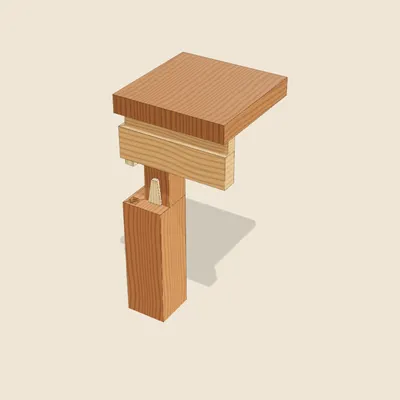
Baojian Joint
bàojiān sǔnThe hidden lock behind every waisted Ming table corner: a mitred shoulder, a triangular tenon and a tapered pin.
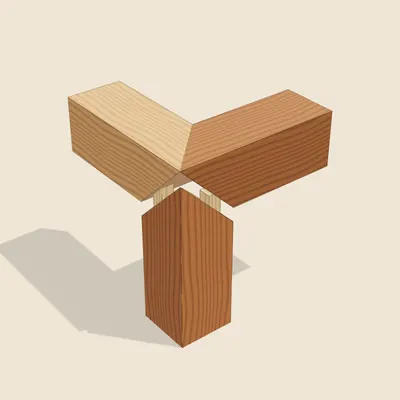
Zongjiao Joint
zòngjiǎo sǔnThree members, three 45° mitres, one perfect point: the corner joint of flush-sided tables and cabinets.
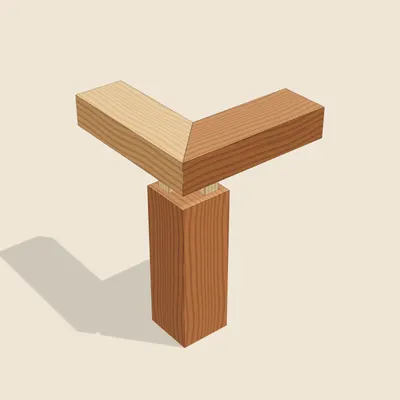
Long-and-Short Tenons
chángduǎn sǔnTwo tenons at right angles on the top of a leg: a long one for the long side, a short one for the end.
Questions
What does 四面平 mean?
“Four sides flush”: leg, apron and top in one face.
How is it different from a waisted corner?
There is no waist; the mitred shoulder sits right under the top.
What holds the aprons?
Half-dovetail hanging pins on the leg.