
Menzhou and Lianying (门轴、连楹、门枕、门簪): How a Chinese Gate Door Turns
Door pivot · 门轴 · 连楹 · 门簪 · 门枕 · 海窝
A Chinese gate door has no hinges.
It turns on two pivots cut on its own stile, one above and one below.
- Chinese
- 门轴 · 连楹 · 门簪 · 门枕 · 海窝
- Joins
- Door stile to the sills; pivot bar to the middle sill
- Found in
- Gate doors and other large doors
- Signature parts
- Pivots · pivot bar · door pins · iron cup
- Compare
- Sliding key
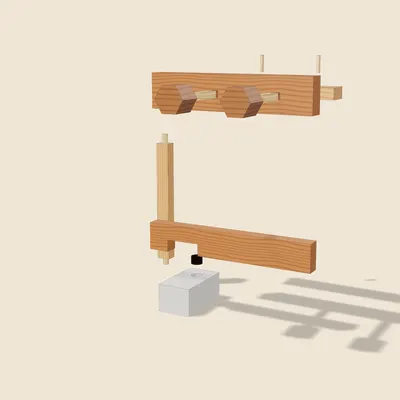
How it works
Top: the pivot bar
Behind the middle sill (中槛) a timber called the 连楹 is fixed along its inside face, with a socket for the door’s top pivot. Ma Bingjian gives its width as two thirds of the sill’s height and its thickness as half its width.
Door pins
For a large door the sill and pivot bar are locked together by 门簪: each has a hexagonal head on the outside, about four fifths of the sill’s height across, and a long tenon that passes through the sill and the bar and is wedged behind. Usually four are used, two on a small door; the heads are often carved. Ma treats them as a typical through-pin.
Bottom: stone and iron
The bottom pivot turns in a cast-iron cup (海窝) set into a stone block, the door-pillow stone (门枕石), which sits under the bottom sill, the sill being notched to fit over it.
The Song version
The Yingzao Fashi (1103, juan 6, 版門) builds a board door on a heavy edge board (肘版) that is left long top and bottom as pivots. Above, the pivot turns in a cross-piece called 雞栖木, the Song name for the pivot bar; below, in a door stone (門砧). Tall doors use iron sleeves, an iron socket plate (鵝臺) and an iron shoe. Its door pins (門簪) come four to a door, and each is divided in three along its tail so that only the middle third is left as the tenon. All sizes are given per foot of door height.
Liang Sicheng’s summary
Liang Sicheng (清式營造則例, ch.5) describes the Qing gate the same way: the pivot’s top passes into the pivot bar (連楹) and its foot stands on the door-stone (門枕); door pins with six-sided heads hold the pivot bar to the middle sill, and the door-stone can be carved in many shapes.
Proportions in the model are illustrative.
How it's made
 Step 1
Pivots
The door turns on two pivots.
 Step 2
Pivot bar
Top pivot turns in the 连楹.
 Step 3
Door pins
门簪 pass through both.
 Step 4
Wedges
Wedged behind.
 Step 5
Iron cup
Bottom pivot in an iron cup.
 Step 6
Stone
The stone sits under the sill.
Variations
Solid plank door (实榻门)
The heaviest gate door: thick planks joined edge to edge and locked by battens, either on the inside face or hidden in through-holes so both faces stay flat. Its battens line up with the rows of door studs.
Framed door (攒边门)
A lighter door for houses: a thick frame mitred at the corners with through-tenons, holding a thin panel whose battens tenon through the stiles.
Without door pins
If there are no 门簪, the sill and pivot bar are held with hidden pins and iron nails.
Lattice doors
Lattice doors use smaller single or double blocks inside the bottom sill for their lower pivots.
Can you CNC this?
Possible, with design or setup changes
The sill and pivot bar mortises are straight through-slots and the pivot sockets are drilled. The round pivots on the stile end need the stile held on end or turned; the hexagonal pin heads and their carving are separate work, and the stone and iron cup are not wood.
Free STL downloads (one file per part)
- Door-pillow stone 门枕石 · menzhou-lianying-door-pillow-stone.stl
- Iron pivot cup 海窝 · menzhou-lianying-iron-cup.stl
- Bottom sill 下槛 · menzhou-lianying-bottom-sill.stl
- Middle sill 中槛 · menzhou-lianying-middle-sill.stl
- Pivot bar 连楹 · menzhou-lianying-pivot-bar.stl
- Door pin 1 门簪1 · menzhou-lianying-door-pin-1.stl
- Door pin 2 门簪2 · menzhou-lianying-door-pin-2.stl
- Wedge 1 楔子1 · menzhou-lianying-wedge-1.stl
- Wedge 2 楔子2 · menzhou-lianying-wedge-2.stl
- Hanging stile with pivots 门边(带门轴) · menzhou-lianying-hanging-stile.stl
Before cutting or printing, read the CNC and 3D-printing notes on tool radius, scaling the STL files and their licence.
Related joints
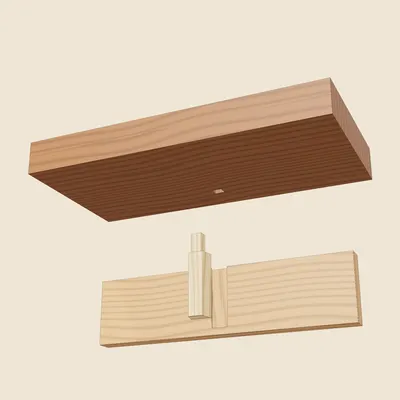
Sliding Key Through an Apron
chuān xiāoA long key with a half-dovetail section slides through a groove in the back of an apron, its top tenoned into the frame above, holding the apron flat.
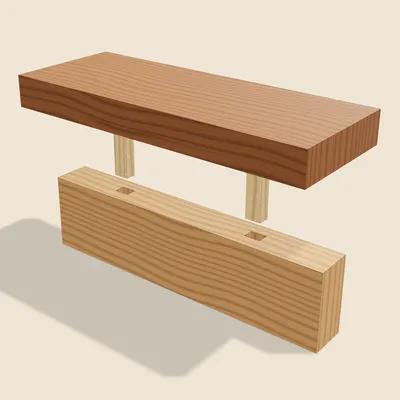
Loose Tenon
zāi xiāoThe tenon is a separate piece of wood planted into mortises in both parts, easy to replace if it wears.
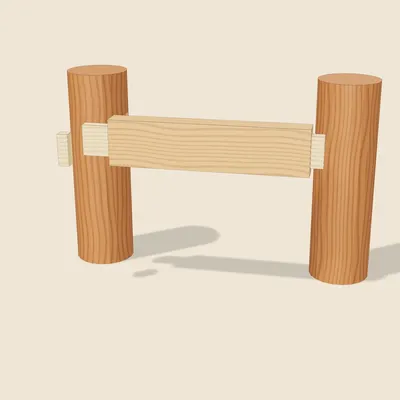
Back-Drawn Sill Tenons
dàotuì sǔnA sill fitted between standing columns has one long and one short tenon: the long end goes in first, then the sill is drawn back so the short end enters, and the gap is packed.
Questions
Where are the hinges?
There are none: the stile’s pivots turn in sockets.
What are the hexagonal knobs over a gate?
The heads of the 门簪 that lock the pivot bar to the sill.
Why an iron cup?
So the bottom pivot turns without wearing the stone.
Further reading
- 马炳坚《中国古建筑木作营造技术》第二版(Ma Bingjian, Timber Construction Techniques of Traditional Chinese Buildings, 2nd ed.),第 263 页,图 7-1
- 马炳坚《中国古建筑木作营造技术》第二版(Ma Bingjian, Timber Construction Techniques of Traditional Chinese Buildings, 2nd ed.),第 264 页
- 马炳坚《中国古建筑木作营造技术》第二版(Ma Bingjian, Timber Construction Techniques of Traditional Chinese Buildings, 2nd ed.),第 126 页,图 3-12
- 马炳坚《中国古建筑木作营造技术》第二版(Ma Bingjian, Timber Construction Techniques of Traditional Chinese Buildings, 2nd ed.),第 266 页,图 7-3
- 马炳坚《中国古建筑木作营造技术》第二版(Ma Bingjian, Timber Construction Techniques of Traditional Chinese Buildings, 2nd ed.),第 270–271 页,图 7-7、7-10
- 李誡《營造法式》卷六 小木作制度一:版門(肘版、雞栖木、門簪、門砧、鵝臺)
- 梁思成《清式營造則例》(Liang Sicheng, Qingshi yingzao zeli, 1934),第五章 裝修:大門(NLC 掃描本 PDF 第 102 頁)