
Guotui Zuo (裹腿做): How a Wrapped-Leg Stool Joins Its Legs to the Seat
Wrapped-leg stool · 裹腿做杌凳
Wrapped-leg furniture imitates bamboo, with members that seem to wrap around the legs.
Under the seat this means an extra border, and the leg tenons pass right through it.
- Chinese
- 裹腿做 · guǒtuǐ zuò
- Joins
- Leg, under-seat border, seat
- Found in
- Waistless stools and tables in the wrapped-leg style
- Signature parts
- Mitred border · long and short tenons through it
- Compare
- Waistless stool
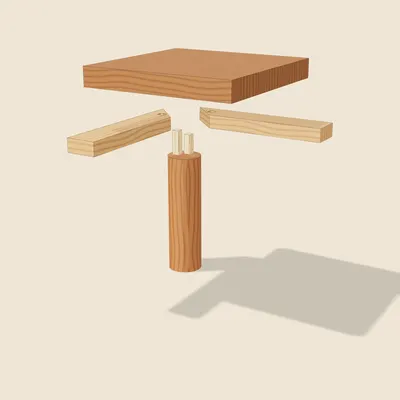
How it works
An extra border
Wrapped-leg stools and tables have no waist, but an added border (垛边) runs under the seat frame. Its pieces meet at the corners in a mitre and are mortised for the leg.
Through, then in
The leg’s long-and-short tenons first pass through the border’s mortises and then fit into the mortises at the corners of the seat. Wang Shixiang notes that for this reason they are often longer than the leg tenons of an ordinary waistless piece.
How it's made
 Step 1
Parts
Leg, border and seat.
 Step 2
Tenons
Long and short tenons on the leg.
 Step 3
Border
Border pieces mitred at the corner.
 Step 4
Through
Tenons pass through the border.
 Step 5
Seat
Then into the seat.
 Step 6
Longer
Tenons longer than usual.
Variations
Plain waistless stool
Without the border, the tenons go straight into the seat.
Can you CNC this?
Possible, with design or setup changes
The border pieces are straight bars with mitres and through mortises, and the seat mortises are blind pockets. The round leg's tenons need the leg held on end or on a 4th axis.
Free STL downloads (one file per part)
- Round leg with long and short tenons 圆腿(带长短榫) · guotui-wudeng-leg.stl
- Under-seat border (front) 垛边(正面) · guotui-wudeng-border-front.stl
- Under-seat border (side) 垛边(侧面) · guotui-wudeng-border-side.stl
- Seat (simplified slab) 凳面(简化为整板) · guotui-wudeng-seat.stl
Before cutting or printing, read the CNC and 3D-printing notes on tool radius, scaling the STL files and their licence.
Related joints
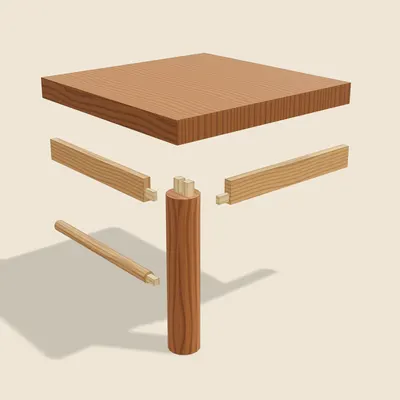
Waistless Stool: Leg to Seat
wú shùyāo wùdèngWithout a waist the aprons sit right under the seat: the round leg tenons up into the seat frame, and the aprons and stretchers tenon into the leg.
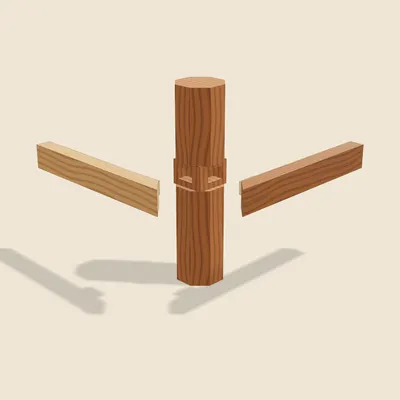
Wrap-Around Stretcher
guǒtuǐ chéngStretchers stand proud of a round leg and meet in a mitre at the corner, imitating bent bamboo.
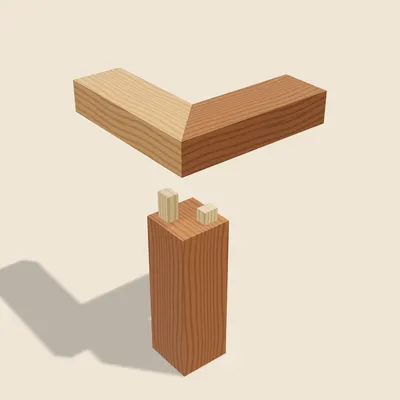
Long-and-Short Tenons
chángduǎn sǔnTwo tenons at right angles on the top of a leg: a long one for the long side, a short one for the end.
Questions
What is the border?
An added frame of mitred pieces under the seat.
Why longer tenons?
They pass through the border before entering the seat.
Is the model seat solid?
It is simplified to a slab here.
Further reading
- 王世襄《明式家具研究》(Wang Shixiang, Research on Ming Furniture),第 111 页
- 王世襄《明式家具研究》(Wang Shixiang, Research on Ming Furniture),第 112 页,图 3.29