
Chuan Xiao (穿销): the Sliding Key That Holds a Long Apron
Sliding key · 穿销
A long, thin apron on a bench or bed can work loose and bow.
A sliding key through its back at mid-span holds it to the frame.
- Chinese
- 穿销 · chuān xiāo
- Joins
- Long apron to the frame above
- Found in
- Benches, long tables, beds
- Signature parts
- Half-dovetail key · groove in the apron back · top tenon
- Compare
- Loose tenon
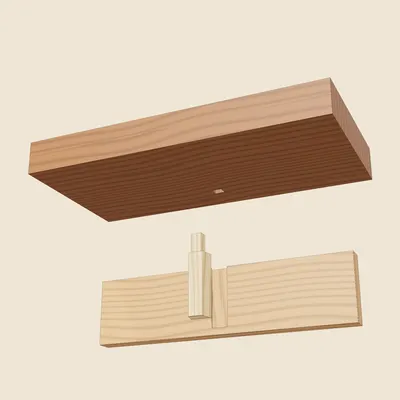
How it works
Unlike a loose tenon
A loose tenon (栽榫) is short and hidden. Wang Shixiang distinguishes the sliding key: it is longer, shows on the back of the part, and is out of sight in use.
Where and how
On some benches, long tables and beds a groove is cut in the back of the apron at mid-span, and a long key with a half-dovetail section slides through it like a batten. Its top end is a tenon into a mortise in the underside of the frame, so the apron is held tight.
Only when needed
He adds that the best makers used loose tenons and keys only when they had to: an apron cut thick enough does not need one. In timber buildings, keys passing through several layers are also used, for example in the tails of some bracket sets.
Proportions in the model are illustrative.
How it's made
 Step 1
Problem
A long apron can bow away.
 Step 2
Groove
A groove in the back at mid-span.
 Step 3
Key
A long key, half-dovetail section.
 Step 4
Tenon
Its top end is a tenon.
 Step 5
Slide
Slid through like a batten.
 Step 6
Held
The apron is held tight to the frame.
Variations
In buildings
In timber frames a key may pass through several layers and be wedged.
Can you CNC this?
Possible, with design or setup changes
The half-dovetail groove can be cut with a dovetail bit along the back of the apron, and the key with the same bit. The key’s top tenon needs a second setup.
Free STL downloads (one file per part)
- Apron 牙条 · chuan-xiao-apron.stl
- Frame above (simplified) 大边(简化) · chuan-xiao-frame.stl
- Sliding key 穿销 · chuan-xiao-sliding-key.stl
Before cutting or printing, read the CNC and 3D-printing notes on tool radius, scaling the STL files and their licence.
Related joints
Loose Tenon
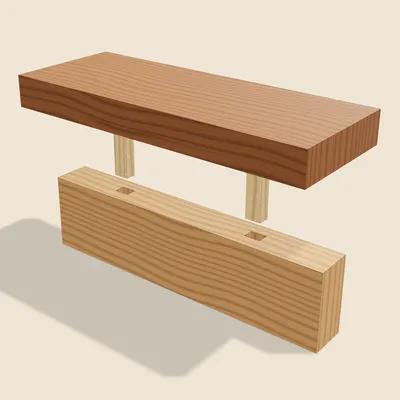
zāi xiāoThe tenon is a separate piece of wood planted into mortises in both parts, easy to replace if it wears.
Sliding Dovetail Batten
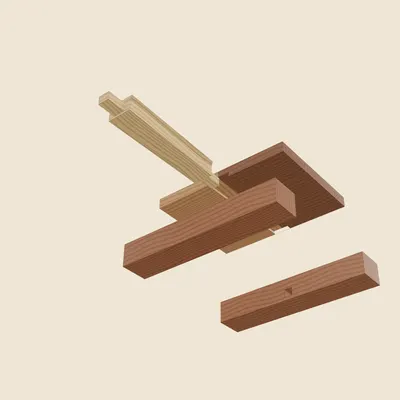
chuāndàiA tapered dovetail batten driven across the back of a panel, its ends tenoned into the frame: the reason old tabletops stay flat.
Through Pin
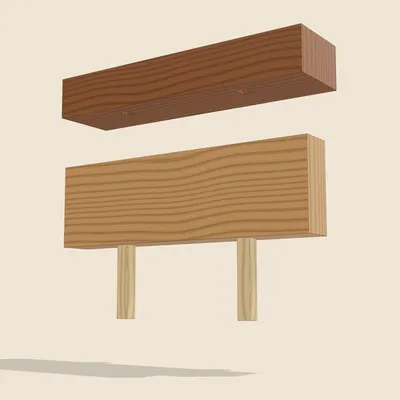
tòu xiāoA planted pin made long enough to pass right through a heavy apron and into the frame above it.
Questions
How is it different from a loose tenon?
It is longer and shows on the back.
Why half-dovetail?
So the apron cannot pull off the key.
Is it always needed?
No, a thick apron does without.
Further reading
- 王世襄《明式家具研究》(Wang Shixiang, Research on Ming Furniture),第 119 页,图 3.45
- 马炳坚《中国古建筑木作营造技术》第二版(Ma Bingjian, Timber Construction Techniques of Traditional Chinese Buildings, 2nd ed.),第 126 页,图 3-11、3-12