
Liangzhu Gumao (梁柱鼓卯): The Song Dovetail That Drops a Beam into a Column
Beam-column dovetail · 梁柱鼓卯 · 梁柱鉸口鼓卯
Where a lintel or beam meets the top of a column, it must not pull away.
The Yingzao Fashi draws a dovetail dropped in from above.
- Chinese
- 梁柱鼓卯 · liáng zhù gǔmǎo
- Joins
- Beam or lintel end to column top
- Found in
- Song-dynasty frames
- Signature parts
- Narrow neck · wide head · open-topped slot
- Compare
- Swallowtail tenon
How it works
The drawing
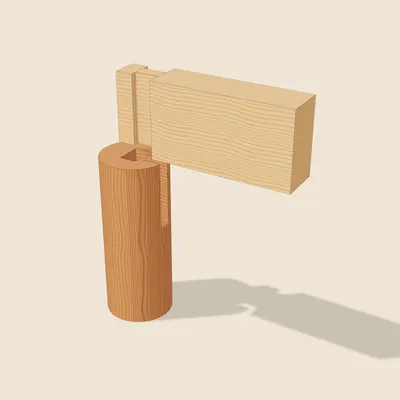
In juan 30 of the Yingzao Fashi (1103), the plate of mortises for beams and lintels (梁額等卯口第六) opens with two beam-to-column joints. In both, the beam end ends in a small projecting head and the column top has a long slot cut down from its upper end. In the 梁柱鼓卯 the head is a plain dovetail; in the 梁柱鉸口鼓卯 the beam shoulder is also notched (鉸口) where it meets the round column.
How it works
鼓卯 means a tenon that swells at the end, like the iron cramps the same book uses to tie stone blocks. The beam is lowered so its head slides down the slot; once in, the wide head cannot pass the narrow mouth, so the beam cannot pull away from the column. The weight above keeps it from lifting.
Inferred reconstruction (推断复原)
This joint is an inferred reconstruction. It is inferred from: the two juan 30 drawings of 梁柱鼓卯 and 梁柱鉸口鼓卯. Inferred, not sourced: the neck and head widths, the depth of the dovetail below the column top, and the beam and column sizes; the drawing gives no measurements, and the shoulder notch of the 鉸口 version is not modelled.
History
The drawing
In juan 30 of the Yingzao Fashi (1103), the plate of mortises for beams and lintels (梁額等卯口第六) opens with two beam-to-column joints. In both, the beam end ends in a small projecting head and the column top has a long slot cut down from its upper end. In the 梁柱鼓卯 the head is a plain dovetail; in the 梁柱鉸口鼓卯 the beam shoulder is also notched (鉸口) where it meets the round column. (Yingzao Fashi juan 三十 (plate scan p. 29)).
鼓卯 means a tenon that swells at the end, like the iron cramps the same book uses to tie stone blocks. The beam is lowered so its head slides down the slot; once in, the wide head cannot pass the narrow mouth, so the beam cannot pull away from the column. The weight above keeps it from lifting.
Inferred reconstruction (推断复原). This joint is an inferred reconstruction. It is inferred from: the two juan 30 drawings of 梁柱鼓卯 and 梁柱鉸口鼓卯. Inferred, not sourced: the neck and head widths, the depth of the dovetail below the column top, and the beam and column sizes; the drawing gives no measurements, and the shoulder notch of the 鉸口 version is not modelled.
Proportions
Sized to the piece
The cited source shows the geometry of 梁柱鼓卯; it does not always publish one millimetre formula for every furniture or building size. Makers sized members to the span and stock in hand.
Proportions in the model are illustrative.
Common mistakes
Common mistakes
- Driving the beam in from the side. The dovetail only enters down the open-topped slot; a sideways push cannot clear the narrow mouth.
- Treating neck, head, and slot depth as book figures. Juan 30 draws the shape; it gives no measurements. Sizes on this page are inferred.
- Reading it as the notched-shoulder (鉸口) version. That plate also shows 梁柱鉸口鼓卯 with a shoulder cut around the round column; this model is the plain dovetail only.
- Confusing it with opposed tenons. One beam dropping into a column top is 鼓卯; two beams lapped and pinned inside the column is liangzhu-duimao.
Related joints elsewhere
Related forms
Western and Japanese workshops have relatives that share a geometric idea (scarf, bridle, dovetail, halving, keyed splice) under other names; they are bridges for readers, not claims of descent.
Stay with the Chinese construction on this page before renaming a piece. See also Compare two joints when a look-alike is listed there.
How it's made
 Step 1
Joint
A beam end on a column top.
 Step 2
Apart
Lifted out upwards.
 Step 3
Dovetail
Narrow neck, wide head.
 Step 4
Slot
Matching slot down the column.
 Step 5
Drop in
Dropped in from above.
 Step 6
Locked
It cannot pull out sideways.
Variations
Notched shoulder (鉸口鼓卯)
The beam shoulder is notched to fit around the column.
Qing swallowtail (燕尾榫)
The later Qing equivalent, used for tie-beams.
Can you CNC this?
Possible, with design or setup changes
The dovetail on the beam end is a straight 3-axis profile; the slot in the round column needs the column cradled and cut from the top end.
Free STL downloads (one file per part)
- Column 柱 · liangzhu-gumao-column.stl
- Beam with dovetail 梁(带鼓卯) · liangzhu-gumao-beam-dovetail.stl
Before cutting or printing, read the CNC and 3D-printing notes on tool radius, scaling the STL files and their licence.
Related joints
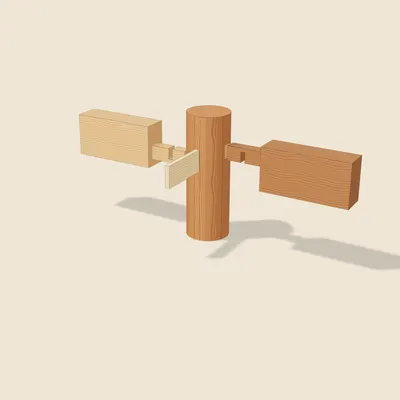
Opposed Beam Tenons with Through-Pin
liáng zhù duìmǎoTwo beams enter a column from opposite sides; inside it their tenons overlap, one above the other, and a square pin threaded through the column and both tenons ties them together.
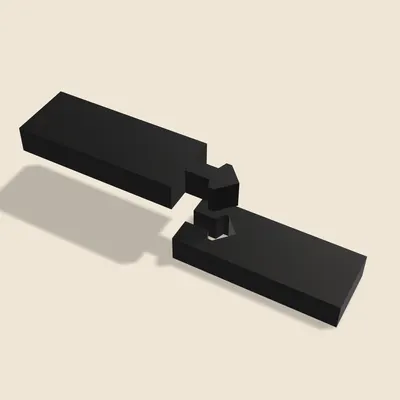
Mantis-Head Splice
tángláng tóu sǔnOne member ends in a narrow neck and a wide “mantis head”, cut through its full depth; it drops from above into a matching socket in the next member, so the two cannot be pulled apart.
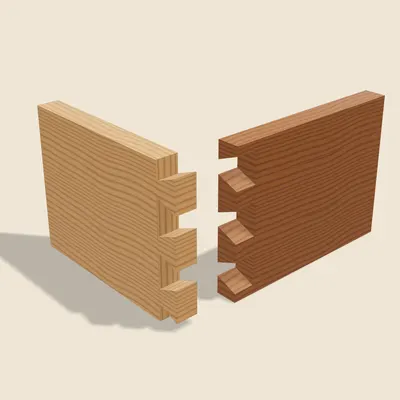
Dovetail Joint
yànwěi sǔnA tenon wider at the tip than at the root, so it can’t pull out: found in boxes, drawers, tables and temple beams.
Questions
Why drop it in from above?
The wide head can only enter along the slot.
Are the sizes from the book?
No, the drawing has no measurements; they are inferred.
What does 鼓卯 mean?
A tenon that swells at the end.