
Dougong Bracket Set (一斗三升): How a Simple Chinese Bracket Set Goes Together
Dougong · 斗栱 · 一斗三升
Bracket sets (斗栱) carry the eaves of Chinese halls. Large ones have dozens of parts.
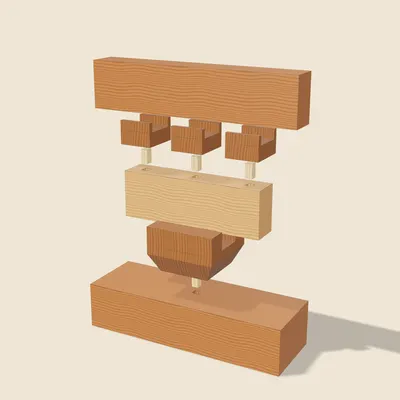
The simplest, one block and three small blocks, shows the principle in five pieces.
- Chinese
- 一斗三升 · yī dǒu sān shēng
- Unit
- 斗口 (dou-kou): the width of the cap block’s slot
- Joins
- Plate, cap block, arm, small blocks, beam
- Found in
- Qing official buildings
- Signature parts
- Cap block slot · bracket arm · pins between layers
How it works
A module, not a size
Qing bracket sets are measured in 斗口, the width of the slot in the cap block; every part is a multiple of it. In Ma Bingjian’s drawings the cap block is 3 斗口 square and 2 high (base 0.8, waist 0.4, ears 0.8), the central bracket arm is 6.2 long, 2 high and 1.24 thick, and the small blocks are 1.4 wide and 1 high. The plate under the set is 2 high and 3 wide. The model uses these proportions.
Layer by layer
The cap block sits on the plate; the arm drops into the slot between its ears; small blocks stand on the arm; the beam lies in their slots. Between the plate and the cap block, and between the layers of the set, pins (栽销) stop the parts from shifting.
Simplified
The curved ends of the arm (卷杀), the slot for the board between sets and any cross members are left out.
How it's made
 Step 1
One set
One cap block, three small blocks.
 Step 2
Pinned
The cap block is pinned to the plate.
 Step 3
Cap block
Base, waist and ears: 0.8, 0.4, 0.8 斗口.
 Step 4
Arm
The arm sits in the slot.
 Step 5
Small blocks
Three small blocks, each pinned.
 Step 6
Beam
The beam rests in the blocks.
Variations
Projecting sets
Larger sets add arms that project outward in steps (出踩).
Column-head and corner sets
Sets over columns and at corners are built differently.
Can you CNC this?
Yes, with small changes
The cap block, arm and small blocks are blocky parts with straight slots, well suited to 3-axis milling; curved arm ends would be a 2D profile. Pin holes are drilled.
Free STL downloads (one file per part)
- Plate 平板枋 · yidou-sansheng-plate.stl
- Pin under the cap block 坐斗栽销 · yidou-sansheng-pin-cap.stl
- Cap block 坐斗 · yidou-sansheng-cap-block.stl
- Bracket arm 正心瓜栱 · yidou-sansheng-bracket-arm.stl
- Pin (left) 栽销(左) · yidou-sansheng-pin-left.stl
- Pin (centre) 栽销(中) · yidou-sansheng-pin-centre.stl
- Pin (right) 栽销(右) · yidou-sansheng-pin-right.stl
- Small block (left) 升(左) · yidou-sansheng-small-block-left.stl
- Small block (centre) 升(中) · yidou-sansheng-small-block-centre.stl
- Small block (right) 升(右) · yidou-sansheng-small-block-right.stl
- Beam above 正心枋 · yidou-sansheng-beam.stl
Before cutting or printing, read the CNC and 3D-printing notes on tool radius, scaling the STL files and their licence.
Related joints
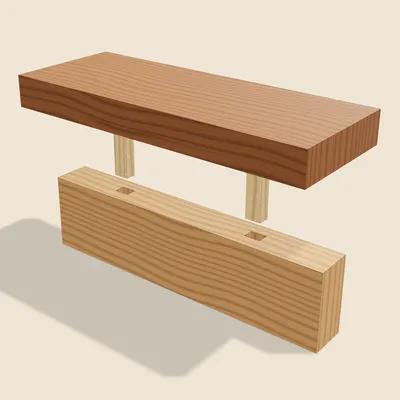
Loose Tenon
zāi xiāoThe tenon is a separate piece of wood planted into mortises in both parts, easy to replace if it wears.
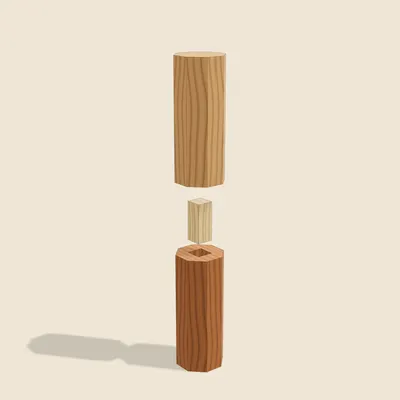
Hidden Dowel
àn xiāoTwo lengths meet end to end and a square pin hidden inside the joint keeps them in line: nothing shows outside.
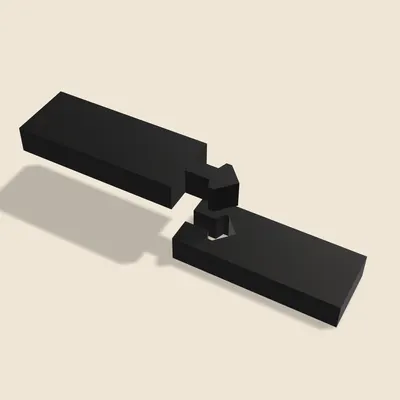
Mantis-Head Splice
tángláng tóu sǔnOne member ends in a narrow neck and a wide “mantis head”, cut through its full depth; it drops from above into a matching socket in the next member, so the two cannot be pulled apart.
Questions
What is a 斗口?
The slot width of the cap block; the module for every part.
What holds the layers?
Pins between each layer.
Is this a full bracket set?
It is the simplest kind, without projecting arms.
Further reading
- 马炳坚《中国古建筑木作营造技术》第二版(Ma Bingjian, Timber Construction Techniques of Traditional Chinese Buildings, 2nd ed.),第 223–260 页
- 马炳坚《中国古建筑木作营造技术》第二版(Ma Bingjian, Timber Construction Techniques of Traditional Chinese Buildings, 2nd ed.),第 240 页,图 6-2
- 马炳坚《中国古建筑木作营造技术》第二版(Ma Bingjian, Timber Construction Techniques of Traditional Chinese Buildings, 2nd ed.),第 126 页,图 3-11
- 马炳坚《中国古建筑木作营造技术》第二版(Ma Bingjian, Timber Construction Techniques of Traditional Chinese Buildings, 2nd ed.),第 165 页