
Liujin Dougong (溜金斗栱): The Qing Bracket Set Whose Tail Climbs the Roof
Sloping-tail bracket set · 溜金 · 秤杆
From outside, this bracket set looks like any other.
Inside the hall, its tail climbs the roof to the next purlin.
- Chinese
- 溜金斗栱 · liūjīn dǒugǒng
- Joins
- Cap block, projecting arm, rising tails, purlin
- Found in
- Qing official buildings, verandas and pavilions
- Signature parts
- Rising tail (秤杆) · through-pins (伏莲销)
- Compare
- Bracket set between columns

How it works
Outside and inside
Liang Sicheng describes the 溜金 set as a special bracket set. Outside the centre line it is exactly like an ordinary one. Inside the centre line, from the beak-head (耍頭) upward, the members are lengthened and rise along the angle of the roof slope as steelyard arms (秤杆), to carry the purlin of the next bay up.
Pinned together
The layers of these sloping arms are threaded together with pins (伏蓮銷), so the whole tail works as one lever: the eaves load on the outside is balanced against the purlin on the inside.
Inferred reconstruction (推断复原)
This joint is an inferred reconstruction. It is inferred from: Liang’s description of the 溜金 set and his plates 插圖十六 and 圖版陸, with outer sizes from the set between columns. Inferred, not sourced: the slope, the lengths of the tails, the number of sloping layers (two here), the size and spacing of the pins, and the purlin size; the arms along the façade are left out for clarity.
Proportions in the model are illustrative.
How it's made
 Step 1
Set
A sloping-tail bracket set.
 Step 2
Apart
Taken apart.
 Step 3
Outside
Outside, an ordinary set.
 Step 4
Rising tail
Inside, the tail rises with the roof.
 Step 5
Pins
Layers threaded with pins.
 Step 6
Purlin
The tail carries the next purlin up.
Variations
落金 (tail resting on a beam)
A related form where the tail ends on a beam or post instead of reaching a purlin.
Song 挑斡
Song sets used sloping cantilevers inside the hall in a similar way.
Can you CNC this?
Possible, with design or setup changes
The sloping tails are flat 2D profiles that a 3-axis machine cuts easily, but they are long; pin holes must be drilled square to the slope in one setup through both layers.
Free STL downloads (one file per part)
- Cap block 坐斗 · liujin-cap-block.stl
- Projecting arm 翘 · liujin-projecting-arm.stl
- Beak-head with rising tail 耍头(溜金后尾) · liujin-rising-tail.stl
- Through-pin 1 伏莲销1 · liujin-through-pin-1.stl
- Through-pin 2 伏莲销2 · liujin-through-pin-2.stl
- Steelyard arm 秤杆 · liujin-steelyard-arm.stl
- Purlin 桁檩 · liujin-purlin.stl
Before cutting or printing, read the CNC and 3D-printing notes on tool radius, scaling the STL files and their licence.
Related joints
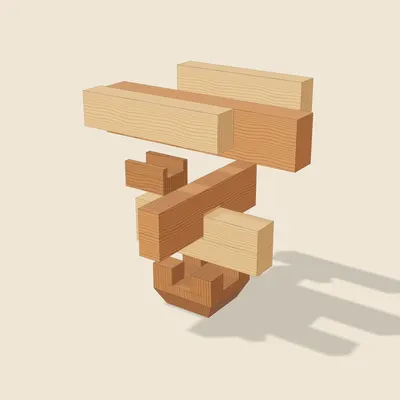
Bracket Set Between Columns
píngshēnkē dǒugǒngA bracket set is built in layers: arms along the façade and arms projecting from it cross in a slot of the cap block, each pair half-lapped, with small blocks carrying the next layer.
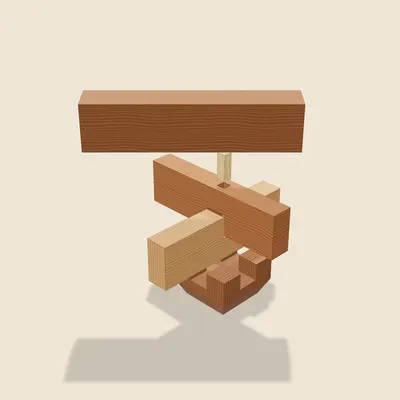
Corner Bracket Set
jiǎokē dǒugǒngOn the corner column each face’s arm runs past the corner and becomes the projecting arm of the other face; a diagonal arm runs out along the corner line to carry the corner of the eaves.
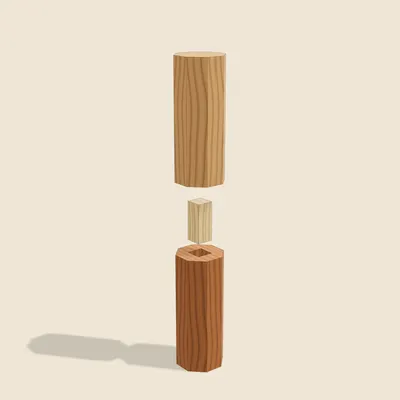
Hidden Dowel
àn xiāoTwo lengths meet end to end and a square pin hidden inside the joint keeps them in line: nothing shows outside.
Questions
What does the tail do?
It carries the next purlin up and balances the eaves.
What holds the layers together?
Through-pins (伏莲销).
Is the slope sourced?
No, it follows the roof and is inferred here.