
Jiaoke (角科斗栱): How a Qing Bracket Set Turns the Corner
Corner bracket set · 角科 · 搭角闹翘
Every other bracket set faces one way. The one on the corner column faces two ways at once.
Its trick: one face’s arm is the other face’s projecting arm.
- Chinese
- 角科斗栱 · jiǎokē dǒugǒng
- Joins
- Cap block, two corner arms, diagonal arm
- Found in
- Qing official buildings, on the corner columns
- Signature parts
- Arms running past the corner · diagonal arm
- Compare
- Bracket set between columns
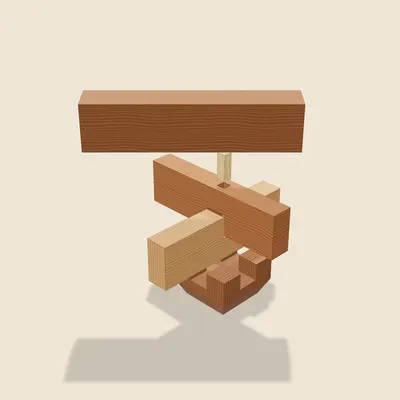
How it works
Two fronts at once
Liang Sicheng explains that a normal bracket set has one outside and one inside, but the corner set stands on the corner column and has two outsides at the same time. The front of the left face is the side of the right face, and the other way round.
Arms that turn into projecting arms
So an arm along one face, once it passes the corner, becomes a projecting arm or cantilever on the other face (搭角鬧翘 or 搭角鬧昂). Inside the corner, the same arms are called 把臂 arms. On the corner line itself there are diagonal arms and cantilevers (斜翘, 斜昂), and above the beak-head a further diagonal piece, the 由昂.
Inferred reconstruction (推断复原)
This joint is an inferred reconstruction. It is inferred from: Liang’s description of the corner set and his plates 插圖十五 and 圖版肆, with sizes taken from the set between columns in his table. Inferred, not sourced: the sizes (taken from the set between columns), the width and length of the diagonal arm, and its level: in the model it sits one layer up on a hidden pin, instead of being cut three ways with the two other arms; the upper layers and the 由昂 are not shown.
Proportions in the model are illustrative.
How it's made
 Step 1
Corner set
A bracket set on the corner column.
 Step 2
Apart
Taken apart layer by layer.
 Step 3
Past the corner
Arm on one face runs past the corner.
 Step 4
Two faces
Each face’s arm is the other’s projecting arm.
 Step 5
Pin
A pin at the crossing (inferred).
 Step 6
Diagonal
A diagonal arm on the corner line.
Variations
With cantilevers (搭角鬧昂)
The arm past the corner becomes a cantilever instead of a plain projecting arm.
Top piece (由昂)
A diagonal piece above the beak-head on the corner line.
Can you CNC this?
Yes, with small changes
All parts are blocks and straight bars with half-laps from one face; the diagonal arm is a long bar, cut square in plan at 45°.
Free STL downloads (one file per part)
- Corner cap block 角科坐斗 · jiaoke-cap-block.stl
- Corner arm A 搭角闹翘甲 · jiaoke-corner-arm-a.stl
- Corner arm B 搭角闹翘乙 · jiaoke-corner-arm-b.stl
- Hidden pin 暗销 · jiaoke-hidden-pin.stl
- Diagonal arm 斜翘 · jiaoke-diagonal-arm.stl
Before cutting or printing, read the CNC and 3D-printing notes on tool radius, scaling the STL files and their licence.
Related joints
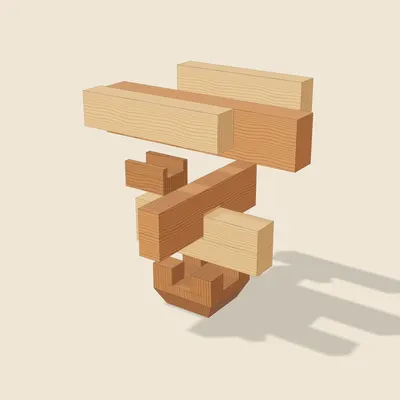
Bracket Set Between Columns
píngshēnkē dǒugǒngA bracket set is built in layers: arms along the façade and arms projecting from it cross in a slot of the cap block, each pair half-lapped, with small blocks carrying the next layer.
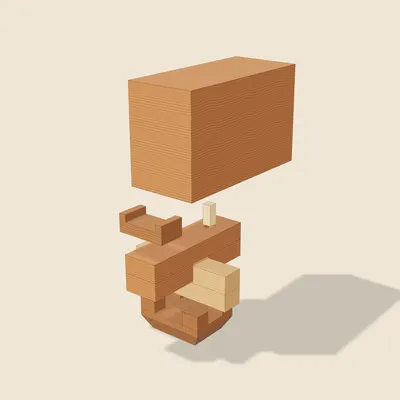
Column-Top Bracket Set
zhùtóukē dǒugǒngThe bracket set on a column carries the end of the main beam, so its cap block is wider (4 by 3 doukou) and its projecting arm twice as wide (2 doukou); the beam head itself takes the place of the upper layers.
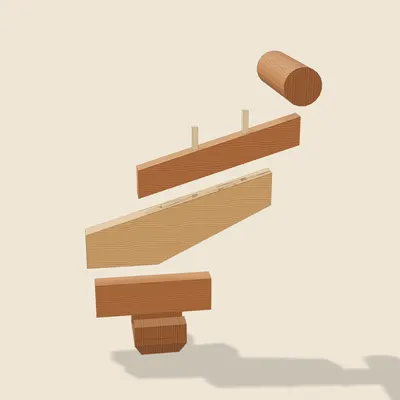
Sloping-Tail Bracket Set
liūjīn dǒugǒngOutside the column line it is an ordinary bracket set; inside, the members from the beak-head up run on and rise with the roof slope like steelyard arms, carrying the next purlin up, with the layers threaded together by pins.
Questions
Why is the corner set special?
It has two outside faces.
What is 搭角鬧翘?
An arm on one face that runs past the corner as the other face’s projecting arm.
Is the model exact?
No, it is an inferred reconstruction; see the note above.
Further reading
- 梁思成《清式營造則例》(Liang Sicheng, Qingshi yingzao zeli, 1934),第三章 斗栱:角科(插圖十五、圖版肆)(NLC 掃描本 PDF 第 61 頁)
- 梁思成《清式營造則例》(Liang Sicheng, Qingshi yingzao zeli, 1934),表一 斗栱各件口數:平身科(NLC 掃描本 PDF 第 131 頁)
- 马炳坚《中国古建筑木作营造技术》第二版(Ma Bingjian, Timber Construction Techniques of Traditional Chinese Buildings, 2nd ed.),第 238–239 页